|
|
|

Introduction
“I’m Not a Bad Person.” |
Free Will |
Finding the Truth: True Love |
Chastity |
Why Did Christ Have To Die? |
Blood and Life |
Our “Broken” Hearts |
Obedient Service |
The Shekinah
A Test
 ONTRARY
to what the average Catholic learns in the average
parish, living a fruitful holy Christian life is not easy. A
true Christian life is hard work because it requires constant awareness of God’s presence,
constant heartfelt prayer for God’s guidance and protection, and
a constant spiritual battle with an increasingly corrupt and
evil secular world. ONTRARY
to what the average Catholic learns in the average
parish, living a fruitful holy Christian life is not easy. A
true Christian life is hard work because it requires constant awareness of God’s presence,
constant heartfelt prayer for God’s guidance and protection, and
a constant spiritual battle with an increasingly corrupt and
evil secular world.
Yet when asked about their basic psychological attitude
about life, many persons will say, “I just want to feel good about myself. I want to feel loved.
I want a sexual partner. I want to have fun and enjoy life. I’m not a bad person.”
On the surface, according to
contemporary social standards, this attitude may seem benign and innocent.
But it has deeper social implications that aren’t readily
seen.
The fact is,
in many of our attempts to enjoy ourselves we end up stepping all over other
persons.
• |
In seeking
wealth we envy and compete with our neighbors, we exploit and deceive
the underprivileged, and we pollute our God-given environment. |
• |
In seeking
entertainment we encourage an industry that seduces our entire culture
with frivolity, vanity, pride, violence, and lust. |
• |
In seeking
erotic pleasure we spread emotional wounds, physical disease, lust,
infidelity, divorce, pornography, and prostitution, along with unwanted
pregnancies, abortion, foster care horrors, and child abuse. |
• |
In seeking
excitement we create addictions and brew a criminal underground to
distribute the materials of addiction. |
• |
In seeking
happiness we’re like the eye of a hurricane, seemingly calm and
peaceful, yet blind to the storm spreading chaos
all around us. |
And that’s what
sin is all about. It’s about being completely
blind to the bad things we do to others as we go about trying to feel good
about ourselves. And yet we’re not bad persons.
Free
Will
We are not bad persons. God created
us as good beings to share in His great love through our free will. Yet because
of what theology calls Original Sin we find
ourselves separated from a full knowledge of God—and from genuine
love. After all, if we really knew love we
wouldn’t step all over others and use them as
objects for our own
satisfaction, would we?
|
You could program
your computer to say, “I love you” every morning when you turn
it on, but that synthesized message wouldn’t be love, would it? A computer
simply does what it is told to do, and, philosophically, if you cannot say
“No” your saying “Yes” is meaningless.
Therefore, love
must be a free choice—an act of will.
Consequently,
many things that we commonly call “love” are not love at all.
Infatuation. Obsession. Fatal attraction. Lust. We call them love
but they have nothing to do with real love because they enslave us to
illusions. |
|
And so, when God created us to
share in His glory, He gave us free will, so
that we would be capable of real love. But with free will comes the ability
to renounce love. That is what sin amounts to: it’s a renunciation of
love; it’s a turning away from moral
responsibility to others that ultimately results
in a separation from God.
So here we are. We’re not
bad persons. And yet we have the freedom to do bad things to others without
even seeing it. How, then, shall we ever see the truth? How shall we ever
know real love?
Finding the Truth:
True Love
God is love. And God created
Heaven and Earth to share in His love. God did not create toys to play with
or slaves to boss around. He created creatures who could share in His love
as equals, so to speak, in love. He gave us His love so that we could
be love.
Because of the
blindness that characterizes our separation
from God, however, we can see nothing but our own self-indulgent
illusions. Left to ourselves, we have nothing
but an empty world of social constructions to give
us comfort. Left to ourselves, we have nothing but
pride, and in that pride we are easily deceived
by evil. Left to ourselves, therefore, we are lost
in slavery to sin. Therefore, only God Himself can
show us what real love is.
Now, if God were to appear to
us in His full glory, we would surely drop down before Him in terror. But
we wouldn’t necessarily love Him. Real love,
after all, is an act of self-sacrifice offered in free will, not something
engendered by
fear.
|
Psychologically,
fear refers to a narcissistic
concern about possible damage to our pride and safety.
In contrast, fear of God
refers to our awe, reverence, and service
before God’s great glory and mercy. Thus, whereas
psychological fear pulls us away from God, fear of God
leads us directly into the embrace of divine love. |
|
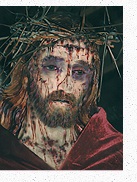
So, in order to teach us real
love, God chose to show it to us through the life of a simple, poor
man—a life which ended with a brutal and humiliating execution.
It was as if God said to all
bystanders, those present and those yet to be, “If you can love
Him, My Son, this humble, broken man hanging in weakness on that cross
out of love for you, you can love anything. If you can love anything, you
will know real love. And if you know real love, you will finally begin to
know Me.”
|
After all, what,
in all its blindness, does human culture tend to value? Well, look at
politics, sports, and
entertainment and you will see an insatiable
thirst for wealth, glamor, power, competition, and revenge. So is it any
wonder that to show us real love, and to bypass all human
illusions, God came to us in poverty, simplicity,
weakness, and gentleness? |
|
And yet, the humiliation inflicted on
Christ backfired on his persecutors. As they were thinking they had defeated Him,
He was resurrected. Thus Christ took all of the insults inflicted on Him
patiently and quietly, without retaliation, so that we could see the
truth of the sin in our hearts—and
repent it, in sorrow—and humiliation—for the
pain we cause to each other.
And that’s why Saint Paul
said (1 Corinthians 1:23) that the crucifixion of Christ seemed like folly
to the Greeks who valued the “wisdom” of natural philosophy; and
to the Jews, who looked for powerful prophetic signs, the crucifixion was
a stumbling block.
For neither natural wisdom nor
human power can illuminate their own darkness.
|
Baptism into Christ, therefore, calls us to a
radical change in our being. Baptism is the renunciation of sin. In the
language of computer technology, it’s like saying that true Christian
faith is not just an “application” that we can run on our existing
“operating systems”; true faith is a process that, beginning with
baptism, creates an entirely new operating system. |
|
Chastity
Sin feels good. Period.
Sin
gives us raw physical pleasure. It can be intense and intoxicating. But sin is
not bad because someone in authority, for some arrogant and mysterious
reason, says so. Sin is not bad because the Catechism says so. Nor is sin
bad because it feels good. Sin leads you away from the goal of holiness and
into the empty pleasures of merely feeling good. Sin misses the point of
life.
God is the point of life, and, in
regard to sexuality, He gave us genitals so that we could bring new life into
the world. Note that we aren’t creators; God is the Creator and we are
procreators—that is, we stand in the place of the Creator. Our genitals
therefore serve the purpose of procreation. They serve love by bringing
children into the world who will learn to love Love—God Himself—to become
love themselves.
Despite its intensity of feeling, sin
defiles love. Sin is the hatred of love. Sin makes pleasure its own end, and so it
ends in failure.
Still, sin feels good—and that
points to the ultimate spiritual battle. Despite the throbbing intensity of
sin’s attraction, we have to struggle against its pleasures and struggle to remind
ourselves that, despite all the allure, sin is the hatred of love.
The battle against sin can be fought only
with love, and chastity is one powerful weapon in
our hands.
|
Chastity is not
the repression of sexuality, it is the purifying transformation of
desire into
love. |
|
As the full human
response to divine love, chastity encompasses
all the psychological, social, and physical consequences of accepting that
the body is the temple of the Holy Spirit (1 Corinthians
6:19). In chastity we renounce lust, dress
modestly, set aside our
illusions about the “self”, and
distance ourselves from—or, in scriptural
language, die to—the corrupt social world
in which we all live, to prepare ourselves for holy service in the Kingdom
of Heaven.
|
If you take the
TWELVE
FRUITS
of the Holy Spirit—Charity, Joy, Peace, Patience, Longanimity (forbearance),
Goodness, Benignity (kindness), Mildness, Fidelity, Modesty, Continence,
and Chastity—and mix them together, you get a fruit salad called mutual
cooperation. Mutual cooperation is the essence of Christian life. And
chastity is a core ingredient in that recipe. You simply cannot have mutual
cooperation if you are always making others into
objects for your personal pleasure. |
|
Chastity is not just an attitude
toward human sexuality, it is the full acceptance
of the human responsibility to the holy lifestyle
that Christ preached—and lived in His body—and that contemporary
society, in all its psychobabble about happiness and
self-fulfillment, tries its best to subvert.
Chastity, then, is a way of
life—the way of life, the only lifestyle, the only
“orientation”—for anyone who would follow Christ and claim
to be Christian. And woe to the soul that spurns chastity. Love is
chaste, and to spurn chastity is to spurn love. If you spurn love, you will
find that in the end you are left with nothing
but everlasting broken emptiness. To
spurn chastity is to spurn Christ Himself, who, in His real and physical
suffering on the Cross—truly present to us in
the broken bread of the Eucharist—offers
the only means to heal our human
brokenness.
|
There is but
one price at which souls are bought, and that is
suffering united to My suffering on the cross. Pure
love understands these words; carnal love will never understand
them. |
|
|
— as told to St.
Faustina
(Diary, 324) |
|
“Why did
Christ have to die?”
Still, there are those who ask,
“But why did Christ have to die? What does this have to do with love?
Why was there bloodshed?”
The answer is
threefold.
1. Blood and
Life
Keep in mind that blood, being
an essential biological aspect of life, is therefore a symbol of life itself.
Consequently, to shed blood for another person means to give up one’s
own life in order to rescue or preserve the life of that other
person.
When Christ shed His blood for
us, then, He did so in order to give us life—that is, freedom from our
bondage to sin. Christ’s death was a glorious mystery that reverberated
from Heaven down to earth, for “obliterating the bond [of
Original Sin] against us, with its legal claims,
which was opposed to us, He also removed it from our midst, nailing it to
the cross” (Colossians 2:14).
And so, before His death, Christ
prayed, “Father, the hour has come. Give glory to Your Son, so that
Your Son may glorify You, just as You gave Him authority over all people,
so that He may give eternal life to all You gave Him” (John
17:1–2).
2. Our
“Broken” Hearts
The
redemption worked in Christ’s death was an
example to us. It showed us how we are capable of killing God Himself
in order to preserve our own self-interests. It showed us, in a way that
no event in the world has ever shown before or since, how we, in our
hearts—the very hearts God has created—and through our own free
will, constantly injure others and defile, mock, and execute divine love
in every moment of our lives. It showed us the ugliness and sin we nurture
secretly in the depths of our own broken hearts.
So unless we acknowledge the
depth of sin in our hearts and choose to accept the redemption offered in
His sacrifice for us—and, in humble, freely willed
obedience to the will of God,
die to the self-indulgent worldly attachments
that nailed Him to the cross—we will never know purity of heart and
real love.
|
God loves everyone,
and He calls everyone into His love. But to accept this call we must give
up everything that is not love. |
|
This is a hard thing to accept.
Many disciples abandoned Christ because of it. Even today there are those
who try to make the Church “relevant” to a
corrupt modern world. But
Christ never said that He came to make life convenient. He came to preach
the Truth.
|
Christ was not
a sentimentalist. Christ called everyone—and still calls everyone—to
repentance. In His own time, many persons
heard His call and obeyed. But there were many persons Christ refused to
heal because they refused to acknowledge and repent their sins. There were
many persons He refused as disciples because they sought worldly glory instead
of Heavenly peace. There were many persons He criticized as
hypocrites—Pharisees, Saduccees, and Herodians. Christ was not a
sentimentalist who accepted everyone “as they are.” He revealed
the truth of our brokenness and called everyone to repent their
sins. And, ultimately, many of those He offended
gathered up their grudges against Him and crucified Him. |
|
Christ was not just a good man
like other so-called “good men” throughout history. Many of these
individuals, although praised by their cultures for being religious or political
leaders who performed notable acts of social justice, were nevertheless stained
with grave personal sins. Christ, however, with the purity of being true
God and true man, offers us forgiveness from our sins and whose
real presence remains with us always through
the Sacraments. Only in the broken bread
of the Eucharist can our psychological brokenness
be healed.
Sadly, those who fail to preach
this truth about our human brokenness and the absolute impossibility of healing
ourselves through our illusory social identifications do no service to
anyone.
THE
RELATIONSHIP BETWEEN PSYCHOLOGY
AND CATHOLICISM
|
Classical Freudian
psychoanalysis is atheistic, and so is most
psychotherapy
today. Even though the brilliant French
psychoanalyst
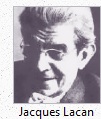 Jacques Lacan had some familiarity with Catholicism,
religion had no part in his psychoanalysis. His concept of psychoanalysis,
which masterfully refined Freud’s ideas, was still a product of natural
reason. But Lacan can teach Catholics much about psychology. To put it in
a nutshell, Lacanian analysis ultimately shows you that all your identifications
with the world are just empty illusions. So you start analysis with your
identity
like a precious porcelain vase, and you end
the analysis, like Job, as a naked man sitting alone
in a pile of broken pottery. So that’s life, you learn, just
a pile of illusions. “Go make something of it anyway,” you’re
told. Jacques Lacan had some familiarity with Catholicism,
religion had no part in his psychoanalysis. His concept of psychoanalysis,
which masterfully refined Freud’s ideas, was still a product of natural
reason. But Lacan can teach Catholics much about psychology. To put it in
a nutshell, Lacanian analysis ultimately shows you that all your identifications
with the world are just empty illusions. So you start analysis with your
identity
like a precious porcelain vase, and you end
the analysis, like Job, as a naked man sitting alone
in a pile of broken pottery. So that’s life, you learn, just
a pile of illusions. “Go make something of it anyway,” you’re
told.
So what does this have to do with Catholicism? Well,
read Saint John of the Cross and you will find that
his description of spiritual purgation
 is, in its practical effects, quite a bit
like Lacan’s philosophy. The difference between the two, though, is
Christ. Christ takes us outside the box
of natural reason. Christ begins where Lacan ends. Lacan leaves us with the
stark, bare psychological truth of our broken lives. Christ—and
only Christ—can heal our brokenness. And in that gap between Lacan and
Christ is precisely where I locate the relation between psychology and religion.
Psychology cannot heal us, but it can help us recognize just how broken we
really are, and it can help us overcome our
resistance to total surrender to Christ. Once
we make that surrender, our healing begins. And
that is precisely what Saint John of the Cross told
us. is, in its practical effects, quite a bit
like Lacan’s philosophy. The difference between the two, though, is
Christ. Christ takes us outside the box
of natural reason. Christ begins where Lacan ends. Lacan leaves us with the
stark, bare psychological truth of our broken lives. Christ—and
only Christ—can heal our brokenness. And in that gap between Lacan and
Christ is precisely where I locate the relation between psychology and religion.
Psychology cannot heal us, but it can help us recognize just how broken we
really are, and it can help us overcome our
resistance to total surrender to Christ. Once
we make that surrender, our healing begins. And
that is precisely what Saint John of the Cross told
us. |
|
3. Obedient
Service
For Christ died also (and
here’s the third part of the answer) in order to be raised again, to
show us that God raises into His glory only those who, without obstinacy
or presumption, without cunning or intrigue, without strife or schism or
protest, empty themselves of all their social
illusions in
humble, obedient service
to Him.
|
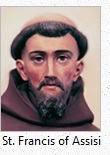 |
Preach the Gospel
at all times; if necessary, use words! |
|
|
—attributed to Saint
Francis of Assisi |
|
There will always be those who
resist this, those who attack the Church from
without and those who sabotage it from within.
Yet the choice is simple: will you freely and totally accept the redemption
from your own emptiness that is being offered to you, or will you
reject it for the sake of your own convenience?
Yet, as simple as it is, the
choice still requires hard work. It requires constant effort to monitor your
feelings and the
impulses that arise with your feelings, and
to override those impulses—those signs of what you want
personally—with a firm decision to live a holy
lifestyle by doing God’s will. It’s all far easier to
serve the devil by doing whatever you want.
So if you fail to approach your
salvation with fear and trembling (see Philippians
2:12b) because you aren’t willing to sacrifice everything for it—as
in the parables of The Treasure Buried in a Field and The Pearl
of Great Price (Matthew 13:44–46)—then you probably don’t
want it that much to begin with.
But if, in absolute fidelity
to the Magisterium of the Church, you accept the hard work of your
salvation, you will then, for the rest of your life,
bear the sadness of a heart broken by the ignorance,
apathy, and sacrilege that surround you. And
yet, in the very midst of this pain, you will bear
the joy of being able to say to Christ, “Thank you Lord; now I feel
what You felt.” And that is real
love.
|
My God, I believe,
I adore, I hope, and I love You. I ask Your pardon for those who do not believe,
do not adore, do not hope, and do not love You. |
—An angel, at Fátima,
1917
|
|
The Shekinah
More about
the Shekinah
Test Your Catholic Faith
Take this
psychological test just for personal enlightenment.
Imagine that you have been
imprisoned—unjustly, let us assume—and that you are scheduled to
be executed later this evening. You are told you may choose anything you
want for your last meal. What do you choose?
You don’t have to tell
me your answer—just keep in mind the things you would like to eat, and
then click below to find out how to score your choices.

Credits
All material on this
website is copyrighted. You may copy or print selections for your private,
personal use only. Any other reproduction or distribution without my
permission is a grave sin.

All material
written by:
Raymond Lloyd
Richmond, Ph.D.
Website designed
by:
Raymond Lloyd
Richmond, Ph.D.
Webmaster:
Raymond Lloyd
Richmond, Ph.D.
 |
provided photographs from which some
of the header images on this website
were adapted, as well as the images for my
guided imagery relaxation CD. |
|
|
|
|



















 Read an excerpt from a treatise about fear of God