|
|
|

By
today’s contemporary ideas in self-help psychology such as making personal
choices and the victimization of women etc., who is responsible for the fall
of “man,” Adam or Eve as it reads in the Bible? How is today’s
psychology the same or different from what the Bible says?
 esponsibility has its own
meaning in regard to spiritual matters, but, as you use the word
responsible in your question, it really has the meaning of
liable in the legal sense. Therefore, I will first make a short digression
into a discussion of law and then come back to the concept of spiritual
responsibility. esponsibility has its own
meaning in regard to spiritual matters, but, as you use the word
responsible in your question, it really has the meaning of
liable in the legal sense. Therefore, I will first make a short digression
into a discussion of law and then come back to the concept of spiritual
responsibility.
Liability and
Tort Law
Liability
refers to being legally bound to make good for any damages caused. For example,
if two cars collide in an intersection, the police investigation will determine
which driver caused the crash, and if the damage is serious enough, the offending
driver may not only face criminal charges but also may be vulnerable—that
is, liable—to being sued for damages according to tort law, in a civil
lawsuit.
Lawsuits and
Christianity
Christianity, however, places limits
on the concept of civil liability. All the principles of Christianity—turn the
other cheek, forgive offenses, and so on—stand opposed to some aspects of tort
law. When you are injured, or your property is damaged, seeking justice according
to criminal law, or seeking compensation for damaged property, is one thing, but
suing for personal damages, such as pain and suffering, against another Christian
is another.
|
Now indeed it
is, in any case, a failure on your part that you have lawsuits against one
another. Why not rather put up with injustice? Why not rather let yourselves
be cheated? Instead, you inflict injustice and cheat, and this to
brothers. |
|
|
— 1 Corinthians 6:7-8 |
Moreover, if you should ever
sue the Church itself for your personal damages, as in allegations of child
molestation, then things can get even more spiritually dangerous, because
not only are you refusing to do what Saint Paul told us to
do—“put up with injustice”—and refusing to trust
in God’s justice, but you are also demanding that Christ Himself
pay you for injuries inflicted on
Him.
|
Keep in mind
that whatever anyone does to you is done to Christ
Himself.[1]
When you are mocked, Christ is mocked; when you are cheated, Christ is cheated;
when you are molested, Christ is molested. Every sin inflicted on anyone
is inflicted on Christ. |
|
Now, it would be important that
someone who was molested would seek to have the offender tried on criminal
charges, or at least brought to discipline by his or her superiors. Moreover,
if a person who was molested is freely offered
psychotherapy or some other sort of
good-will settlement, then fine. But if that person sues the Church for
compensation for what has been “lost” from life, then all that money will
purchase nothing but a one-way ticket to hell. Some
lawsuits, after all, are just a
“civilized” form of revenge, a desire
to hurt the other person just as you have been hurt. Do unto others as
they do unto you. That’s the Satanic inversion of the Golden Rule
which says, “Do to others whatever you would have them do to you”
(Matthew 7:12). All forms of revenge, therefore, derive from an obstinate
refusal to
forgive.
But if you do
not forgive others, neither will your Father forgive your
transgressions. |
— Matthew 6:15 |
Christian Spiritual
Liability
Notice that what I said above
about lawsuits pertains to cases in which you are the injured party.
When you are the one causing the injury, however, things become different.
In this case, you have a spiritual liability to God for your
sins—that is, for the injuries you cause to
Him directly, for the injuries you cause to others, or for the injuries you
cause to yourself. Even after you repent
your behavior, you will still have to “make good”—either in
this life or in Purgatory—the real damage you
have done. This “making good” can be thought of as your own personal
spiritual purification.
Purification,
not Compensation
Life’s purpose is not measured
by how much one can accumulate in terms of wealth, or status, or education;
therefore, demanding compensation for lost wealth or lost status or lost
education will get you nowhere. Nor will clinging to resentment over your
injuries get you anywhere—except for where that one-way ticket will
take you.
Life’s real purpose is measured
in terms of purification of heart, and this
purification happens both because of injuries
and in spite of injuries. If you fail to achieve
a pure heart, it will be because you have failed to utilize the life
opportunities God has given you, and no amount of blame or finger pointing
will justify your failure. It’s all on you.
Now, that sounds harsh, doesn’t
it? But it’s all based in love, and training
ourselves to love is the basis of our spiritual purification.
|
 O love, powerful and sweet,
happy is he who is possessed by thee, for thou dost strengthen, defend, and
preserve him from all ills of body and soul. Thou gently guidest all things
to their end, and never dost abandon man. Thou art ever faithful, thou givest
light against the deceite of the devil, the malice of the world, and against
ourselves, who are so full of self and so perverse. This love is so illuminative
and efficacious that it draws all imperfections from their secret caverns,
that we may apply the remedy and purge ourselves from them. O love, powerful and sweet,
happy is he who is possessed by thee, for thou dost strengthen, defend, and
preserve him from all ills of body and soul. Thou gently guidest all things
to their end, and never dost abandon man. Thou art ever faithful, thou givest
light against the deceite of the devil, the malice of the world, and against
ourselves, who are so full of self and so perverse. This love is so illuminative
and efficacious that it draws all imperfections from their secret caverns,
that we may apply the remedy and purge ourselves from them.
This love, which rules and governs our will, in order
that it may grow strong and firm to resist temptation, so occupies the affections
and the intellect that they desire naught beside. The memory is engrossed,
and the powers of the soul are satisfied, so that love remains her sole possessor
and inhabitant, and she allows nothing else to enter there. Love exhales
a continual sweet perfume, by which man suffers himself to be allured, and
so powerful is this fragrance that however great may be the torments through
which he passes to salvation, there is no martyrdom he would not suffer gladly
to attain it. |
|
|
—Saint Catherine of Genoa
Spiritual Dialogue, Third Part, Chapter IV |
|
Responsibility
This, then, brings us back to
your question and leads to the psychological meaning of
responsibility. To “take responsibility
for your own life” means two things.
• |
First, taking responsibility
for your own life means that you stop blaming others for anything that happens
to you. It means that no matter what happens to you, you, as a Christian,
have an obligation to pay the price yourself for its remedy.
No matter what your parents—or
anyone—ever did to you, you have an obligation to work in the
present to achieve your healing. Only you can do the
work because it is you who will stand before God in judgment when you die, and
part of that judgment will concern how you treated those who hurt you—your
enemies—and how well you trusted in God’s justice.
Even
self-loathing and
self-punishment—even to the point of
suicide,
believe it or not—are all veiled forms of
blaming others as a way to avoid facing
up to the truth of your
unconscious
past.
|
|
• |
Second, taking responsibility
for your own life means that you assume spiritual liability for the injurious
consequences of your actions. This will lead you to feelings of
sorrow and to the
desire to do anything it takes to alter your
behavior. To shirk this responsibility, however, will lead you into the dead-end
trap of victimization. |
|
Victimization
To achieve healing it is
psychologically necessary to feel the pain of what
happened to you, and to come to terms with that pain through intense
scrutiny, in or out of
psychotherapy. But you can’t
blame anyone for that pain without betraying your
baptismal vows. Christ, after all, was not
victimized [2]—He
freely sacrificed Himself for us. So no one who
genuinely lives a Christian
lifestyle can be victimized. Martyrs freely
accept the abuse of the world, and saints patiently tolerate it, yes. But
they are not “victims.”
And why aren’t they
“victims”?
In the ancient sense of the word,
victim means an animal offered in sacrifice. These sacrificial animals,
however, did not offer themselves—they were taken from the flocks—and
so, through the ages, the term victim became unconsciously associated
with the idea of someone who (a) loses something against his will or (b)
is cheated or duped by another. Consequently, in modern secular society at
least, the meaning of a holy victim has been lost to us, and our use
of the term victim carries with it all the unconscious resentment
we feel for being cheated, duped, or unfairly treated. In essence, according
to today’s language, a victim is someone who has been
victimized.
And so, when we call someone
a victim today we imply that the person suffered unwillingly and unfairly;
moreover, according to modern sensibilities, we unconsciously assume that
this injustice deserves some compensation. If the compensation does not come
freely, we demand it. We sue. We protest. We even
kill.
This very attitude, this bitterness
and resentment for having been treated unfairly, is the poison that prevents
emotional wounds from healing.
In contrast, those who
entrust their pain to God free themselves from
unconscious resentment and blame; in letting their suffering joyfully flow
through them in imitation of Christ as the true holy victim, they
choose not to feel victimized. No matter what happens to them, they
never lose the mystical peace of healing through divine love.
|
Some persons,
however, will avoid the work of
psychotherapy because they believe
that admitting the truth about their parents amounts to blaming
their parents. Consequently, they will drive their resentments out of
sight into the unconscious. But this unconscious resentment locks them into
everlasting unconscious blame which prevents them from ever taking responsibility
for their own lives. |
|
Blame and
Hiding
Now, the story of Adam and Eve
is actually a story that makes this very point, for it is a story about the
original sin of finger pointing and blame. Look at the story. The serpent
tempts Eve, and she in turn tempts Adam. God finds Adam hiding and asks what
happened. Adam points his finger at Eve and blames her. And he blames God
in the process: “This woman you gave me—she made
me do it.” God turns to Eve. “Is that true?” Eve points to
the serpent: “He made me do it.”
So what is the
sin here? It’s the failure to trust in God and
forgive others after having been hurt or
misled—and the failure to trust in God and seek forgiveness after having
made a mistake. It’s the hiding and the
blaming—out of fear—that turns away from
God’s mercy and points a finger at others
to make them responsible. Adam and Eve victimized each other, and all of
humanity followed. But in His freely choosing to be a holy victim—the
Paschal sacrifice—Christ offers us freedom from the poisoned trap of
victimization.
Notice well: Adam and Eve both
fail. The story is not about whom to blame, it’s about the emptiness
of fear and blame itself. When, because of our pain, we fear the world, we
end up blaming the world. But, when we fear God—that is, when we stand
in awe of his majesty and mercy—we are then
led to the pure and healing fragrance of his divine
love.
And so, having lectured you enough,
I will give a blessing:
May your trials
be of such intensity
And may they be received under such guidance
That you are brought to that holy place
where you can say,
“What sweet and perfect joy! Now I know how Christ
felt!” |

Notes
1.
“Then He will say to those on His left, ‘Depart from Me, you accursed,
into the eternal fire prepared for the devil and his angels. For I was hungry
and you gave Me no food, I was thirsty and you gave Me no drink, a stranger
and you gave Me no welcome, naked and you gave Me no clothing, ill and in
prison, and you did not care for Me.’ Then they will answer and say,
‘Lord, when did we see You hungry or thirsty or a stranger or naked
or ill or in prison, and not minister to Your needs?’ He will answer
them, ‘Amen, I say to you, what you did not do for one of these least
ones, you did not do for Me’” (Matthew 25:41-45). Remember, too,
that, at the height of Saul’s persecution of Christians, Christ asked
him, “Why are you persecuting Me?” (Acts 9:4).
2.
Christ was, and is, a victim in the ancient sense of the term,
which referred to an animal offered in sacrifice: as the Paschal Lamb, Christ
willingly offered Himself in sacrifice on the cross for our
salvation. Keep in mind, though, that in His
sacrifice, Christ neither lost anything nor was He cheated or duped. He did,
however, “cheat” death of its power over us, and, in that sense,
death itself was made a “victim” of His sacrifice.
Recommended
Reading
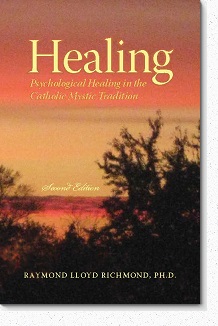
A treasure of a resource for psychological and spiritual healing. Information
gathered from my websites (including this webpage) is now available at your fingertips
in book form.
 |
|
Healing by Raymond Lloyd Richmond, Ph.D. explains how psychological
defenses help to protect us from emotional injury. But if you cling to the
defense mechanisms that were created in your childhood and carry them on
into adulthood—as most everyone does unconsciously— your quest for spiritual
healing will be thwarted by overwhelming resentments and conflicts. Still, God
has been trying to show you that there is more to life than resentment and
conflict, something so beautiful and desirable that only one thing can resist its
pull: hate So now, and in every moment until you die, you will have a profound choice
between your enslavement to old defenses and the beauty of God. That decision has to
come from you. You will go where you desire.
Ordering
Information |
|
|