|
|
|

Does
not all sin come from woundedness? It seems that each time I self-examine
for sin, what I find is tied to my own woundedness. So, is it really to be
guilty over or simply to be healed?
 ell, to be clever I could say,
“No—and Yes. Because there is sin and there is sin, and there is
woundedness ell, to be clever I could say,
“No—and Yes. Because there is sin and there is sin, and there is
woundedness
 and there is woundedness.” Anyway, we should forget about being
clever—the point is to recognize that the whole issue can be very
confusing.
and there is woundedness.” Anyway, we should forget about being
clever—the point is to recognize that the whole issue can be very
confusing.
A good place to begin is with
the Catechism of the Catholic Church, especially with
§§386–412.
Original
Sin
Notice that everything begins
with the concept of Original Sin. To keep it simple, Original Sin
refers to the fact that we live essentially blind to the presence of
God—the Bible tells the story of Adam and Eve and the Fall to explain
it. But you can just feel it with your heart: we are separated from the direct
vision and knowledge of God. Any knowledge we have of God comes from revelation,
when God reveals Himself to us—as in Scripture, through the prophets,
and, ultimately, through Christ.
|
Did Adam and Eve
really exist? Did all humans descend just from two individuals? What about
the scientific theory of evolution? What about questions like these? What’s
the truth? Well, the Church teaches us what is worthy of belief, but if you
still doubt, the truth is, we don’t really need to
know. Asking these questions does not assist
our salvation. Asking whether the events described
in the Bible about Adam and Eve actually occurred in the past is a meaningless
intellectual distraction because the events do happen in every moment of
the present. Every soul is created by God from dust. Every soul is tempted to
doubt God and thereby to fall into the fraud
of self-sufficiency. Every soul hides from
God when it commits sin. |
|
Original Sin, therefore, is the
state of human nature into which we all are born, a kind of
spiritual blindness. This state of separation
from God affects all of us, no matter how
“nice” we might think we are.
But notice also that none of
us is personally responsible for this state.
As §405 of the Catechism says, “it is a deprivation of original
holiness and justice, but human nature has not been totally corrupted: it
is wounded in the natural powers proper to it; subject to ignorance,
suffering, and the dominion of
death . . .”
I’ll break off from the
text here to point out that at this point we could say that our woundedness
is the result of Original Sin and that it is nothing “to be
guilty over” as if we were personally responsible
for it.
Concupiscence:
Sin Feels Good
But the text continues,
“. . . and inclined to sin—an inclination to evil
that is called concupiscence. Baptism,
by imparting the life of Christ’s grace, erases original sin and turns
a person back toward God, but the consequences for nature, weakened and inclined
to evil, persist in man and summon him to
spiritual battle.”
This concept of
concupiscence explains something that
tends to baffle most Christians. How is it that we can continue to commit
sin even when we know that it is wrong? Well, the truth is, sin feels
good.
Yes, sin feels good.
Some sins, such as
lust, give
us raw physical pleasure, and some sins, such as hatred and
revenge, give us psychological satisfaction. Either
way, because sin feels good, we are constantly tempted to do things with
our lives that are personally corrupt—and this IS a cause for true
sorrow.
Missing the
Point
Sin is not bad because someone
in authority, for some arrogant and mysterious reason, says so. Nor
is sin bad because it feels good. Sin is bad because it misses the
point.
The Hebrew word for sin,
hata’a, means to “miss the mark.” Similarly, in
psychological language, we can say that sin is a perversion.
Perversion
is a word that has become politically incorrect in today’s world. The
verb to pervert, however, literally means “to lead astray”
or “to misdirect,” and so perversion has the psychological sense
of something that leads a person away from a goal.
|
As an example,
consider the nature of alcohol abuse. Psychologically
speaking, alcoholics drink in order to avoid the pain of facing up to and
making amends for all the times they have failed to take responsibility for
their lives. Hence the abuse of alcohol can be called a perversion because
it leads a person away from the true aim of dealing with the guilt
and into a drunken state of illusory
well-being. |
|
Thus the point of a perversion
is to always miss the point.
In psychological
language, then, we can say that a perversion leads you away from the true
depths of your emotional pain—and from any
healing—by distracting you with something
merely pleasurable.
Furthermore,
in theological language we can say that sin, in being a perversion, leads
you away from the goal of holiness and into the empty, self-centered pleasures
of merely feeling good.
|
If you revered
the meaning of life, and if you understood the reality of evil,
you would refuse to commit sin. |
|
Personal
Sin
The fact that you commit
sin—that is, do bad things—does not make you a bad person.
Catholic theology teaches that
human nature is essentially good, and that the proclivity to sin can be overcome
by divine grace when we repent our bad behavior—that is, when we see
it as a true offense against God’s love, feel sorrow for it, and turn
to God for mercy.
This personal sin, therefore,
is the result of woundedness. So do you get it? That’s what I
meant earlier about the “No and Yes”: Original Sin causes our
woundedness, and this woundedness leads to personal sin. So woundedness is
caught in the middle.
And there’s the connection
to psychology.
Psychology in the
Catholic Mystic Tradition
Catholic
psychology can show us the ways in which we cope with our
woundedness—our essential
brokenness, fragmentation, and vulnerability
that lead us to dwell in self-pity, to seek our own empty pleasures, and
to neglect the good of others.
Then we have a choice.
Either we accept our woundedness
by recognizing our blindness, embracing our
weakness, and listening to
its pain—and then turning away from sin out of deep, heartfelt sorrow
for the evil our woundedness causes—or we
hide from it,
seducing the despair with impiety, creating more and
more woundedness, and more and more
guilt.
The Deception
of “Knowing”
Sadly, in spite of all that
psychology has to offer within the Church, many persons today prefer to believe
that because “God created me the way I am” they don’t have
to scrutinize and change their personal behavior.
Instead, they concern themselves with what they
“know.” Some take up the
Protestant idea that salvation comes from
knowing that Christ is your “personal savior.” Some take
up non-Christian religious practices in which
spirituality depends, for example, on knowing
how to meditate in a particular manner.
But none of this
“knowing,” in itself, is sufficient to motivate them to accept the
suffering, sacrifice, and prayer which the Bible,
the Church fathers, and the Catholic mystics have consistently said are
absolutely necessary to purge them of the imperfections
of sin and the tempting desire to seek the pleasures of sin. None of this “knowing”
can show them the real horror of sin.
 When I beheld that vision in which I saw the magnitude of the
stain of even one least sin against God, I know not why I did not die. I
said, “I no longer marvel that Hell is so horrible . . . . since I have
beheld the terrible stain caused by but one venial sin. And what, in comparison
to that, would be a mortal sin? And then so many mortal
sins?” When I beheld that vision in which I saw the magnitude of the
stain of even one least sin against God, I know not why I did not die. I
said, “I no longer marvel that Hell is so horrible . . . . since I have
beheld the terrible stain caused by but one venial sin. And what, in comparison
to that, would be a mortal sin? And then so many mortal
sins?” |
—Saint Catherine of Genoa
The Life and Doctrine of St. Catherine of Genoa
First Part, Chapter XXII |
It’s Your
choice
So it’s very simple: Nothing that
you know can stop you from committing sin. Only real love for God can motivate
you to reject sin. You can’t commit sin and love God at the same time. Therefore,
it will be important to make a deep and heartfelt decision to choose one or the
other—sin or love—because, in essence, sin is anything and everything that misses
the point about holiness and leads you away from love.
|
“I just
want to have fun,” they say. “I’m not a bad person.”
Oh, how we deceive ourselves! As if it were possible to commit sin “just
for fun” and say it really doesn’t matter. Can you lie “just
for fun” and not be a liar? Can you steal “just for fun”and
not be a thief? Can you commit adultery “just for fun” and not
be an adulterer? Can you commit murder “just for fun” and not be
a murderer?
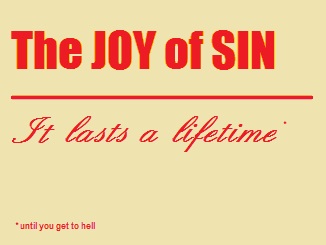
So beware. Despite
the tourist propaganda, what happens in the City of Sin does not stay in the
City of Sin—it follows you, accuses you, and haunts you everywhere you go and
in everything you do. |
|
Therefore, it’s very sad
that some persons, despite all they “know”—even knowing that
God is love—will spend their entire lives avoiding that fundamental
choice: sin or love.
|
Whoever says,
“I know Him,” but does not keep His commandments, is a liar, and
the truth is not in him. But whoever keeps His word, the love of God is truly
perfected in him. |
|
|
—1 John 2:4-5 |
|
It’s not a matter of what you know,
but of what you desire, deep in the depths of your
unconscious. As long as you stay within the box of
sin, the things you desire are a result of your woundedness, but, in the
end, you will go where you desire, and where you go,
well, that is your personal responsibility.
What the
Catechism of the Catholic Church says:
1855 Mortal
sin destroys charity in the heart of man by a grave violation of God’s
law; it turns man away from God, who is his ultimate end and his beatitude,
by preferring an inferior good to him.
1861 Mortal sin is a radical possibility of human freedom,
as is love itself. It results in the loss of charity and the privation of
sanctifying grace, that is, of the state of grace. If it is not redeemed
by repentance and God’s forgiveness, it causes exclusion from Christ’s
kingdom and the eternal death of hell, for our freedom has the power to make
choices for ever, with no turning back. However, although we can judge that
an act is in itself a grave offense, we must entrust judgment of persons
to the justice and mercy of God.

Healing
Psychological Healing in the Catholic Mystic Tradition
by Raymond Lloyd Richmond, Ph.D.
 A treasure of a resource for psychological
and spiritual healing. Information gathered from my websites is now available at your fingertips
in book form with a comprehensive index. A treasure of a resource for psychological
and spiritual healing. Information gathered from my websites is now available at your fingertips
in book form with a comprehensive index.
Psychological defenses help to protect us from
emotional injury, but if you cling to the defense mechanisms that were created in your
childhood and carry them on into adulthood—as most everyone does unconsciously—your quest
for spiritual healing will be thwarted by overwhelming resentments and conflicts.
Still, God has been trying to show you that there is more to life than resentment and
conflict, something so beautiful and desirable that only one thing can resist its pull:
hate.
So now, and in every moment until you die, you will have a profound choice between your
enslavement to old defenses and the beauty of God. That decision has to come from you.
You will go where you desire.
More information
|




















 Read an excerpt from a letter about repentance