|
|
|

Then
can anyone outside the Church be saved?
 he only honest answer to this question
is, “I don’t know”—but this requires some
explanation. he only honest answer to this question
is, “I don’t know”—but this requires some
explanation.
You see, if I simply gave you
the technical theological answer of the Church, you could just say, “I
don’t agree.” So, to say anything psychologically meaningful, we
need to bypass a technical answer and deal directly with doubt
itself.
To do this, let’s begin
with what the Gospels say.
The Testimony
of the Gospels
The testimony of the Gospels
makes it quite clear that only through Christ can a person enter the Kingdom
of Heaven.
|
So Jesus said
again, “Amen, amen, I say to you, I am the gate for the sheep. All who
came [before Me] are thieves and robbers, but the sheep did not listen to
them. I am the gate. Whoever enters through Me will be saved, and will come
in and go out and find pasture. . . .” |
|
|
—John
10:7-9 |
|
|
|
|
|
I am the way
and the truth and the life. No one comes to the Father except through
Me. |
|
|
—John 14:6 |
|
This testimony also makes it
clear that baptism is a prerequisite for life
in Christ. (Let’s not forget, though, that in the early Church baptism
was an event of singular importance, unlike the mere social formality it
often becomes in today’s world. In the early Church, baptism meant a
sincere repentance of past sins, a literal
rejection of the pagan social world, and a dedication
to the holiness of a chaste body and pure heart,
at all costs, persevering unto death.) So, can someone unbaptized be saved?
According to the testimony of the early Church, “No.”
|
Whoever believes
and is baptized will be saved; whoever does not believe will be
condemned. |
|
|
—Mark
16:16 |
|
The testimony of the Gospels
also makes it clear that the Eucharist is essential for life in
Christ.
|
Amen, amen,
I say to you, unless you eat the flesh of the Son of Man and drink His blood,
you do not have life within you. |
|
|
—John 6:53 |
|
Now, can someone who denies Christ
be saved? According to the testimony of the Gospels,
“No.”
|
God so loved
the world that He gave His only Son, so that everyone who believes in Him
might not perish but might have eternal life. For God did not send His Son
into the world to condemn the world, but that the world might be saved through
Him. Whoever believes in Him will not be condemned, but whoever does not
believe has already been condemned, because he has not believed in the Name
of the only Son of God. |
|
|
—John
3:16-18 |
|
Can someone who denies the grace
offered to us through the Church be saved? According to the testimony of
the Gospels, “No.”
|
I am the vine,
you are the branches. Whoever remains in Me and I in him will bear much fruit,
because without Me you can do nothing. Anyone who does not remain in Me will
be thrown out like a branch and wither; people will gather them and throw
them into a fire and they will be burned. |
|
|
—John
15:5-6 |
|
Therefore, the Gospels make it
perfectly clear that only through Jesus can we find salvation. Saint Peter
summed it up with these words:
|
There is no salvation
through anyone else, nor is there any other Name under Heaven given to the
human race by which we are to be saved. |
|
|
—Acts 4:12 |
|
OK. There are the many answers
given to us by Scripture.
Possibility
But what about those persons who
are not Catholic? Is it possible that any of them can be saved? Or, said in
another way, will God, in His great mercy, look deep
into a person’s heart and find whatever repentance is there? Well, it’s
possible. There can be hope for those who cry out to God for mercy even at the
last second of life.
The Catechism of the
Catholic Church, quoting Lumen gentium, makes the following
point:
|
Those who, through
no fault of their own, do not know the Gospel of Christ or His Church, but
who nevertheless seek God with a sincere heart, and, moved by grace, try
in their actions to do His will as they know it through the dictates of their
conscience—those too may achieve eternal
salvation.[1] |
|
|
—Catechism
of the Catholic Church, 847 |
|
A Sincere Heart?
Scripture says that no one can be
saved outside Christ, and yet the Catechism speaks about the salvation of a sincere
heart. Can these two views be reconciled? Well, the answer is “Yes.”
Church tradition makes it clear that
the only impediment to salvation is unrepentant sin.
Therefore, if a person outside the Church were to renounce all behaviors that the Church
says are sins and repent those sins with a sincere heart, the person could be saved.
But if any person actually managed to do this, he or she would be following the commands
of Christ and therefore would not be “outside of Christ.” Thus even if a
person outside the Church were to be saved it’s still true that there can be no
salvation outside of Christ.
Consequently, when asked if someone
outside the Church can be saved, the correct response is, “I don’t know.”
That is, none of us now alive has the ability to know what God sees when God looks
into a person’s heart. Is that heart sincere? Does it repent the sins that the Church,
following the teachings of Christ, says are sins? Well, we don’t know what is going on
in that person’s heart; only God knows.
So there’s the possibility.
And now let’s look directly at that possibility: Would you want to
risk the eternal welfare of your soul on something you don’t know?
Purgatory
Beyond
Speculation
If God had wanted to just snap
His fingers and say, “You’re all saved,” then why did He go
to all the trouble of the Incarnation and Passion? The fact is, just wiping
sin away would have violated our
free will—and it would also violate divine
justice, as Jesus told Saint Faustina,
My mercy does
not want [the suffering in Purgatory], but justice demands
it. |
—Diary,
20 |
Note carefully that, contrary to popular
belief, the purifying, penetential suffering in Purgatory is not
punishment. In its psychological sense, punishment is a technique to decrease
specific behavior. After death, however, there is no need to decrease sinful
behavior. There is, though, a need to purge from all
souls the desire to sin which is spiritually
bound to all the sins the souls have committed through the course of their lives. This
purging of a desire and all the harm brought into the world through its associated sins
has been falsely called “punishment,” but it is properly called purification.
Thus, even though God forgives our sins
when we repent them while we are alive—that is, He constantly welcomes us back to Him
despite our sins—the stain of our sins must be removed from us after death in Purgatory
before we can endure the fire of His love in Heaven. In Heaven, any stain of impurity
will burn and torment a soul, so an impure soul will fling itself out of Heaven.
Yes, the purification process necessary to
remove the stain of our sins is painful suffering, just as Christ’s passion was painful
suffering. But the purification process of Purgatory is not arbitrary; the suffering is
as painful as it needs to be, and it takes as long as it needs to take, according to the
disposition of any particular soul. The “price” of a soul’s purification is penance
for all the accumulated spiritual damage caused by the sins that were committed by that
soul, and that penance is not something that can be evaded or simply dismissed. You can,
however, decrease the extent of your suffering after death if, before death, you follow
a spiritual life of holy penance that helps to make reparation for your sins and purge
from your heart the desire to sin. Then, depending on the price you pay in this life,
after death the remainder of the purging work will be done in Purgatory until your soul
becomes pure in its love for God.
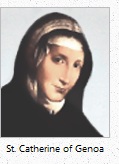
According to the testimony
of the mystics, such as Saint Catherine of Genoa, who literally wrote the
book about
Purgatory, [2] we can understand something
very important about all this.
 As Saint Catherine learned, all
that separates a soul in hell from a soul in Purgatory
is sorrow for sin. Those
souls in hell are in hell, and eternally separated from God, precisely because,
in their physical lives, they declared their lack of love for God through
their refusal to acknowledge, repent, and pay for their sins. But if you can cry out to
God and say, “Have mercy, Lord, I was wrong. What I did was a sin. I’m
sorry. Teach me how to change my life. Guide me, and I will do what You tell
me,” then you can be reconciled with God and hope that when you die you will
get to Purgatory rather than hell. As Saint Catherine learned, all
that separates a soul in hell from a soul in Purgatory
is sorrow for sin. Those
souls in hell are in hell, and eternally separated from God, precisely because,
in their physical lives, they declared their lack of love for God through
their refusal to acknowledge, repent, and pay for their sins. But if you can cry out to
God and say, “Have mercy, Lord, I was wrong. What I did was a sin. I’m
sorry. Teach me how to change my life. Guide me, and I will do what You tell
me,” then you can be reconciled with God and hope that when you die you will
get to Purgatory rather than hell.
|
No matter what
religion you practice now, at the moment of your death you will find yourself
standing before Christ in the light of divine truth. Every act of your life
will be accounted for. It will all come down to one
question: do you really have sorrow for all your
sins? Truth will be absolute. There can be no excuses,
no deception. |
|
Repentance
Consequently, the whole key to
salvation is
repentance.
Assuming you have no unrepentant
mortal sins (sins that completely sever the
relation with God), in Purgatory all imperfections will be burned away. What
is left over will be sent to heaven, to enjoy everlasting life with
God.
|
You might think
here of imperfections as rust on metal, like your car. The more severe the
rust, the more metal has been consumed. When the rust is cleaned away, there
will be a lot of holes in the metal, right? So a soul with a lot of imperfections
will have a lot of “holes” in it when those imperfections are burned
out of it in Purgatory, and therefore not very much substance to get to heaven.
In contrast, a soul who has lived a holy life has very much substance for
heaven.
And note this,
too: the soul, unlike metal, can, through spiritual purgation (with the
assistance of the Sacraments of the Church) while in this world, clean off
old “rust” from past sins and have new life grow back to fill the
old holes—before getting to Purgatory. That’s a precious
gift from God. |
|
Taking Doubt
Seriously
Now, consider the full implications
of this. Only in Christ are we told what sin really is. And only through
Christ’s mercy can we receive absolution for
our sins once we acknowledge them. Nowhere, other than in the Catholic Church,
are we offered the opportunity and the graces
to see the full extent of sin, to name it as sin, and to repent
it.
It’s a horrifying thought,
but those persons who claim to live “good” lives and yet continue
to live in sin—even as they claim that it is
not sin—are fooling only themselves. And how do they fool themselves?
They fool themselves by not taking their doubt seriously enough to say, “I
don’t know; I could be wrong.” After all, once you can say “I
don’t know” you have only one sane response: set aside speculation
and stop taking risks.

Notes
1. Note that this passage refers to those persons
who never heard of Christ. Those who have heard of Christ but
reject Him present a different case, and such persons would do well to listen
to these words of Christ Himself: “Whoever rejects Me and does not accept
My words has something to judge him: the word that
I spoke, it will condemn him on the last day” (John 12:48).
2. The online text (which is now in the public
domain) may be found at www.catholic-forum.com:
Treatise
on Purgatory by Saint Catherine of Genoa.
Recommended
Reading
 |
|
Hungry Souls by Gerard
J.M. van den Aardweg recounts stories of
supernatural visits, messages, and warnings from Purgatory. These are trustworthy,
Church-verified accounts of earthly visitations from the dead in Purgatory. Accompanying
these accounts are images from the "Museum of Purgatory" in Rome, which contains relics
of encounters with the Holy Souls, including numerous evidences of hand prints burned
into clothing and books; burn marks that cannot be explained by natural means or duplicated
by artificial ones.
TAN Books and Publishers |
|
 |
|
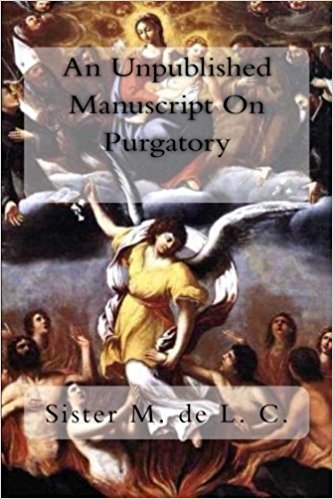
An Unpublished Manuscript on
Purgatory by Sister M. de L. C. recounts the mysterious relation continued for several
years between the living nun and a departed religious suffering in Purgatory.
“When the soul leaves the body it is as if it were lost in or, if I may say
so, surrounded by God. It finds itself in such a bewildering light that in the twinkling of an
eye it sees its whole life spread out, and at this sight, it sees what it deserves, and this
same light pronounces its sentence. If the soul deserves to go to Purgatory, it is so crushed
by the weight of the faults that still remain to be blotted out, that it hurls itself into
Purgatory.”
“In the great Purgatory there are several stages. In the
lowest and most painful, like a temporary hell, are the sinners who have committed terrible
crimes during life. For such souls, Purgatory is terrible. Next to these come the souls, who
though they did not commit great crimes like the others, were indifferent to God. They are in
Purgatory for the long years of indifference. They suffer unheard of pains and are abandoned
either without prayers or if they are said for them, they are not allowed to profit by them.
In the second Purgatory are the souls of those who died with venial sins not fully expiated
before death, or with mortal sins that have been forgiven but for which they have not made
entire satisfaction to the Divine Justice. Lastly, there is the Purgatory of desire which is
called the Threshold. Very few escape this. To avoid it altogether, one must ardently desire
Heaven and the vision of God. That is rare, rarer than people think, because even pious people
are afraid of God and have not, therefore, a sufficiently strong desire of going to
Heaven.”
Order
at Amazon.com |
|
|




















 Read
an excerpt from a homily attributed to
Read
an excerpt from a homily attributed to