|
|
|
Love engenders unity;
Heresy engenders diversity . . .
diversity
is heresy. |
Fear |
Healing |
Therapy |
Spiritual Counsels |
Books |
About CSF
The Question |
Rejection of Graces |
Condoning Sin |
Diversity |
The Cry of the True Church
 S
a part of studying
Church Tradition, every person who calls himself
or herself a Christian must develop an understanding of the theological concept
of heresy. S
a part of studying
Church Tradition, every person who calls himself
or herself a Christian must develop an understanding of the theological concept
of heresy.
The
Question
Now, many of us in today’s
world bristle at the use of the word heresy, but technically anyone
who dissents from the true faith is a heretic. The word heretic comes from
the Greek word hairetikos which means “able to choose.” Thus a heretic
is someone who chooses some aspects of the Christian faith
and rejects other aspects of it. To speak of heresy, then, is not
judgmental; it’s a simple fact.
|
When a criminal
stands in court and hears the judge say, “This court finds you guilty,
so go to prison,” that’s judgment. Likewise, when someone says,
“Go to hell,” that, too, is judgment.
But to tell someone that he is living in sin and is in grave danger of ending
up in hell is a warning, not judgment. As for what
will actually happen to this poor soul . . . well, only God can make that
judgment. |
|
Anyone who wishes to enter deeply
into the Catholic faith, therefore, must pose this question: When individuals
reject various aspects of true Catholic teaching—and often treat it
with contempt and hostility—do they also reject the salvation that Christ
offers them through His Church?
To answer this question, we must
consider two separate, but interrelated, topics: the rejection of graces,
and the condoning of sin.
Rejection of
Graces
Many persons falsely believe that
the garden of baptismal grace will tend itself, but it needs constant attention
through the sacraments [1]
and sacramentals [2]
lest it go to weeds. Through the Catholic Church all Catholics can obtain all
the graces necessary to work out their salvation.
These graces include not just the seven sacraments (Baptism, Confirmation [or
Chrismation], the Eucharist, Penance, Anointing of the Sick [commonly called
“Last Rites” when administered near death], Holy Orders, and Holy
Matrimony) but also all the devotions that help us to
pray constantly for our needs and for the sake of other
souls, and to sustain us in our efforts to make sacrifices
for others.
As part of their protest against
Catholic Tradition, however, most Protestants reject the
Real Presence of Christ in the Eucharist, and so they
reject most of the sacraments, as well as sacramentals (e.g., icons, statues, and
medals) and Catholic devotions such as intercessory prayers to the Blessed Virgin and
the saints. Furthermore, many persons do not just reject the sacraments, they hate and
defile them. Nevertheless, such persons believe that they commune with Christ in their
hearts directly through prayer to Him. But our bodies are the temples
of the Holy Spirit and need the physical nourishment of Christ’s Body and Blood
to be sustained in the hard work of our salvation, and we also need the spiritual comfort
of the community of the saints through sacraments, sacramentals, and intercessory
prayer.
Nevertheless, rejecting many
of God’s graces, as long as it does not become
sacrilege,[3]
is not necessarily a mortal sin, for though
it impairs one’s closeness to God and offends and wounds charity, it
may not completely destroy charity.
Sadly, by rejecting many
graces, such as the Eucharist, the
Rosary, the Chaplet of The
Divine Mercy, and the Liturgy of the Hours, no
soul will be able to advance very far in spiritual perfection. Even if it manages
to avoid mortal sin, it will die encumbered by its
attachments to the world, it will
have many stains to be burned out of it in Purgatory, and
it will likely be only a spark of holiness in heaven compared to the stellar
luminescence of the great saints who have given themselves totally to Christ
without protest.
Condoning
Sin
The rejection of graces, however,
has an insidious psychological consequence. Without being able to cling tightly
to the rock of true Faith, anyone can get blown off into
the open seas, with no sense of direction and no guideposts, and, in this
desolate and empty place, such persons become susceptible to the deceptions and
illusions of human
desire. Even in trying to follow their
conscience, they more often than not see things
according to what they want to see, not according to what is truly good for
them—or what serves the true good of others. So, lost in
pride and
blindness, they defile
love and fall prey to all the temptations of
sin.
This is precisely what happens to all
heretics. Cutting themselves off from the truth of Catholic doctrine, and drifting
wherever the wind of popular sentiment happens to be blowing, everything becomes
relative. Sin slowly loses its revulsion. Before long, even those who have been
baptized and have (supposedly) renounced the ways of the devil
begin to believe that sin really isn’t sin. With their
baptismal promises hanging from them in tatters, they end
up condoning sin.
Thus there are many “devout Catholics” just
like ßideη who are as far from true Catholic doctrine as hell is from heaven.
Consider, for example, the seven
capital (or deadly) sins: lust, pride, avarice, envy, wrath, gluttony, and
sloth.[4] Look
at them as evidenced by contemporary life in America.
• |
The sin of lust has become
glamorized in modern culture; lust has infested all aspects of identity and
entertainment, making lust the most prevalent sin today.
Fornication has become a recreational sport.
Immodesty has become the cultural norm. Birth
control pills have become a matter of personal grooming, as commonplace as
shampoo. Homosexuality, bisexuality, and heterosexuality have become
choices of preference like items on a menu. Divorce
has become no more significant than getting an automotive
oil change. Abortion has become just a medical
treatment for the unwanted “side effects” of fornication. |
|
• |
Pride,
avarice, and envy have become standard practices in business and
sports. |
|
• |
Wrath?
Anger and revenge
have become the daily practice of our legal system and our political system,
as well as a way of life on our streets and in our homes. |
|
• |
Gluttony? Potbellies and
obesity have become a national trademark, in
the context of rampant and insatiable consumerism. |
|
• |
Sloth? Resting our potbellies
in front of a television for several hours every day has become the national
“exercise,” in the context of a growing indifference to self-discipline and
personal integrity. |
|
In all of this, life is reduced
to its lowest common denominator—personal pleasure and convenience—and
sin becomes just a commonplace way of life because
a holy life is just too inconvenient.
Here, then, we find the real
danger of heresy. When true Catholic virtues—such as
chastity; humility;
modesty; detachment
from the world; suffering and obedience;
and prayer and sacrifice as works of
mercy—are pushed aside, then sin is condoned even
by those who call themselves Christian. When sin is condoned, it can’t be
repented. And when a soul does not repent its sins,
it falls into unforgivable sin, and it cannot be
saved.
|
In aviation,
a pilot flying on a dark night with no lighted horizon for reference can
become disoriented, putting the airplane into what is aptly called a
graveyard spiral—a spiraling dive into the ground. Even as the
airplane plunges to its destruction, centrifugal forces will counteract the
force of gravity, and the pilot will “feel” that everything is
normal, even if the plane is upside down. The flight instruments, of course,
will tell the truth, but because everything feels OK, the pilot will
ignore the instruments, believing that they have gone bad. |
|
With this lesson from
aviation, perhaps you can now understand how someone lost in heresy can be
living in mortal sin and yet feel that
he or she is living a Christian life. Deceived by the sentimental desire
to be “accepting,” and ignoring the instruments—the
Tradition of the Catholic Church—it will
be only a matter of time before he or she plunges to total destruction, to
hear Christ the Judge say, “You say you ate and drank with Me, but I
do not know you; get away from Me and depart into the
darkness.”
Diversity
Diversity? Well, the desire of the
wicked leads to doom (Psalm 112), and Uncle Sate wants you!

The Cry of the True Church
Let my eyes stream with tears
day and night, without rest,
Over the great destruction which overwhelms
the virgin daughter of my people,
over her incurable wound.
If I walk out into the field,
look! those slain by heresy;
If I enter the city,
look! those consumed by hunger for true doctrine.
Even the religious and the priests forage
in a land they know not.
Have you struck us a blow
that cannot be healed?
We wait for peace, to no avail;
for a time of healing, but terror comes instead.
We recognize, O Lord, our wickedness,
the guilt of our fathers;
that we have sinned against you.
For your name's sake spurn us not,
disgrace not the throne of your glory;
You remember your covenant with us,
and still we break it.

1. What is a sacrament? A sacrament is
a visible sign (sacramentum) of the mystery of salvation
(mysterium). The sacraments, says the Catechism of the Catholic
Church, “are efficacious signs of grace, instituted by Christ and
entrusted to the Church . . . . The visible rites by which the sacraments
are celebrated signify and make present the graces proper to each sacrament.
They bear fruit in those who receive them with the required dispositions”
(§ 1131).
2. Tangible things, such as holy water, icons,
statues, medals, and scapulars, and intangible things, such as blessings, are all
sacramentals. Sacramentals, says the Catechism of the Catholic Church, “signify
effects, particularly of a spiritual nature, which are obtained through the
intercession of the Church. By them, men are disposed to receive the chief
effect of the sacraments, and various occasions in life
are rendered holy” (§ 1667).
Thus, whereas sacraments in and of themselves are God’s real
presence in this world, produce graces of divine love for those who are properly
disposed to receive them, sacramentals inspire us
to desire and hope in divine love rather than put our
hope in frivolities that come to an end in hell.
3. Sacrilege, says the
Catechism of the Catholic Church, “consists in profaning or treating
unworthily the sacraments and other liturgical actions, as well as persons,
things, or places consecrated to God. Sacrilege is a grave sin especially
when committed against the Eucharist, for in this sacrament the true Body
of Christ is made substantially present for us” (§ 2120).
4. Of all the deadly sins, only sloth (or acedia)
can be confused with a medical disorder. Whereas sloth refers to a lack of
desire to work or exert yourself, fatigue refers to a lack of energy to do things
that you really desire to do.
Chronic fatigue, usually called Chronic Fatigue Syndrome (CFS)
or Chronic Fatigue and Immune Dysfunction Syndrome (CFIDS), used to be called
neurasthenia. The syndrome is characterized by a wide variety of symptoms such as
fatigue, weakness, muscle and joint pain, headache, memory and concentration difficulties,
and difficulty sleeping. No one has yet found a single cause for this syndrome; in fact,
current scientific research reveals that CFS is a complex medical disorder with multiple
causation. In my personal clinical experience, however, I have seen that one cause of
chronic fatigue can be demonic parasitism.
The text of
this webpage, integrated with other material from my websites,
has been conveniently organized into a paperback book of 350 pages, including
a comprehensive index.
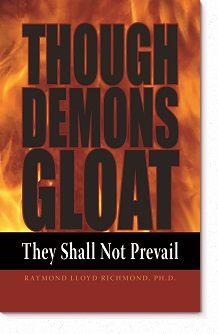 |
 |
Though Demons Gloat: They Shall Not Prevail
by Raymond Lloyd Richmond, Ph.D.
Though we are attacked by liberal activists from without and by apostasy
from within, the true Church—that is, the body of those who remain
faithful to Church tradition—weeps, and she prays, because she knows
the fate of those who oppose God.
Our enemies might fear love, and they can push love
away, but they can’t kill it. And so the battle against them cannot be
fought with politics; it requires a profound personal struggle against
the immorality of popular culture. The battle must be fought in the
service of God with pure and chaste lifestyles lived from the depths of
our hearts in every moment.
Ordering Information |
|
|




















 Can anyone outside
the Church
Can anyone outside
the Church Read about spiritual blindness