|
|
|

I grew up
in a Catholic family without any sense of personal boundaries. My father would
sometimes walk around naked and liked us to watch him urinate. My mother was
always trying to make me dress “sexy,” right from grade school. I was hated by
other kids. I felt miserable and hated myself. I left the Church because my
parents were too disgusting, but my life has been a mess with divorce,
masturbation, pornography and, well, a mess. Now I’m trying to come back to
the faith. What does “the body is the temple of the Holy Spirit” mean? It seems
to be something important for me but I never hear anyone talk about it.
 t’s fitting that you should
ask this question on the Solemnity of Corpus Christi, the “Body of
Christ.” t’s fitting that you should
ask this question on the Solemnity of Corpus Christi, the “Body of
Christ.”
Sexual Morality
and the Body
In his first letter to the
Corinthians, Saint Paul responds to reports of sexual immorality in the church
at Corinth. He specifically uses the example of prostitution, which, in Corinth
at the time, would have been both heterosexual and homosexual. Saint Paul’s
preaching about sexual morality (1 Corinthians 6:12–20) points
to the fact that, whereas most sins are “outside
the body”—that is, they are offenses against charity to other
persons—sexual sins not only defile love, they
are also sins against one’s own body. Saint Paul reminds the Corinthians
here that they are “members of Christ” and tells them the
following:
|
You must know
that your body is a temple of the Holy Spirit, who is within—the Spirit
you have received from God. You are not your own. You have been
purchased, and at a price. So glorify God in your
body. |
|
|
— 1 Corinthians
6:19–20 |
Sadly, most individuals
today do not consider their bodies to be temples of the Holy Spirit; instead,
they make their bodies into temples of lust. Our modern culture has glamorized
the sin of lust, and even Christians have been duped into rejecting their
baptismal promises to seek the empty approval of a world sinking ever deeper
into self-deception. They watch movies and TV filled with lust. They look at
magazines filled with lust. They listen to music filled with lust. And they
say to the world, “I am a devout Catholic.”
Purity of Soul
and Body
The theology of the body tells us
that Christianity is not a matter of abstract spiritual
knowledge or esoteric
enlightenment; instead, Christian life fully involves
purity of both soul and body. And it explains why genuine Christian
mysticism is not about out-of-the-body experiences.
After all, Christ was born in a body, He suffered and died in His body, and
He was resurrected in His body. And He left us His Body and Blood—really,
truly, and physically—to nourish us during the
hard work of our salvation.
The Body as a
Temple
But where, you might wonder,
does the idea that the body is a “temple” come from?
It comes from Christ himself.
All four Gospels recount the same story of The Cleansing of the Temple
(Matthew 21:12–13; Mark 11:15–17; Luke 19:45–46; John
2:13–17) when Christ overturned the tables of the money changers and
merchants, proclaiming, “My house shall be a house of prayer, but you
have made it a den of thieves.” When asked for a “sign” He
could offer for doing this, Jesus replied, “Destroy this temple and
in three days I will raise it up” (John 2:19). He was speaking of His
own body.
The Body’s
Role in Our Salvation
Thus, in demanding both spiritual
and physical cleanliness in the temple, and in promising the resurrection
of the body as justification for demanding that cleanliness, Christ shows
us that our physical bodies play a key role in our salvation. Joined to Christ
in the saving grace of Baptism we become
part of Him, “members of Christ,” the true Temple itself. At
Confirmation, when we receive the Holy Spirit, who dwells in our bodies
to teach us prayer, we become “temples”
of the Holy Spirit. And in the Eucharist we
receive Christ’s real Body and Blood to feed our real bodies and strengthen
our spirits.
|
In the 1960s
the hippie movement seemingly brought a sense of
spirituality into the world. But, grounded in its
protest of social
hypocrisy, it really did no more than incite
us to an adoration of pure physiology cut adrift from all moral guidance.
It began with the naive promise that the
emptiness of life could be filled with
psychedelic drugs, mind-numbing music, and free sex,
and it led to rampant divorce and abortion on demand. In the end, the hippie
movement shows, through its lingering effects in our culture today, that
spirituality, when divorced from religion, is mere
psychobabble. And it leaves the body in a moral wasteland. |
|
Why Modesty? It’s
All in the Lust of the Eyes
 Eye movement analysis studies
have shown that when the average man looks at a woman from the front, he
focuses his gaze on her crotch and on her breasts; when he looks at a woman
from behind, he focuses his gaze on her buttocks. Eye movement analysis studies
have shown that when the average man looks at a woman from the front, he
focuses his gaze on her crotch and on her breasts; when he looks at a woman
from behind, he focuses his gaze on her buttocks.
The studies don’t tell us
what he is thinking, but my own clinical work with male
fantasy does tell
us.
Psychologically, the man is assessing
the woman to fit her into one of two categories: (a) a woman with whom it
would be possible to have sexual relations, or (b) a woman with whom
it would be not possible to have sexual
relations.[1]
Ultimately, he makes his assessment by noticing how the woman dresses. If,
by the way she dresses and moves she reveals the critical parts of her body,
his gaze will focus on those parts, he will see her as “possible,”
and his lusts will be lit like a skyrocket; otherwise, his gaze will dismiss
the idea of her being a sexual
object.[2]
|
When the average
(that is, non-sociopathic) man looks at a nun who wears a habit, he sees
her immediately as sexually impossible. This in itself should be sufficient
reason for nuns who refuse to wear habits to think twice about their bodily
responsibility to others. |
|
The Body Serves
Love and Holiness
This all means that we were not
created to serve our own worldly desires—or the “lusts of the
flesh,” as Saint Paul calls them. We were not created to seek social approval
by using our bodies to incite lust in others. We were created to share in God’s
love. And so, in Christ, we are all called to serve
God’s will in holiness, and, once accepting that call, we must have
our lives overturned and our temples cleansed in
baptism.
And we must keep ourselves clean
and chaste, morally and physically. So, too, our hearts, the center of our
body, must be pure.
|
Blessed are the
clean of heart, for they will see God. |
|
|
— Matthew 5:8 |
The Example of
Mary
The Blessed Virgin
herself is the model for all feminine modesty and humility. Because of her
purity and humility, Mary was chosen to bear Our Lord, and, because of her
love for the divinity she carried within her, she maintained a demeanor of
modesty for the rest of her life.
In a similar way, every Christian
woman is called to see herself as a vessel of grace, treating with respectful
humility the vessel of her reproductive functioning—which, being given by God
the Father, is not something she possesses—and protecting her entire body with
the cloak of
modesty.[3]
|
Let Mary’s soul
be in each of you to proclaim the greatness of the Lord. Let her spirit be in
each to rejoice in the Lord. Christ has only one mother in the flesh, but we all
bring forth Christ in faith. Every soul receives the Word of God if only it keeps
chaste, remaining pure and free from sin, its modesty undefiled. The soul that
succeeds in this proclaims the greatness of the Lord, just as Mary’s soul magnified
the Lord and her spirit rejoiced in God her Savior. The Lord is magnified, not
because the human voice can add anything to God but because he is magnified within
us. Christ is the image of God, and if the soul does what is right and holy, it
magnifies that image of God, in whose likeness it was created and, in magnifying the
image of God, the soul has a share in its greatness and is exalted. |
|
|
— From a commentary of Luke by Saint Ambrose,
bishop |
Modesty
Why do we wear clothing?
The most commonly given answer is,
“To cover our nakedness.”
But that’s the wrong answer. The
correct answer—the Judeo-Christian answer—is that we wear clothing to
give our bodies dignity. Modest clothing covers our bodies with dignity.
Immodest clothing, in contrast, reveals the body by making a pretense of covering
it.
Our bodies are meant to be
chaste and modest temples of the Holy Spirit so that we can relate to others
through our hearts with true love. Our bodies are not meant to be covered
with the graffiti of tattoos (Leviticus 19:28), or made
into works of “art” with piercings, hair dye, gaudy make up, shaved heads,
or hostile punk hair styles. Our bodies are not meant to be defiled by making our
reproductive organs into the equipment of a recreational sport. Nor are our bodies
meant to be made into instruments of social acceptance, expressions of vanity and
pride, and provocations to lust.
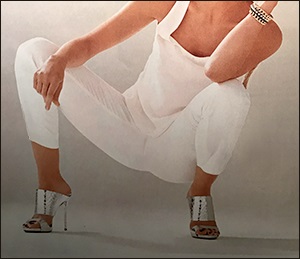
Modest clothing, for both women
and men, should take the precaution of doing everything possible to avoid
inciting lust. It should cover the body with dignity rather than
reveal the body. In this context, clothing can be immodest either because
it is tight-fitting or because it exposes bare flesh. For women especially,
tight-fitting clothing (including jeans, slacks, leggings, T-shirts, and
tank tops, along with athletic wear and swim “suits”), shorts,
short skirts, bare shoulders, and low necklines (especially with a cross dangling in the
cleavage) [4]
all serve one unspoken purpose: to incite lust. Political corectness is
irrelevant; lust is an unspoken dialogue between a woman’s body and a man’s
imagination:
• |
When a woman wears a
low neckline, especially a V neckline, she is implicitely saying (whether she’s
aware of it or not), “Look here. I have two nice toys down there waiting
to be played with.” |
• |
When a woman exposes
bare skin, especially her shoulders and thighs, she is implicitely saying
(whether she’s aware of it or not), “Look here. Wouldn’t you like to run your
hands over my bare skin?” |
• |
When a woman wears
pants, especially tight jeans and leggings, she is implicitely saying (whether
she’s aware of it or not), “Look here. I have a nice butt and crotch waiting
for someone.” |
|
 |
|
|
When just a thin layer of cloth
separates fashion from pornography
isn’t it proof
that fashion is pornographic? |
|
|
A woman wearing
immodest “clothing” is a woman in sin, because she has forsaken her
supernatural dignity and is inviting everyone who sees
her to rape her visually.
This whole issue
is about desire—or, more specifically,
the desire of the Other.
As a very simple
example of how this desire of the Other plays out in everyday life,
consider how a boy might see a girl eating ice cream and then declare
to his parent, “I want ice cream!” Psychologically, seeing the
girl’s desire for her ice cream arouses the boy’s
desire for ice cream. She sure looks like she feels real good about herself!
Give me some of that ice cream so I can feel good about myself too!
Similarly, when a man
sees a woman dressed immodestly, he thinks to himself, She sure looks like she
really enjoys her body! Well, I’d like to enjoy her body too!—and that
is what lust is all about. |
|
Even though contemporary culture
has been indoctrinated with the idea that lust—and
social nudity—is truthful, liberating, and
natural, lust is deception, not truth;
it makes the body in itself seem to have meaning while it mocks the
divine truth of the chaste soul.
Therefore, just because certain
styles of clothing (or lack of clothing) may be socially accepted does not
prevent them from being weapons for wickedness; that is, sins of pride and
lust, and grave offenses to the holiness we pledged in our
baptismal vows.
|
Sin must not
reign over your mortal bodies so that you obey their desires. And do not
present the parts of your bodies to sin as weapons for wickedness,
but present yourselves to God as raised from the dead to life and the parts
of your bodies to God as weapons for righteousness. |
|
|
— Romans 6:12–13 |
Endeavor, then, to develop a
“modesty of the eye” that does not seek to be “seen”
as a sexual object or to “see” others as sexual
objects.
|
So when a woman
dresses immodestly, she is telling the world that she is f---able. And when a
Christian woman tells the world she is f---able, well, it’s diabolically
obscene. |
|
The Roots of Immodesty
All children need a comforting
sense of absolute belonging and acceptance. Some children receive this comfort
as babies, under their parent’s protection, but many children suffer a
deep lack: some parents are emotionally or physically distant and rarely provide
any comfort and acceptance to their children; and some parents are outright
abusive,
leaving their children to languish in an environment of criticism and
neglect.
Thus it’s rare in
today’s world to find any families who teach
children to love God with all their hearts and minds and strength and who
don’t indoctrinate their children right after
baptism with all the impiety of the
anti-Christian world around them. Because most parents
do not live out in their actions whatever
religious faith they profess with their lips, normal family life is
more often than not characterized by self-indulgence, resentment, manipulation,
hidden alliances, and a general lack of honest communication.
As a result, many children tend
to emerge from their families with a profound craving for approval and
acceptance from others. And one sure way to satisfy this craving is to use
their bodies to manipulate others with lust.
Summary
We are constantly being brainwashed by
social media, movies, television, magazines, and popular music to hold lust as our
greatest desire in life. Nevertheless, even though lust has become a cultural religion,
Christian bodies are meant for holiness in Christ, and in Christ we are not our
own; we belong to Christ, soul and body. Our salvation depends on the Body
and Blood of Christ, not on our own bodies or the body of another person.
|
Now the works of the
flesh are manifest, which are fornication, uncleanness, immodesty,
luxury, idolatry, witchcrafts, enmities, contentions, emulations, wraths, quarrels,
dissensions, sects, envies, murders, drunkenness, revellings, and such like. Of the which I
foretell you, as I have foretold to you, that they who do such things shall not obtain the
Kingdom of God. |
|
|
— Galatians 5:19–21 |
|

1. Note that “possible” here does not
necessarily mean likely. The woman could be married or single, older
or younger, shorter or taller, of a different race, or even in the company
of another man. These thoughts exist primarily in the realm of
fantasy, which, by definition, is not limited
by reality.
Note also that every Christian man
has the obligation to train himself to recognize and resist these
fantasies.
2. Male clients of homosexual persuasion have
told me that they see other men the same way.
3. Women are often told that if they are not
deliberately dressing to provoke lust then they are doing nothing wrong.
But this is a lie. Everyone today knows that contemporary fashion has one
purpose: to be sexy. And sexy means inciting lust. Sexy dress
broadcasts one message, intentional or not: that the wearer has rejected
moral responsibility to the body and enjoys sexual pleasure as a form of
entertainment. Any woman who dresses as “everyone else” does and
pretends that she is morally innocent is deceiving herself.
4. “Crucifix Cleavage” is
sacrilege.

Healing
|
Though
Demons
Gloat
|
Anger
&
Forgiveness
|
Falling
Families,
Fallen Children
|
Disasters
and
trauma
|
Psychology
from the
Heart
|
 |
 |
 |
 |
 |
 |
Psychological Healing
in the Catholic Mystic tradition |
True Christian
Identity
In Confronting
Evil |
How to Turn the
Emotional Wounds
of Daily Life Into
Psychological Growth. |
The Psychological
and
Spiritual Remedy
For Our Cultural
Disintegration |
The Struggle For
Psychological
and Spiritual
Growth |
Collected Texts
About the Spiritual Depth of
Clinical Psychology |
More information |
More information |
More information |
More information |
More information |
More information |
Desire
and
Distraction
|
Fear
|
Stopping
Smoking
|
Borderline
Personality
Disorder
|
Catholic
Compassion
|
 |
 |
 |
 |
 |
A Catholic Perspective
On Behavioral Change
and Its Subversion |
A Catholic Explanation
Of a Universal
Problem |
Through
Faith
and
Prayer |
Healing
the
Rage |
When They Tell You
That the Moral Teachings
of the Catholic Church
Are Wrong |
More information |
More information |
More information |
More information |
More information |
|






















 Read a discourse by Saint Athanasius