|
|
|

But
what if we were taught, more often than not, how to be kind to one another
through charity? Don’t you think sin would then take a back seat? Reading
about sin all of the time is depressing. . . .
 he mandate of Christianity is simple: love. Yet in this simplicity,
complicated problems can spring up like weeds, for we more often than not
use “love” as a mere excuse for
self-indulgence. In the modern world
especially—although it has been a problem throughout Church history—we
commonly scorn real love. We scorn the suffering, self-sacrificial love with
which Christ loved us to save us from our sins. And even though Christ commanded
us to love each other “as I have loved you,” we scorn this love
because we have so perverted and eroticised the concept of “love”
that we even condone sin today in the name
of Christ. he mandate of Christianity is simple: love. Yet in this simplicity,
complicated problems can spring up like weeds, for we more often than not
use “love” as a mere excuse for
self-indulgence. In the modern world
especially—although it has been a problem throughout Church history—we
commonly scorn real love. We scorn the suffering, self-sacrificial love with
which Christ loved us to save us from our sins. And even though Christ commanded
us to love each other “as I have loved you,” we scorn this love
because we have so perverted and eroticised the concept of “love”
that we even condone sin today in the name
of Christ.
Love is Hard
Work
Some people claim that the Church
puts too much emphasis on the concept of sin, and
that, if parents didn’t scare children with talk of sin and focused
more on love, the world would be a better place. This argument can
even lead to the idea that we should accept everything in the name
of Christian love, and that we lack charity and are being
judgmental merely to speak about sin.
“It’s offensive to another’s individuality,” they claim,
“to say that something that ‘does not really hurt others’
is morally wrong.”
Well, it’s a great sadness
that most parents do not teach their
children how to love. Love is hard work, and most
parents shrink from that work. When children do something wrong, for example,
it’s far easier to tell the children they will go to hell if they misbehave
than to show them consistently, by example,
that all behavior should be motivated by love
for God. And so the children grow up being afraid of
hell and understanding nothing about true love.
Love’s Opposite:
Sin
Still, sin is a
reality. In psychological terms, sin can be described
as a sort of infatuation with the vanity of our personal desires.
That is, most people are narcissistically preoccupied
with their immediate desires and have little, if any, altruistic awareness
of anyone or anything else around them. Psychologically, this behavior allows
you to feel good about yourself (that is, to feel strong and “in
control”) by using, hurting, or neglecting someone else. Sin therefore
leads you away from true love and compassion, and it sends you right into
all the predicaments of self-indulgence. Sin really does hurt others because
sin defiles love.
Simply teaching charity, therefore,
will not make sin “take a back seat.” Ironically, teaching charity without also
teaching the full meaning of sin unwittingly promotes sin. Without an awareness of
sin, love essentially means “anything goes.” This sort of reasoning leads to the
belief that “if it feels good, do it,” and this belief is just a step away from the
devil’s motto: Do what thou wilt.
So, to see what is really required to
overcome sin and the abuse of love, let’s look more closely at the meaning of love
in general and charity in particular.
Forms of
Love
Love, in its purest and
most divine meaning refers to something so far beyond our comprehension that
it is, well, incomprehensible. Christian theology says that “God is
love,” but most of us can grasp that concept only intellectually. Many
Catholic mystics through the ages, however, have had an immediate experiential
encounter with divine love, and they all end up saying essentially the same
thing: I thought my heart would burst and that I would die right
there.
 But by reason of this secret
and intimate union with God, there remains in the Soul a sweet impression,
so firm and assured a satisfaction, that no torture, however cruel, could
overpower it, and a zeal so ardent that a man, had he a thousand lives, would
risk them all for that hidden consciousness which is so strong that hell
itself could not destroy it. But by reason of this secret
and intimate union with God, there remains in the Soul a sweet impression,
so firm and assured a satisfaction, that no torture, however cruel, could
overpower it, and a zeal so ardent that a man, had he a thousand lives, would
risk them all for that hidden consciousness which is so strong that hell
itself could not destroy it. |
—Saint Catherine
of Genoa
Spiritual Dialogue, Part Third, Chapter X |
This sort
of love is what Catholic mysticism is all about: a love for Christ
so overwhelming that a person would risk anything and give up
anything to get close to it.
In order to understand this divine
love, however, let’s consider love’s other meanings commonly accessible
to general secular human experience.
• |
A
child’s love for a parent refers
to a natural emotional bond every child must make with a caretaker in order
to survive the helplessness of infancy and childhood. This childlike love
for a parent aptly describes the love we commonly feel for God as well—that
is, when we are not in mystical ecstasy experiencing a taste of love in its
most profound possibilities! |
• |
We also naturally love our siblings
within our families; this is called brotherly
love, and it is necessary for peace and growth in
families—although sibling rivalry often manifests in
dysfunctional families. |
• |
What we commonly call
romantic love, or
erotic love (from the Greek eros),
is just “common love”—a politically correct distortion of
real love. Romance—in all truth, and contrary
to popular sentiment—is actually a mixture of two things: a dependent,
infantile attachment to a caretaker, and desire.
Now, infantile dependence needs no further explanation
because it is a natural experience between an infant and a parent. But when an
adult develops a dependence on another adult in the way that a child would
have a dependence on a parent, then the dependence is disordered and perverted
(except in cases of dementia, for example).
Desire, in the
psychological sense, refers to our attempts to fill ourselves with things
that feel pleasurable or soothing, so as to
hide from ourselves the
reality of our essential human
emptiness and brokenness. When you look
at another person with desire, you do not see a soul enrobed in chaste beauty;
you see only your own exuberant fantasy that your aching throb
of loneliness might be alleviated.
Romance, therefore, is the desire to fill your bodily
emptiness with an attachment to the body of another person—a person
as broken and empty as you
are.
|
Desire isn’t
necessarily a bad thing, however. Although Buddhism, for example, teaches
that all desire must be
avoided,[1]
and although Christian theology teaches us that misplaced desire can lead
us straight into sin, desire can be raised to the
level of the divine. In fact, that’s the essence of the Catholic mystic
tradition: to desire union with God as the supreme desire. As the deer
longs for streams of water, so my soul longs for you, O God (Psalm 42:2).
In this mystical desire for God we turn away from the
illusory social
attractions of the world around us and turn only
to God for strength and refuge. That’s what
it means to “die” to the world. And that’s a necessary step
toward holiness for everyone—clerics, religious, and the
laity. |
|
|
• |
We can naturally love our neighbors,
too; this is called neighborly love,
and it, too, is necessary for social survival—although aggression and
war often stain all societies. |
Charity Raised
to the Divine: Real Love
Our natural human capacity for
charity is but a faint reflection of the divine love by which God created
and redeemed us. Yet when human charity is raised to the level of the divine
through Christ, it enters into a true mystery. In regard to charity,
or real love, then, Christ told us something
very important. Listen to what He said.
No one has greater
love than this, to lay down one’s life for one’s
friends. |
—John
15:13 |
Now, think about this. Why would
someone lay down one’s life for anyone except to save that person
from something?
Well, this brings us right back
to the topic of sin.
Sin’s
Antidote
The Hebrew word for sin,
hata’a, means to “miss the mark.” Consequently, to
save us from the emptiness of self-satisfaction into which we have
wandered and to bring us back to the point—the river of life—God
gave us his only beloved Son. In true love for us, God knew that only through
his Son’s freely willed Passion and death can the
free will of a hardened sinner be brought
to sorrow and
contrition.
|
Jesus loves everyone,
and He calls everyone into His love. But to accept this call we must give
up everything that is not love. That is, we must give up
sin. |
|
Thus our task in life
is to accept God’s love—the loving gift of
redemption that God, in His great
mercy, offers us. We have only to do as Christ
commanded us—“As I have loved you, so you also should love one
another” (John 13:34)—by sacrificing our
pride and desire for personal pleasure in order
to repent our sins and help save others
from their sins.
This, then, explains the Christian
meaning of suffering. Just as Christ suffered
and died for us, so we must “die” to our natural desire for
self-satisfaction and then offer our suffering for others, in the hope that
they might be saved from their sins. As Christians, we are called to “pray
and make sacrifices” for others (as Our
Lady of Fátima told the children), freely offering our suffering as
the price it takes to bring hardened sinners to
contrition. Remember, this capacity to suffer
derives from a love of such a firm and assured satisfaction that no torture,
however cruel, could overpower it.
|
As long as you
are concerned about what you can get from life, you will always be
dissatisfied. Everything material—food, entertainment, drugs, masturbation,
pornography, erotic pleasure in another person—passes quickly only to leave
us overpowered by cravings for more. Real love, however, endures every insult
peacefully and so it can never be overpowered by anything. |
|
Real
love—or true love—therefore, is not about getting noticed
or feeling accepted. Real love is a process of giving—not the
giving of material things that merely bribe others to like us, but the giving
of qualities such as patience, kindness, compassion, understanding, mercy,
forbearance, and forgiveness, qualities whose ultimate purpose is the salvation
of other souls.
|
Now, many persons
today claim to love Christ. But do they really love Him? Are they
willing to do anything it takes to purify
themselves for His service? Are they willing to love their enemies—that
is, to endure peacefully the suffering caused by their enemies and to offer
it as a prayerful sacrifice for the repentance and conversion of those very
enemies? Or, instead of really loving Christ, do they simply take satisfaction
in the idea of loving Him and let real love wither and die in the
darkness of their hearts? |
|
In order to love others in the
way of true love, though, we have to see sin for what it is, in all its
pervasive, ugly reality. This isn’t at all depressing—in fact,
it should be a cause for joy, because seeing sin for what it is opens the
possibility of mercy. What greater charity is there
than this?
But if we can’t see sin
for what it is, then we aren’t loving our neighbors, we’re loving
their sin—and that is very, very depressing.
When Love is
Thwarted
Once you understand what love
really is and commit yourself to living it, and you encounter others, even
family members, who defy love, you will have several choices, but only one
of them is healthy.
You could try to protect yourself
from rejection or abandonment by being especially careful of what you say or do
lest you offend someone. You might even convince yourself that this course of
action demonstrates love. But it doesn’t; all it demonstrates is
fear. It demonstrates your fear that if you don’t take
responsibility for the feelings of others, you will get hurt—and so it also
demonstrates your fear of trusting that God will accept and protect you when
others reject you. So don’t deceive yourself; acting out of fear is not an act
of love.
Or you could confront those persons
and tell them how you want them to act. Or you could ridicule them. Or
you could even kill them. But such behavior would be acting out of hatred, not
love.
As for the healthy alternative,
you could go about witnessing your faith and speaking
the truth in all things, regardless of how others might react. If others treat
you harmfully, you can speak the truth about their lack of
charity.[2] Then,
if they apologize, there is nothing more you need to do. If they get defensive and
angry and treat you with disrespect, then you can say, “Listen, I’m not going to take
this sort of treatment from you. If you are disrespectful to me again, I will get up
and leave.” Then, the next time someone is disrespectful, say, “Look, I warned you once.
I’m not going to take this mistreatment.” Then leave. But always pray for the repentance
of the offender and give the pain to God so that you don’t get
stuck in resentment.
Depending on the type of people with whom
you are dealing, you may have to keep repeating your warnings and leavings over and over.
That, though, however tiring, would be love. It would not only demonstrate a loving concern
and mercy for the offenders, but also it would demonstrate healthy
self-love and self-respect.
But it may happen that the offenders completely
reject you. They could do this directly by telling you to never come back, or they could do
this indirectly by saying, “I don’t care what you have to
say!” [3] In
either of those cases, accept the fact that the relationship is over (at least until the others
repent). Then you will be alone, yes, but you will be in the hands of God. It may feel scary,
but pray and trust in God, and do not be afraid.

Notes
1.
Buddhism, an atheistic natural philosophy, denies the reality of God. And
consequently, even though some of its followers may acknowledge Jesus as
a “good man” or a prophet, they deny the divinity of Jesus the
Christ.
Buddhism teaches that all suffering is the result
of desire. Suffering has no value in such a philosophy, so it teaches a deadening
of all desire as an escape from suffering. Many individuals, therefore, are drawn to Buddhist
practices because they seem to offer an esoteric “spirituality”
while making no moral demands on a person beyond the ethics of non-attachment
and acceptance.
But genuine spirituality
must embrace the redemptive purpose of sacrifice and suffering when endured
in love for others, as Christ demanded, and this true love, therefore, can
be understood properly only in the context of Christian theology. Without
God, there can be no love, only self-indulgence—and without a proper
understanding of love in the first place there can be no meaning in God sending
His Son to redeem us, and no meaning in suffering as the only means to overcome
sin: that which “misses the point” about
love.
Considering all of this, it’s ironic that atheistic
Eastern philosophies have so many techniques for achieving self-restraint
and self-discipline, and yet they know nothing about love of God. Yet so
many Catholics, who possess, through the Church, all the graces necessary
to dwell in God’s love, scorn the discipline necessary to make efficacious
use of those graces.
2.
I don’t recommend that you try this with strangers, however. In situations where you
don’t know the offender, it is usually best to keep quiet and pray silently.
3.
When others say, “I don’t care what you have to say,” they are telling you that they
don’t love you; when love is dead, any relationship is dead—at least, until they
repent and apologize.
Recommended
Reading
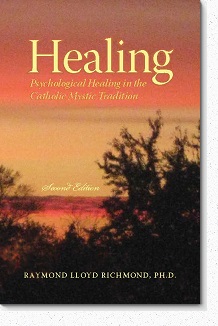
A treasure of a resource for psychological and spiritual healing. Information
gathered from my websites (including this webpage) is now available at your fingertips
in book form.
 |
|
Healing by Raymond Lloyd Richmond, Ph.D. explains how psychological
defenses help to protect us from emotional injury. But if you cling to the
defense mechanisms that were created in your childhood and carry them on
into adulthood—as most everyone does unconsciously— your quest for spiritual
healing will be thwarted by overwhelming resentments and conflicts. Still, God
has been trying to show you that there is more to life than resentment and
conflict, something so beautiful and desirable that only one thing can resist its
pull: hate So now, and in every moment until you die, you will have a profound choice
between your enslavement to old defenses and the beauty of God. That decision has to
come from you. You will go where you desire.
Ordering
Information |
|
|






















 Read
more from the writings of Saint Catherine of Genoa
Read
more from the writings of Saint Catherine of Genoa