|
|
|

What about
the need to know yourself and love yourself? Many can’t love themselves
so they use the love of God instead. . . . Also, I’ve found it
harder for people to forgive themselves than others
. . . . We have to like and love ourselves before we can know
what love is and then start loving others, including God.
 our question about self-love actually
points to a deeper matter: the fact that curing self-hatred is the key to psychological
and spiritual healing from emotional wounds. If self-hatred is cured, then self-love
will follow. This cure, however, is not easy to achieve because several difficult—and,
we might dare to say, loathsome—concepts must be understood along the way of the
cure. Why loathsome? Because these concepts contradict the common sense that comforts the
thinking of most persons. our question about self-love actually
points to a deeper matter: the fact that curing self-hatred is the key to psychological
and spiritual healing from emotional wounds. If self-hatred is cured, then self-love
will follow. This cure, however, is not easy to achieve because several difficult—and,
we might dare to say, loathsome—concepts must be understood along the way of the
cure. Why loathsome? Because these concepts contradict the common sense that comforts the
thinking of most persons.
So, yes, we need to respect
ourselves—and care about the welfare of our souls—as part of the
process of learning to love God; after all, persons who were
mistreated as children will come up with all
sorts of reasons to blame themselves and despise themselves for being unlovable.
With a
self-condemning
psychological attitude like that,
no one can appreciate God’s love for us all.
Yet it is just as important that
respect for the self (or “self-love”) does not become its own
psychological defense—the defense of
narcissism—in which you seek your own self-interest
at the expense of others.
Real
Love
Real love, or true love, derives
from divine love and is intimately related
to love of neighbor. Remember that the two greatest commandments are these:
“You shall love the Lord, your God, with all your heart, with all your
soul, and with all your mind,” and “You shall love your neighbor
as yourself” (Matthew 22:34–40).
Now, we love God because He created
us to share in His love. God is love. He is not like some deluded emperor
who demands adoration from everyone around him to satisfy his inflated ego.
Souls who love God don’t serve Him because He demands their obedience
like an irrational parent; souls who love God love Him in love for
the sake of love, and, through His
grace, they become love. Therefore, to love the Lord, your God, with
all your heart, with all your soul, and with all your mind means that you
will do anything it takes—pay any cost, endure any pain—to make
love the sole purpose of your life.
Therefore, without loving God
it is impossible to love ourselves with anything more than
narcissism or our neighbors with anything more than
lust. Let’s look more closely at what love of
self and love of neighbor really entail.
Self-Love
A good metaphor to help you
understand your own personal value in the context of self-love comes from
aviation.
|
If you have ever
flown on a commercial airliner, you have heard the safety talks at the beginning
of the flight. One talk concerns the oxygen masks, which will drop down from
the overhead compartment in the event of a sudden decompression at altitude.
In that talk, you are warned to put on your own mask before trying to assist
someone else.
Do you know why?
Well, at high altitudes there is very little oxygen in the air, and the brain
can survive for only a few seconds without supplemental oxygen. So, in the
time it takes to help someone else who is confused and struggling, you could
both pass out and die. But if you put on your own mask immediately, you will
have the oxygen you need to survive and think clearly, so you can be of real
help to others.
The point here
is that unless you take care of yourself first, you cannot be of any help
to others. |
|
To love yourself, therefore,
means overcoming two self-defeating tendencies. Some persons will falter
more on one point than the other, so be careful to note the differences between
the following two points.
Self-condemnation
On the one hand, loving yourself
requires that you stop condemning yourself psychologically—to stop believing
that God wants to condemn you—and to start accepting that God desires
your salvation. You may feel like
garbage because of the way you were treated
in childhood, but in God’s eyes you are not garbage. In love, God created
you at your conception, and in love He calls you to Him always: “Though
father and mother forsake me, the Lord will receive me” (Psalm 27: 10).
To accept your salvation all you have to do is place yourself in
obedience to God, treating your body as a
temple of the Holy Spirit and treating your soul
with ardent concern for its growth in purity by
avoiding the defilement of inner evils:
|
From within people,
from their hearts, come evil thoughts, unchastity, theft, murder, adultery,
greed, malice, deceit, licentiousness, envy, blasphemy, arrogance, folly.
All these evils come from within and they
defile. |
|
|
— Mark 7:21-23 |
|
Self-blame
On the other hand, loving yourself
requires that you stop blaming yourself for your past failures. No matter
how often and in what way you have fallen into those inner evils—no
matter how wretched you feel—all is not lost
if only you learn from your past mistakes and
trust that, in God’s infinite mercy, He will help you
learn from and remedy your mistakes.
|
Some persons,
however, will unconsciously persist in trying to punish themselves for their
failures even though they say, “Jesus, I trust in You!” dozens
of times a day. Why? Well, all that self-punishment (or self-sabotage)
is just a veiled attempt to hurt someone else—usually a
parent—who failed you in some way, somehow leaving you feeling rejected,
unloved, unwanted, or incompetent. If you are
blind to this unconscious desire to hurt
others, you will not be able to purify yourself from its effects, and it
will poison your heart and kill off any love that might try to grow
there. |
|
Love of
Neighbor
Considering what has just been
said about self-love, to love your neighbor as yourself, therefore,
means to treat your neighbor’s body as a temple of the Holy Spirit,
to treat your neighbor’s soul with ardent concern for its salvation,
and to stop blaming your neighbor for past mistakes.
Moreover, this dynamic of
blame, whether it be enacted as self-punishment or as a desire to
hurt your neighbor, leads to the topic of forgiveness.
Forgiveness
In regard to
forgiveness, you cannot forgive yourself. Why? There
are two reasons.
1. |
Even though
self-destructive and
self-sabotaging behavior may seem to be anger
at the self, at its core it is an expression of
anger at someone else, because of what that person
did to you or failed to do for you. It’s as if you use
victimization to amplify the effects of the original injury, and you then
throw your dysfunction back into the face of the one who hurt you, in an
attempt to force that person to see how much he or she hurt
you.[1]
It may be unpleasant to admit it, but, in all truth, you use your disability
unconsciously as a subtle form of revenge, which is itself a form of
hate.[2]
For the original wound to heal, it will be necessary to set aside your
personal desire for satisfaction and forgive, by trusting in God’s
perfect justice. Thus you don’t forgive yourself,
you forgive the person who hurt you in the first place.
|
|
2. |
When you engage in self-destructive
behavior, you injure your own body, the temple of
the Holy Spirit. In this sense, through injury to His temple you injure
God Himself. For healing to occur, it will be necessary to
repent your behavior so that God
can forgive you. |
|
Thus your forgiveness
begins in your forgiving others by loving them no matter what they do to
you.[3]
Remember, Christ told us to love others as I have loved you.
And how did He love us? He loved us even as we mocked, tortured, and killed
Him. No matter what we did to Him, He did not hate us. Therefore, integral
to love is the refusal to hate, and in so far as you persist in hating others
and refuse to forgive them, God will not forgive you.
But if you do
not forgive others, neither will your Father forgive your
transgressions. |
— Matthew 6:15 |
Think of it like an electrical
circuit: neither love nor forgiveness can flow from God through you if you
are not “grounded” in others.
Premature
Forgiveness
So when you speak about the fact
that “forgiving” others is easier than forgiving ourselves, you
expose the psychological deception of
“premature forgiveness.”
Premature forgiveness isn’t really forgiveness at all; that’s why it’s so easy.
It’s just a way to distract ourselves from our own pain by saying the
politically correct words and doing the politically correct things as a pretense
that we love others, when really our hearts are swollen with unspoken bitterness
for what we have lost. It’s just an intellectual way of telling ourselves
that everything is fine when really we haven’t felt
our emotional pain and brought it to God in heartfelt
scrutiny and
prayer.
Clinical
Counsels
1. |
If you believe that God despises
you and that you are unlovable, then you don’t really love
God. |
|
You are blaming yourself for your parents’ inability to love you.
|
2. |
If you say you love God but engage
in self-destructive behavior, then you don’t really love
yourself and so don’t care about your salvation. |
|
You are using self-destruction (motivated by self-hatred) to satisfy your
anger at others by punishing them unconsciously. But you can’t love
yourself if you secretly hate yourself.
|
3. |
If you say you love yourself
but aren’t concerned about the salvation of others, you don’t really
love others. |
|
You’re confusing self-indulgence with love and are using spirituality
as an excuse for narcissism.
|
4. |
If you say you love others but
continue to hold grudges against anyone, you don’t really forgive
others. |
|
You’re using premature
forgiveness [4]
as a tactic to convince yourself that you are loving when you really are
filled with feelings of victimization.
|
5. |
If you say you love others but
don’t find your own life meaningful, you don’t really love
yourself. |
|
You’re following the rules with intellectual perfectionism, not
love. |
The Loathsome Part
Now, despite all that has been said so far, if you
have difficulty loving yourself, then you will be saying, “Yes, I already know that. I have heard it
over and over before. But I still hate myself.” So, yes, despite all you know intellectually,
you still hate yourself. And the loathsome reason is this: your self-hatred is a
manifestation of your unconscious hatred for your
abusers.
Furthermore, you will remain stuck in self-hate
unless you accept another loathsome fact: Hatred is futile.
Hatred cannot make others do what you want them to do, such as love you, or listen to you, or
stop hurting you. In fact, hatred does not do anything except drive hatred
into everything it touches.
So where does that leave you? It leaves you in a
loathsome reality: You are helpless. Your intellect is futile. Your common sense is futile.
Your only hope is to surrender to God’s love. You must accept the truth that,
despite all your sins and all your hate, God does not hate you, nor can you make Him hate you.
Remember: hatred is futile, so it’s impossible that God hates anything. So, as loathsome as it
is, you are helpless. But when you are willing to accept that hatred is futile, then you can
surrender to God’s love, and then you will understand forgiveness. And that will be your help
and your salvation.

Notes
1. Most often, this hatred is unconsciously directed
at your parents. Whether your dysfunction be extreme—such as suicide,
drug addiction, alcoholism, and personality
disorders—or more subtle—such as perfectionism, chronic
procrastination, or a lack of success in a career—it all has an unconscious
intent of hating and hurting your parents (especially your
father in regard to his lack of guidance, protection,
or emotional involvement) by hating and hurting yourself. And, because this
intent is unconscious, it can be maintained right into adulthood—even
after your parents have died!
2. The spiritually negative
emotion of hate does not necessarily mean a passionate loathing; it
can just as well be a quiet, secret desire for harm to come upon someone
or something. Hate can be a subtle thing, therefore, and it often is experienced
more unconsciously than consciously. Consequently, it will often be very
easy to deny that you feel any hatred for anyone at all.
Note also that hatred and anger are
theologically synonymous. Christ Himself taught the crowds, “But I say
to you, whoever is angry with his brother will be liable to judgment”
(Matthew 5:22). And Saint John the Evangelist reflected this sentiment when
he said, in one of his letters, “Everyone who hates his brother is a
murderer” (1 John 3:15). The theological implication of these texts,
therefore, is that any desire for harm to come to another person—whether
through active loathing or through passive resentment—is, in its spiritual
essence, an evil desire to remove the fullness of life (with its possibility
of love and forgiveness) from that person.
3. Even though it is foolishness
to honor our enemies, we still have to love them. Christ not only told us to
love our enemies, but also He showed us how not to do it.
• |
Loving your
enemies does not mean accepting everything they do. |
• |
Loving your
enemies does not mean ignoring the danger they cause to you and to
others. |
• |
Loving your
enemies does not mean forgetting the harm they have caused. |
• |
Loving your
enemies does not mean that they will escape divine justice. |
Loving your enemies,
as Christ made perfectly clear right from the Cross, means that you care about their
salvation and wish for their repentance regardless of how miserably they treat you.
Even as He was being crucified, Christ was not plotting revenge on His enemies; instead,
with a broken heart flowing with mercy, He yearned for their repentance.
4. This means that you’re still denying your
unconscious anger and resentment, so even though
you think you’ve come to terms with what happened, there are still emotions
about the event which you have pushed out of awareness. In fact, many persons
can get caught up in this premature forgiveness as a way to avoid coping
with all the unpleasant emotions they would rather not
examine.

Healing
Psychological Healing in the Catholic Mystic Tradition
by Raymond Lloyd Richmond, Ph.D.
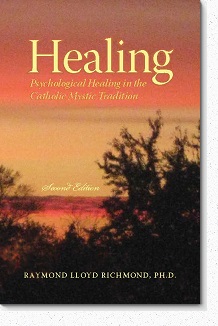 A treasure of a resource for psychological
and spiritual healing. Information gathered from my websites is now available at your fingertips
in book form with a comprehensive index. A treasure of a resource for psychological
and spiritual healing. Information gathered from my websites is now available at your fingertips
in book form with a comprehensive index.
Psychological defenses help to protect us from
emotional injury, but if you cling to the defense mechanisms that were created in your
childhood and carry them on into adulthood—as most everyone does unconsciously—your quest
for spiritual healing will be thwarted by overwhelming resentments and conflicts.
Still, God has been trying to show you that there is more to life than resentment and
conflict, something so beautiful and desirable that only one thing can resist its pull:
hate.
So now, and in every moment until you die, you will have a profound choice between your
enslavement to old defenses and the beauty of God. That decision has to come from you.
You will go where you desire.
More information
|






















 Read
an excerpt from a treatise about love of God
Read
an excerpt from a treatise about love of God