|
|
|
Are you really
praying, or are you merely praising yourself? |
Reverence for the Mass |
Spiritual Counsels |
Books |
About CSF
Introduction |
Asking for Guidance |
Praying Constantly |
Feelings in Prayer |
Distractions During Prayer |
When You Don’t Receive Answers to Your Prayers |
Vocal Prayer and Mental Prayer |
Prayer of the Heart
(The Sign of the Cross;
Improvised Prayer;
The Jesus Prayer;
Catholic Mindfulness;
Insomnia;
Prayer Before Eating) |
Formal Prayers |
Beyond the Basics
(Deliverance Prayer;
The Miraculous Medal;
The Angelus;
The Rosary;
The Chaplet of The Divine Mercy;
The 3 O’Clock Prayer) |
The Liturgy of the Hours
 ECAUSE
we do not experience a normal sensory
perception of God, in order for our lives to produce holy virtues it is necessary
to maintain a constant mental contact with God through heartfelt prayer. ECAUSE
we do not experience a normal sensory
perception of God, in order for our lives to produce holy virtues it is necessary
to maintain a constant mental contact with God through heartfelt prayer.
|
When you pray out of duty,
you are trying to make God approve of you. When you pray from the heart, you are
expressing your love for God. |
|
Prayer, therefore, is not a way to bribe
a cosmic magician to work magic tricks so we can get whatever we want from life. Nor is
prayer a matter of earning spiritual rewards points that can buy our way into
heaven. Nor is prayer about warm feelings. Prayer is about staying close to God so as
to live a virtuous life. Consequently, in its proper nature, prayer leads us into
spiritual protection: protection from evil,
protection from temptations, protection from
trauma, protection from doubt, and
protection from despair, among other things.
Our time in prayer, therefore,
is the only time, in this life, when we can live in holiness. How sad that
so many of Christ’s own anointed treat Him so carelessly as to neglect
simple, heartfelt prayer in which we speak intimately to God as we would speak
to another trusted person.
When you constantly open your heart to
God in prayer, you will be constantly in His protection. On the other hand, if you
neglect this prayerful communication with God you will be afflicted with all the
untreated wounds of your own psychological emptiness.
|
For some
persons—especially those wounded by childhood
abuse or neglect—the greatest obstacle to prayer is the irrational (that
is,
unconscious)
belief that they are such despicable
and evil persons that God has totally abandoned them and refuses to hear
any pleas for help. Although this belief is refuted by the Bible itself (e.g.,
1 Timothy 2:4), such a belief derives psychologically from a confusion of
God with the “Other” (i.e., the social world around us). In truth,
the social world, at its best, is completely indifferent to our welfare,
and, at its worst, it “sees” us only as
objects to be manipulated for its own satisfaction.
In other words, it is not God’s rejection of you but
sin itself—the rejection of God by the
“Other”— that has abused you. |
|
If you cling to the understanding that
God does not reject anyone—but that in our blindness and anger we can reject God—then
you can perceive prayer to be a constant reminder of the presence of God, and prayer
will be something you want to do, not something you have to do to gain
acceptance or to avoid punishment.
Asking for
Guidance
The surest approach to learning to pray
properly is to begin by desiring to love God and to trust in His guidance and protection.
Then instill in your heart a deep sorrow for
sin (both yours and that of others) while desiring to be freed
from the illusions of your own identity. Then confirm
this desire by fasting; that is, by making sacrifices
of time, food, and other personal pleasures. And then sustain this desire by constantly
speaking to God as you would to a trusted master, telling Him, in quiet confidence,
everything you are experiencing and asking Him for help and guidance in accomplishing
every task before you.
You might want to use the following
prayer to the Holy Spirit as a short formal prayer in regard to guidance; this
is my own version. But be careful! It’s easy to say the words, but do you have
the courage to allow the process of transformation to
occur within you?
|
O HOLY
SPIRIT,
take me as Your disciple.
Guide me; illuminate me; sanctify me.
Show me what is holy,
and I will pursue it.
Show me what is unholy,
and I will turn from it.
Direct me, and with Your grace I will obey.
Lead me, then, into the fullness of Your Truth and Wisdom.
Amen. |
Praying
Constantly
We should all learn to pray
constantly—as our Lord Jesus Christ advised us (Luke 18:1). This involves
vocal prayer, which is the recitation
of the Church’s “standard” prayers, and it involves
mental prayer, which has three dynamically
intertwined components: a quiet, internal meditation (i.e., a deliberate
thinking about divine things); contemplation (i.e., a surrendering to the
experience of divine love); and spontaneous communication with God (i.e.,
constantly being aware of God’s presence, and asking for His help, in all
that you experience in every moment.
Therefore, in praying constantly,
we bring our minds into our hearts, such that our thoughts are constantly
attuned to the presence of God, and our hearts are constantly inflamed
with love for God and concern for the salvation of our
neighbors.
|
 Are we then ceaselessly
to bend our knees, to lie prostrate, or to lift up our hands? Is this what
He meant in saying: Pray without ceasing? Even if we admit that we
pray in this fashion, I do not believe that we can do so all the time. Are we then ceaselessly
to bend our knees, to lie prostrate, or to lift up our hands? Is this what
He meant in saying: Pray without ceasing? Even if we admit that we
pray in this fashion, I do not believe that we can do so all the time.
Yet there is another, interior kind of prayer
without ceasing, namely, the desire of the heart. Whatever else you may be
doing, if you but fix your desire on God’s Sabbath rest, your prayer
will be ceaseless. Therefore, if you wish to pray without ceasing, do not
cease to desire.
The constancy of your desire will itself be
the ceaseless voice of your prayer. And that voice of your prayer will be
silent only when your love ceases. For who are silent? Those of whom it is
said: Because evil has abounded, the love of many will grow cold.
The chilling of love means that the heart is
silent; while burning love is the outcry of the heart. |
|
|
—From a discourse on the psalms
by Saint Augustine, bishop
(Office of Readings, Friday:
Third Week of Advent) |
|
Feelings in Prayer:
Natural and Spiritual
Some persons become discouraged
because they don’t feel anything when they pray. Some persons
even take this as an indication that they aren’t “worthy” enough
for God to listen to their prayers. And some persons seek out
charismatic groups in an
effort to create their own ecstatic feelings.
Natural
Feelings
Prayer, however, is not a
psychological process, and genuine Catholic mystics have consistently told
us that we aren’t supposed to feel anything in prayer; that is, we
aren’t supposed to feel natural feelings such as feeling special
or feeling good about ourselves. God works His graces silently in the
soul—unseen, unfelt, and unheard by the natural bodily
senses.
Spiritual
Feelings
In contrast to natural feelings,
which more often than not lead us into the deadly sins of pride and sensual
pleasure, spiritual feelings such as
compunction, loving gratitude, and joy do have a very
profound place in prayer. These spiritual feelings emerge from the depths of
one’s heart (i.e., one’s spiritual being) when prayer produces the
fruits of God’s grace.
Distractions
During Prayer
Our minds will always tend to
wander when praying. So, when you encounter
distracting thoughts during your meditations,
you can do several things:
• |
First, take a brief mental
“time out” and do what you can to recognize the content of your
“wanderings.” |
• |
Then look at the distractions
psychologically and seek to explain to yourself why they are happening
just at that moment and what they are telling you about the current
difficulties you face in your life. |
• |
Finally, say to yourself,
“It’s OK. I don’t have to repeat the prayer until I get it
perfect without distractions. My intent is love; I don’t have to be perfect
to love, and I don’t have to be perfect in not having intruding thoughts. I
just have to renounce distractions when they occur and then return to prayer.
So let’s return to the prayer.” |
When You Don’t
Receive Answers to Your Prayers
Although some persons mistakenly
complain that God does not answer their prayers, God always
answers our prayers. Yet the answer may not be what we would like
or what we are expecting. In this regard, from my clinical work I
have seen four characteristic mistakes that are commonly made.
1. |
Not
listening. In every moment God is telling
you through inner inspiration how to do His will, but because you don’t
like what He is saying—or because you’re afraid to hear
the truth—or because you are caught up in your anger—you don’t
listen. |
2. |
Not paying
attention. God often answers prayers through
external circumstances, rather than through inner inspiration. Hence, you can
receive guidance from what you read, from what others say, or even from the
mystical meaning of events around you. When you find yourself in a difficult
situation, therefore, it can be an opportunity to grow in faith by facing the
difficulty with trust that God will guide you through the problem. But if you’re
not paying attention to the fact that a trial can be an opportunity, you will
just complain about how miserably you are being treated
and how it seems that you aren’t receiving any consolation from your
prayer. |
3. |
Pride. Some persons have a deep psychological need to feel
“special,” and they will pray for things knowing that, if they
were given what they want, it would either prove to the world how exceptional
they are, or it would give themselves reason to believe that they are special
to God. In either case, this is a request that serves the
illusions of the “self,” not God’s
will. |
4. |
Testing
God. Some persons will pray for God to do
something for them, such as “Make me stop smoking.” Such a request,
however, is just a way to put God to the test in a no-win situation.
On the one hand, if God really were to interfere with
their free will and make them suddenly stop
smoking, for example, then they would never have to come
to terms with the underlying anger toward their
parents that makes them continue smoking in the first place. Thus, if God
gave them what they wanted, He would be denying them what they really need:
spiritual purification from their anger and from their lack of forgiveness.
On the other hand, if God does not give them what they
want, then they can blame God for “hating” them. This will allow
them to believe that there is something “wrong” with themselves,
thus allowing them to continue to believe that they themselves were at fault
for their parents abusing them—and this self-blame allows them to hide
from themselves their anger at their parents:
“I’m at fault, not my parents, so I have no right to be angry with
them.” Moreover, all the while they can hate God for “hating”
them. After all, hating God is a way to get punished, right? It goes to show
how people will send themselves to hell in
order to protect their parents from the parents’ faults and protect themselves
from their own unconscious hatred of their
parents. |
In short, even though many persons will
pray for divine inspiration, they have a deep unconscious resistance to opening the
door when inspiration comes knocking. It’s like praying, “God, make me get strong,”
and yet refusing to do the hard work of lifting the weights that will strengthen
you.
Vocal Prayer
and Mental Prayer
Although vocal prayer (such as the Divine
Office, the Rosary, and Mass) is a necessary part of Catholic life, without constant
mental prayer as well it will not help much to heal you from your emotional wounds.
Still, vocal prayer has a value.
 Saint Teresa of Avila spoke
constantly about the difference between vocal prayer and mental prayer. She
also spoke very carefully about this difference. Because of the many abuses
resulting from the illuminists—or alumbrados—of Teresa’s
time, many theologians looked on mental prayer (or contemplative prayer)
with suspicion, fearing that it would result in a contempt for vocal prayer
(or liturgical prayer), along with a contempt for the Church tradition in
general. Saint Teresa of Avila spoke
constantly about the difference between vocal prayer and mental prayer. She
also spoke very carefully about this difference. Because of the many abuses
resulting from the illuminists—or alumbrados—of Teresa’s
time, many theologians looked on mental prayer (or contemplative prayer)
with suspicion, fearing that it would result in a contempt for vocal prayer
(or liturgical prayer), along with a contempt for the Church tradition in
general.
But, psychologically speaking,
Saint Teresa got it right. All prayer, she said, begins with vocal
prayer—such as the Our Father and the
Hail Mary—and then, by meditating on
the meaning of what is being said, even as it is being said, the soul
will effectively be led to mental prayer. And not just that, but in the quiet
moments between periods of vocal prayer—even while performing our daily
work—the soul should be filled with contemplative mental prayer of pure,
timeless love.
So, in regard to vocal prayer
and mental prayer, it’s not a matter of either-or. When the soul struggles
through darkness, it needs the beauty of mental prayer to cheer its heart
and help it along. But it also needs the discipline of vocal prayer to keep
it on the true path, lest it decide to chase off after
fairy lights in the distance and be lost
forever.
If you receive personal
revelations in the form of apparitions (visual perceptions),
 or locutions
(auditory perceptions), be cautious. Mind you, I’m not speaking here of ordinary
distractions or dreams. or locutions
(auditory perceptions), be cautious. Mind you, I’m not speaking here of ordinary
distractions or dreams.
For more information
about various mystic phenomena, see Kevin Orlin Johnson’s book, Apparitions,
on the Recommended Readings page.
Because you can
be easily deceived—by your own
unconscious
and by demons, here are some warnings.
• |
Sometimes these
perceptions can be just your own thoughts—that is, wish fulfillments. |
• |
Sometimes these
perceptions can be your own thoughts informed by natural wisdom that you have
acquired unconsciously. |
• |
Sometimes these
perceptions can be your own thoughts informed by supernatural wisdom; as long as
this intuition is limited to knowledge about
something rather than a command to do something, it can be spiritually
safe, albeit unsettling. Just leave it to God and wait for confirmation. But if
you are told to do something out of the ordinary, do not obey, because it is likely
a demonic command. Seek guidance from a confessor. |
• |
Sometimes these
perceptions can be the result of demonic caricatures of divine persons in their
attempt to lead you astray through your own pride of believing yourself
to be so “special” that saints and angels would appear to you and tell you what
to do. |
• |
Note carefully that
if you begin to believe that these perceptions are a telepathic communication
with another living person giving you directions through mental
telepathy or through dreams, then you are on a collision course with a psychotic
delusional disorder.[1] |
You
have only one protection against insanity and spiritual
destruction:
Seek always to
be humble, not
special, and reject anything that contradicts
Scripture or Tradition or the Magisterium (teaching) of the
Church.
Prayer of the Heart
Saint Augustine, in one of his
letters (Letter 130 to Proba 8, 15.17–9, 18), raised the question,
“Why do we pray if God already knows what we need?”—and then
he answered it: we pray to stretch our desire for
God.
That’s a good answer, and
a deepening of it, I think, comes if you read about the apparitions at
Fátima. “Pray, and make
sacrifices,” Mary told the children,
making it clear to them that many souls go to their spiritual destruction
because they have no one to pray for them. Imagine that. Pray, she warned,
not just for ourselves, not just to stretch our desire to see God, not just
to inflame our love of God—yes, we must do that constantly—but pray also for
the souls in Purgatory and for others now living who might be lost without our
prayers and sufferings—our sacrifices—on their behalf. Furthermore, our prayer
for others also includes prayer for those who might be harmed by our sins, the
very sins that arise in us because we fail to pray properly.
|
This point is
often difficult for some persons to comprehend because they do not realize
that both prayer and sin have mystical effects on other souls, not just
practical effects in the material world. |
|
So heed Our Lady’s warning
and begin to pray properly.
The Sign of
the Cross
The Sign
of the Cross is a prayer in itself which should begin and end any other prayer
in private devotion. It also has a place in liturgical celebration. If you
watch people in church, however, you will often see them making the Sign
of the Cross so hastily that they seem to be brushing flies away from their
faces. Make the sign deliberately and with reverence, because it’s not some
sentimental sign of the Trinity, it’s the Sign of the Cross; that is,
when you do make the Sign of the Cross, you make an implicit agreement to take up
your own cross by accepting—without protest or
resentment—all suffering for the sake of the
conversion of sinners. Whether you keep that agreement, well, only God knows.
But you will be accountable for it on the day of your judgment. That thought
should give you pause.
|
|
|
English |
|
Latin |
______________________ |
|
______________________ |
|
|
|
IN the
Name of the Father |
(Forehead) |
IN
nómine Patris |
and of the
Son |
(Mid-chest) |
et
Fílii |
and of the
Holy |
(Left Shoulder) |
et
Spíritus |
Spirit. |
(Right Shoulder) |
Sancti. |
Amen. |
|
Amen. |
|
|
|
Improvised
Prayer
The best
way to begin anything is with honesty, so you might
want to say something such as, “OK. Here I am, God. I don’t
know what to say. I don’t know what to do. I’m scared. Teach me.
Guide me and protect me, and lead me to You.”
Remembering that Christ told
us to pray constantly (Luke 18:1), so that the lovely garden of the Spirit
He planted in you at baptism receives careful
cultivation and does not go to weeds, do not be afraid to repeat your improvised
prayers constantly.
Moreover, maintain a constant
awareness of God’s presence by talking to God about everything
you do, telling Him of your difficulties and frustrations, asking for His guidance, and
doing everything for love of Him.
You might also want to add such
supplications as the following.
• |
God, teach me how to
love You. |
• |
God, teach me how to
trust You. |
• |
God, help me to recognize
the false beliefs that work in me to obstruct
my love for You. |
• |
God, teach me purity of
heart that I might overcome my desire to sin. |
• |
O God, I’m so alone. Have
mercy on me. |
• |
God, I don’t know what to do.
Show me how to get through this. |
• |
Protect me, Lord, from
the evil and perversion in this world. |
The
Jesus Prayer
With this short prayer you can
sustain a process of constant prayer, so as to have a constant mindfulness
of the presence of God.
|
LORD
Jesus Christ, Son of God, have mercy on me. |
Say the prayer repeatedly
moment-by-moment during your daily activities, interspersed with other
mental and vocal prayers as you prefer.
|
You will often notice
that no sooner will you start to pray than your mind will
wander, and you will be off in your own thoughts. So, make a personal vow that
once you realize that your mind has wandered from the prayer you will stop
thinking and immediately return to the prayer. Don’t try to analyze how
your thoughts drifted, and don’t berate yourself for getting distracted.
Just immediately stop thinking and return to the prayer. |
|
Catholic
Mindfulness
Saying the Jesus Prayer with the specific
intent of experiencing a relaxed and healing meditative mindfulness is a
Catholic application of the psychological concept of mindfulness
meditation. For clarification here keep in mind that this prayer has two
aspects, a psychological one and a spiritual one, which should be distinguished and
understood.
1. |
The
Psychological Aspect. If you repeat in your
mind any word or phrase, over and over, you can put a check on wandering
thoughts. This in itself can bring you a sense of calmness and peace. The
process is purely psychological, however, and does not depend on the meaning
of the word or words you repeat. Such a psychological process is often called
“centering prayer.” |
2. |
The Spiritual
Aspect. When said merely as an aid to relaxation,
the Jesus Prayer remains in the mind, but when said as a true prayer it descends
into the heart to engender a warm spiritual desire
for divine love. Therefore, as you say the words of the prayer, turn your attention
to your heart so as to allow an ardent love for God to fill it. Imagine yourself
saying the words directly to Christ, as you would speak intimately to another
person, and let your heart overflow with love.
You will then find yourself engaged in six spiritual tasks:
calling Jesus Lord;
voicing the Holy Name of Jesus;
acknowledging Jesus as the Messiah (i.e., Christ);
acknowledging His divinity (i.e., Son of God); and
asking for His mercy. |
The practice of Catholic Mindfulness is a
simple process: sit quietly, focus on your breathing, and without thinking of anything
else pray the Jesus Prayer in its full spiritual aspect. In order to keep a focus on
your breathing while reciting the Jesus Prayer, say the first part of the prayer as you
slowly inhale, and then, as you slowly exhale, say the last part of the
prayer.
|
[inhaling] Lord Jesus Christ,
Son of God / [exhaling] have mercy on me. |
|
Then keep repeating this
process for as long as you want, preferably for about a half hour.
Insomnia
If you have a problem with
waking up in the middle of the night (called
insomnia in clinical terms), worrying about
not sleeping will only deepen the insomnia. The psychological core of insomnia is
your worrying about some impending matter such that you become trapped in obsessive
thinking about the matter as you try to sleep. Many persons believe that they are
experiencing some mysterious physiological problem when in actuality the problem is
simply a matter of unrestrained thinking. The solution to insomnia,
therefore, is to relinquish your fixation on thinking and then to trust that God
will provide the guidance necessary to help you find your way through the trials and
difficulties of life.
Therefore, follow these procedures:
1. |
When you lie in bed at night in
preparation to sleep, realize that in sleep you are completely helpless in the world
and that only a complete surrender to God will be of any protection. Therefore, make
a deliberate commitment to surrender yourself to God’s protection.
To do this, lie in bed calmly, relax all
your muscles, and repeat to yourself, “Into Your hands, O Lord, I commend my
spirit.” But do it by coordinating the prayer with deep, calm, and regular breathing.
Silently, in your mind, say the first part of the prayer while inhaling deeply,
and then exhale deeply as you say the second part of the prayer.
Inhale |
|
Exhale |
Into Your hands,
O Lord, |
/ |
I commend my
spirit |
Make a disciplined effort to repeat
this process over and over until you fall asleep, warding off any other thoughts.
When thoughts try to intrude, do not allow yourself to dwell on them. If you do slip
and lapse into them, immediately stop thinking about anything and return to the
prayer and the deep breathing, until you fall asleep. Note that you may have to say
the prayer for an hour at a time before you fall asleep, so be careful not to give
up prematurely.
|
2. |
Whenever you wake up in the middle of
the night and cannot immediately fall asleep again, then follow a process similar
to the process of falling asleep initially, but it is often helpful to use shorter
statements than when first falling asleep. You may use any of the following
variations. Remember, though, that the prayers are not magical incantations whose
efficacy depends on saying the exact words; rather, the efficacy of the prayer is
in your intent.
Inhale |
|
Exhale |
Lord Jesus
|
/
|
have mercy.
|
Breathe
deep
|
/
|
the holy
grace.
|
In the following
prayer, the sequence has been divided
into two alternating passages. |
To you |
/ |
O Lord, |
I commend
|
/
|
my
spirit.
|
As when you first go to bed, make a
disciplined effort to repeat this process over and over until you fall asleep again,
warding off any other thoughts. When thoughts try to intrude, do not allow yourself
to dwell on them. If you do slip and lapse into them, immediately stop
thinking about anything and return to the prayer and the deep breathing, until you
fall asleep. Note that you may have to say the prayer for an hour at a time before
you do fall asleep again, so be careful not to give up prematurely.
|
Formal
Prayers
Before
Eating
Say a short prayer before eating or
drinking anything, even water, so as to remind yourself about your total dependence
on God:
|
BLESS
us, O Lord, and these Thy gifts
which we are about to receive
from Thy bounty, through Christ our Lord.
And, as you learn
to eat a more austere diet, add the following to the
above to increase your gratitude to God:
Thank You for such humble
and simple food;
may it fulfill all our physical needs,
for without even Your most lowly of gifts
we would perish.
Amen.
|
OUR
FATHER |
Be
careful not to slur together the seven petitions of the Our Father
(Matthew 6:9–13) like the “elemeno P” of the grammar school
alphabet. Say this prayer slowly, carefully, and distinctly. |
|
|
OUR
Father, who art in Heaven, |
|
(1) |
hallowed be Thy
Name, |
|
(2) |
Thy Kingdom
come. |
|
(3) |
Thy will be
done on earth as it is in Heaven. |
|
(4) |
Give us this day our
daily bread; |
|
(5) |
and forgive us our
trespasses as we forgive those who trespass against us; |
|
(6) |
and lead us not into
temptation, |
|
(7) |
but deliver us from
evil. |
PATER
NOSTER
|
PATER
noster, qui es in cœlis,
sanctificétur nomen tuum.
Advéniat regnum tuum.
Fiat volúntas tua,
sicut in cœlo et in terra.
Panem nostrum quotidiánum
da nobis hódie.
Et dimítte nobis débita nostra,
sicut et nos dimíttimus
debitóribus nostris.
Et ne nos indúcas in tentatiónem:
sed líbera nos a malo. Amen. |
HAIL
MARY
|
HAIL,
Mary, full of grace,
the Lord is with thee;
blessed art thou among women,
and blessed is the fruit of thy womb, Jesus.
Holy Mary, Mother of God,
pray for us sinners,
now and at the hour of our death. Amen. |
AVE
MARIA
|
AVE
María, grátia plena!
Dóminus tecum.
Benedícta tu in muliéribus,
et benedíctus fructus
ventris tui, Iesus!
Sancta María, Mater Dei,
ora pro nobis peccatóribus
nunc et in hora mortis nostræ.
Amen. |
GLORY
TO THE FATHER
|
GLORY
be to the Father, and to the Son, and to the Holy Spirit.
R. As it was in the beginning, is now, and ever
shall be, world without end. Amen. |
GLORIA
PATRI
|
GLORIA
Patri, et Fílio, et Spirítui Sancto.
R. Sicut erat in
princípio, et nunc et semper, et in saécula sæculórum.
Amen. |
THE PRAYER
TO SAINT MICHAEL THE ARCHANGEL
|
SAINT
Michael the Archangel,
defend us in battle;
be our protection against the wickedness and
snares of the devil.
May God rebuke him,
we humbly pray:
and do thou, O Prince of the heavenly host,
by the power of God,
cast into hell
Satan and all the evil spirits
who prowl about the world
seeking the ruin of souls.
Amen. |
The prayers that follow are traditional prayers
(also see the Prayer Menu of this website),
but I have altered some of the texts to make the language and ideas more psychologically clear
and direct. The underlying idea of these prayers is to purge yourself of your own desires and
to learn to listen to divine guidance. You learn to pray, after all, by
praying.
(Peace Prayer
of Saint Francis of Assisi)
LORD,
make me an instrument of Your peace.
Where there is hatred, let me sow love.
Where there is injury, let me sow pardon;
Where there is doubt, let me sow faith;
Where there is despair, let me sow hope;
Where there is darkness, let me sow light;
Where there is sadness, let me sow joy.
O Divine Master, grant that I may seek
Not so much to be consoled as to console;
not so much to be understood as to understand;
not so much to be loved as to love;
not so much to be seen as to see You in all things.
For it is in giving that we receive;
it is in pardoning that we are pardoned;
it is in dying that we are born to everlasting life.
Amen.
MEMORARE (with my own adaptations)
I REMEMBER,
O most gracious Virgin Mary,
that never was it known
that anyone who fled to thy protection,
implored thy help,
or sought thy intercession
was left unaided.
Inspired with this confidence,
I fly unto thee,
O Virgin of Virgins, my Mother.
To thee I come;
before thee I stand, sinful and sorrowful.
O Mother of the Word Incarnate,
look kindly upon my petitions,
and in thy mercy hear and answer me.
Amen.
ANIMA
CHRISTI (with my own adaptations)
SOUL
of Christ, sanctify me.
Body of Christ, save me.
Blood of Christ, inebriate me.
Water from the side of Christ, wash me.
Passion of Christ, strengthen me.
O good Jesus, hear me.
Within Your wounds hide me.
Do not permit me to be separated from You.
From the malignant enemy defend me.
In the hour of my death call me.
And bid me come to You,
That with Your saints I may praise You
Through the ages of the ages.
Amen. |
|
ANIMA
Christi, sanctífica me.
Corpus Christi, salva me.
Sanguis Christi, inébria me.
Aqua láteris Christi, lava me.
Pássio Christi, confórta me.
O bone Iesu, exáudi me.
Intra tua vúlnera abscónde me.
Ne permíttas me separári a te.
Ab hoste malígno defénde me.
In hora mortis meæ voca me.
Et iube me veníre ad te,
Ut cum Sanctis tuis laudem te
In saécula sæculórum.
Amen. |
|
And here’s one prayer
(i.e., song) of my own.
SHALL I
taste the sweetness of Your splendor
In a world of bitter strife?
Shall I hear the silence of Your glory
In a world of raucous din?
Shall I smell the fragrance of Your beauty
In a world of foul decay?
Shall I see the fullness of Your visage
In a world of empty show?
Shall I feel the ardor of Your presence
In a world grown cold and rude?
Shall I know Your loving and Your mercy
As my senses cry in pain,
by sorrow torn apart?
Yes, I shall, if only in my sadness
I will learn to seek Your Heart,
Your broken, Sacred Heart.
|
RENUNCIATION PRAYER:
Definitions, Warnings, and Procedures
Definitions
Exorcism. Exorcism
is a formal process governed by Church rubrics by which a priest exorcist—i.e., a
priest who has been appointed by his bishop to practice as an exorcist—uses ritual prayers
to cast a demon out of a person’s body.
Deliverance Prayer.
Deliverance Prayer is an informal process by which any priest can say prayers to cast
spirits away from someone; in this process, the priest commands a spirit that has been
harassing a person (but not possessing that person) to cease the harassment and leave the
person in peace.
Prayer with Lay persons.
Lay persons cannot, through their own authority, command spirits, although lay persons can pray
with you or for you to help you push demons away from you.
Self Prayer.
You can also use deliverance prayer by yourself, for your own deliverance. In this case you
don’t command a demonic spirit, you renounce the influence it has over you.
|
Note well that even though an
exorcist can cast demons out of you, and even though a priest can push demonic influence
away from you, and even though you can say the words of deliverance prayer, if you do not
loathe sin from the depths of your heart, and if you cling to even the slightest desire for the
pleasure of sin, demons will continue to have power over you, and you will continue to repeat
your sins no matter how much you “say” you don’t want to
sin. |
Warnings
Lay Persons Praying Over You. Be
careful to ensure that any lay person simply prays with you, not over you. If
a lay person prays over you (such as by holding hands over you, laying hands on you,
breathing on you, etc.), then you can be infected, psychologically and spiritually, with spirits
of that person’s
unconscious sins. [2]
|
In
regard to lay men and women involved in deliverance ministry, these unconscious sins are
commonly anger and lust in the lay persons’ personal lives; their desire to “be in
control”; and their pride of thinking of themselves, because of their ministry, as
being important, special, and/or favored by God. |
Binding Demonic Spirits.
You cannot bind a demonic spirit through your own authority. Only a priest can bind a demonic
spirit through his authority as a priest. Through your love for God, however, you can “bind” demonic
spirits when you say, “Because of my love for God, I reject the temptations of any demonic spirits.”
That is, when your love for God makes you disinterested in evil temptations, you deprive demonic
spirits of their power over you—and so it can be said that this disinterest effectively “binds”
the demonic spirits’ evil power over you.
Rebuking Demons. Don’t
even dare to believe that you can rebuke a demon. No human, not even a bishop-appointed exorcist,
has that authority. Even the angels will not rebuke demons. [3] God, and God alone has the authority to rebuke demons.
Constant Renunciation.
Keep in mind that even though others can pray for you, only you have the ability to cast demonic
influence from your heart. Thus, every moment of your life must be infused with a loathing
for sin so that with deliverance prayer you can immediately renounce every temptation that arises
in your heart. If you do not renounce every temptation as soon as it arises and quickly turn away
from it, that means that you take pleasure in your sins and that, deep in your heart, you do not
want to let go of sin. Thus if you have any desire for the pleasure of sin, you will hesitate to
renounce it immediately, and the demons will easily overpower you.
A Renunciation Prayer for
Irreverent Attitudes and Behaviors
Evil spirits can cause distress by binding to your
irreverent attitudes and behaviors. Evil spirits can also cause distress to you because of the
irreverent attitudes and behaviors of others around
you.[4] For your
deliverance, confess to God your culpability in any of these attitudes
and behaviors; make appropriate penance; and then use the following
prayer formula to renounce the spirits bound to any of your own irreverent attitudes and
behaviors or to protect yourself from the harmful spirits bound to the irreverent behaviors of
others around you.
Note that if deliverance prayer consists of elaborate
intellectual wordiness and flowery embellishments, the demons will laugh at it. So let the deliverance
prayer be a matter of humble simplicity, as follows.
|
In
the name of our Lord Jesus Christ, I renounce the spirit of [abortion, addiction, adultery, anger,
anxiety, apathy, arguing, arrogance, blame, calumny, clutter, competition, compulsions, complaining,
confusion, cursing, darkness, defiance, delusions, demoralization, depression, despair, disbelief,
discouragement, disobedience, distractions, distrust, divorce, doubt, dread, emulations, entitlement,
envy, erotic fantasies, evil, fatigue, fear, fornication, fraud, frustration, gluttony, gossip, hatred,
headaches, immediate gratification, immodesty, immorality, impatience, impiety, ingratitude, injustice,
insecurity, insolence, irreverence, jealousy, lethargy, loneliness, lust, lying, malice, marijuana,
masturbation, migraines, negativity, nicotine, obsessive thoughts, obstinacy, oppression, panic,
paranoia, pornography, pride, procrastination, protesting, rage, rioting, rumination, seizures,
self-blame, self-hate, self-punishment, sensuality, shame, slander, social acceptance, social pressure,
stress, strife, sugar, suspiciousness, tattoos, tobacco, transgenderism, trauma, vainglory, vanity, vengeance,
victimization, violence, vulgarity, weariness, worrying, worthlessness, wretchedness, etc.] and the
hold [5] it
has over me. And I ask our Lord Jesus to send it to the foot of the Cross.
Repeat as often as needed for any of these or other
spirits. |
|
A Renunciation Prayer for
Physical Illness
Few people are aware of the fact that evil spirits
can cause distress by binding to a physical illness. Although it is not possible to renounce an
illness (because it is a physical reality), you can facilitate healing from the illness by
renouncing any evil spirit attached to that illness or to a troubling symptom of that illness.
Note carefully, though, that many physical illnesses can result from personal sin (and that, in
the case of children, illnesses can result from the parents’ sins). Therefore, to seek healing
for your own physical illness or to seek healing for your child’s physical illness, first
confess your sins resulting from your past or present irreverence;
then make appropriate penance; and then use the following prayer
to facilitate healing.
|
IN
the name of our Lord Jesus Christ, I renounce the spirit of [state the illness or symptom]
and the hold it has over me. And I ask our Lord Jesus to send it to the foot of the Cross.
Repeat as often as needed for any of these or other
spirits. |
|
A Renunciation Prayer for
False Beliefs
|
IN
the name of our Lord Jesus Christ, I renounce the false beliefs [specify]
and the unhealthy behaviors [specify] to which I am prone and the hold they have over
me; and I affirm the true beliefs [specify] and the healthy behaviors [specify]
which I intend to carry out. |
|
Praying for Continuing Protection
A particularly powerful method of prayer for
dedicated, continuing protection is to combine the Jesus Prayer
(Lord Jesus Christ, Son of God, have mercy on me) with renunciation prayers. To do this,
take time to sit (or stand) quietly and pray a decade of Jesus Prayers and then pray a variation
of the renunciation prayer most suited to your needs. Continue praying another decade of Jesus
Prayers, and then pray another variation of the renunciation prayer—and so on. You can do this
easily with an Orthodox
knotted prayer rope
that has a bead between every ten knots; pray Jesus Prayers on the knots and a renunciation
prayer on the beads. alternatively, you can use Rosary beads, praying a Jesus Prayer on each of
the Hail Mary beads and one variation of the renunciation prayer on each of the
Our Father beads. One circuit around a hundred knot prayer rope or two circuits around
the Rosary beads will be optimal.
THE CHAPLET OF SAINT MICHAEL
 According to
tradition, a Carmelite nun received a private revelation (time unknown) from Saint Michael
the Archangel about praying the chaplet. although the Catholic Church approved the prayer
in 1851, I have found theological, psychological, and grammatical errors in the text of
the chaplet. According to
tradition, a Carmelite nun received a private revelation (time unknown) from Saint Michael
the Archangel about praying the chaplet. although the Catholic Church approved the prayer
in 1851, I have found theological, psychological, and grammatical errors in the text of
the chaplet.
Therefore,
my adapted version of this prayer is not only
theologically and psychologically improved but also it is more concise, so that it can be
prayed in less time, thus allowing it to be prayed more spontaneously and more frequently
than the original version.
|
THE MIRACULOUS MEDAL
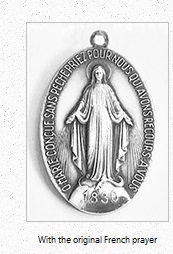 Like the
angels, Mary had free will, and in her conception she was given the grace, like the
angels, to be free of the desire to commit sin. Unlike Mary, the rest of humanity, in
its state of original sin, is afflicted with the
desire to commit sin, and so, for the sake of our salvation,
we must endeavor always to renounce that unholy desire which lurks deep in the heart of
our fallen being. Keeping the medal of the Blessed Virgin over our hearts gives us assistance
in our battle of renouncing sin and evil. Like the
angels, Mary had free will, and in her conception she was given the grace, like the
angels, to be free of the desire to commit sin. Unlike Mary, the rest of humanity, in
its state of original sin, is afflicted with the
desire to commit sin, and so, for the sake of our salvation,
we must endeavor always to renounce that unholy desire which lurks deep in the heart of
our fallen being. Keeping the medal of the Blessed Virgin over our hearts gives us assistance
in our battle of renouncing sin and evil.
So wear the Miraculous Medal around
your neck at all times as a seal upon your heart; having it on
your Rosary beads misses the point. The chain for the medal, therefore,
should be long enough to keep the medal over your heart, rather than over your throat
as a piece of jewelry. And say its prayer many times a day:
O Mary, conceived without sin, pray for us who have recourse to
thee.
|
THE ANGELUS
In the Angelus, we are reminded
how Mary became a model for us in totally surrendering her will to God’s
will. With her simple and humble Fiat (Latin for “let it be
done”), she offered herself to God in unquestioning obedience.
So, pray the Angelus (or
the Regina Caeli during the Paschal Season—that is, from Easter
Sunday to Pentecost Sunday)—every day at noon, if not also at the traditional
times of 6:00 AM and 6:00 PM. Set
the alarm on your watch for 11:59 AM to remind you to
stop whatever you are doing. It may seem like a nuisance to stop work to
pray, so just remember that if it weren’t for God, you wouldn’t
have any work in the first place.
THE ROSARY
Pray the Rosary—at
least five decades (that is, one group of Mysteries)—each day, if possible.
The Blessed Virgin herself told the children at Fátima to pray the Rosary
every day for peace in the world and for the conversion
of sinners. How can we, then, in our troubled times, fail to pray as ardently
today?
An ideal time for this prayer
is in the evening after dinner, just when most persons waste their time watching
TV. If you have children, pray the rosary with them;
a young child can sit in your lap for bonding time, and older children can
pray along with you.
 The
Rosary requires meditation on some central Christian mysteries, so you will first
have to learn the nature of these mysteries. I recommend the following book: The
Rosary requires meditation on some central Christian mysteries, so you will first
have to learn the nature of these mysteries. I recommend the following book:
Rosary: Mysteries, Meditations,
and the Telling of the Beads (Dallas: Pangæus Press, 1996) by Kevin
Orlin Johnson.
 Step-by-step instructions
for praying Step-by-step instructions
for praying
The Rosary
THE CHAPLET
OF THE DIVINE MERCY
The Chaplet of The Divine Mercy
was given to Saint Faustina (see her Diary) as a
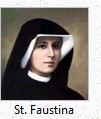 pledge that any soul that sees and realizes the gravity of its
sins, and finds itself therefore immersed in misery,
should not despair, but should, with child-like trust, throw itself into
the arms of Christ’s mercy. And it offers
grace and hope to even the most hardened of sinners (cf. Diary,
1541).
pledge that any soul that sees and realizes the gravity of its
sins, and finds itself therefore immersed in misery,
should not despair, but should, with child-like trust, throw itself into
the arms of Christ’s mercy. And it offers
grace and hope to even the most hardened of sinners (cf. Diary,
1541).
Petitioners who pray the Chaplet
request mercy on the whole world and, in the process, perform a work of mercy
themselves.
Saint Faustina was also told
that if the Chaplet were said by the bedside of a dying person,
“unfathomable mercy envelops the soul” and “the very depths”
of God’s “tender mercy are moved” for the sake of Christ’s
sorrowful Passion (Diary, 811; 1541).
 The Chaplet is such a concise
and compact prayer that you should learn to recite it as often as you can,
in all moments of “spare” time: while you’re driving (or stuck
in traffic), riding the bus, walking from one place to another, and so on.
And, if you get a small Rosary ring, you can pray just one decade
of the Chaplet throughout the day, as a way to take mini breaks from work
(forget the cigarettes and coffee). The Chaplet is such a concise
and compact prayer that you should learn to recite it as often as you can,
in all moments of “spare” time: while you’re driving (or stuck
in traffic), riding the bus, walking from one place to another, and so on.
And, if you get a small Rosary ring, you can pray just one decade
of the Chaplet throughout the day, as a way to take mini breaks from work
(forget the cigarettes and coffee).
STATIONS OF THE CROSS
Jesus told Saint Faustina, “I
remind you, My daughter, that as often as you hear the clock strike the third
hour, immerse yourself completely in My mercy, adoring and glorifying it;
invoke its omnipotence for the whole world, and particularly for poor sinners;
for at that moment mercy was opened wide for every soul. . . . try
your best to make the Stations of the Cross in this hour” (Diary, 1572).
THE LITURGY OF
THE HOURS
The Liturgy of the Hours (or
Divine Office) is an ancient form of prayer that combines psalms, readings,
and other prayers and intercessions. It can be obligatory according to the
rule of many religious orders, but it is just as well an important voluntary
form of prayer for the laity.
The modern version of the Liturgy
of the Hours is found in either a one-volume edition or a four-volume edition
and consists of the Office of Readings, Morning Prayer, Daily Prayer, Evening
Prayer, and Night Prayer.
The one-volume edition, called
Christian Prayer, has
• |
an abbreviated Office of
Readings; |
• |
an abbreviated Daily
Prayer. |
Every layperson
who desires a rich prayer life should, at a minimum, read the Office of Readings
and the Morning Prayer.
|
 Learning to use the Liturgy of the Hours can
be a daunting task because the daily texts change according to various holy
days and seasons. Learning to use the Liturgy of the Hours can
be a daunting task because the daily texts change according to various holy
days and seasons.
Just follow very carefully the
General Instruction of the Liturgy of the Hours (found in Volume 1
of the four-volume set) and the instructions in the section called the
Ordinary (found in each volume).
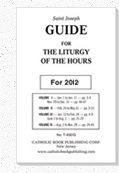
Use the Saint Joseph Guide
for the Liturgy of the Hours (a small booklet that serves the entire
year, available in any good Catholic bookstore, or directly from the
publisher)
as a valuable help for locating the correct sections to use each
day.
Step-by-step instructions
for praying
The Liturgy of the Hours

Notes.
1. Delusions are false beliefs about reality that
seem so real to a person that the beliefs are maintained despite rational proof or
evidence to the contrary. In many cases, delusions tend to be “encapsulated;” that
is, a person afflicted with delusions can, in most respects, seem perfectly normal
to others and only in regard to the specific delusions will anything seem to be
unusual.

Here are examples of various types of delusions:
• You believe that you are being obstructed, attacked, or conspired against by
others. In many instances, these paranoid delusions
result when you misinterpret ordinary daily events as being specifically directed against
you. For example, if someone bumps into you accidentally, you can falsely believe that the
person has deliberately tried to implant something evil into you. Or if someone parks next
to your car while you are talking on your mobile phone, you can falsely believe that you
are being followed and that your conversation is being recorded.
• You believe that another person is communicating with you through mental
telepathy and is trying to control you with secret commands. Such delusions can
result when you misunderstand unconscious processes, such as an inner voice of guilt
for secret sins.
• You believe that requests or demands of you are being given to you through your
dreams. Such delusions can result when you misunderstand the process by which
dreams can
reveal inner truths about yourself.
Note that finding help in coping with the distress of delusions can be problematic
because delusions, which result from false perceptions, can easily be confused with
actual spiritual experiences resulting from witchcraft or demonic oppression. Nevertheless,
regardless of whether your distress is psychological (a matter of your own misperceptions
of external events or a misunderstanding of unconscious processes) or social (a matter of
someone’s hatred for you) or spiritual (a matter of witchcraft or demonic attack),
it’s important only that you renounce the experience and refuse to fear it or obsess
about it. Your protection does not depend on your trying to stop another person from
attacking or persecuting you, nor does it depend on your trying to prosecute the other
person for a crime; your protection is a matter of your refusing to fall into
fear or anger, and therefore your protection depends on your trusting in God to protect
you from any evil.
Therefore, if you experience distress from what seem to be telepathic communications
from others, say to yourself, “Let them do what they want; it’s of no concern to
me. God will protect me.”
If you experience dreams about living persons making requests or demands of you, refuse
to comply with any demands you perceive and make yourself wake up to break the hold of
the dream by praying to the Blessed Virgin and to Saint Michael for protection. Note,
however, that if you dream about requests or demands from spiritual entities, first refuse
to comply with any demands you perceive and then seek guidance from a spiritual director.
Remember, God’s will cannot be thwarted, so even if the demand is legitimate your delaying
in complying with it until you can be certain of its legitimacy does no harm to
God.
2. Note that by virtue of his holy orders any
priest has authority over demonic powers and that his authority is not affected by his
personal sanctity. Thus any priest can pray over you for deliverance from evil spirits.
Lay persons can safely pray with you or for you while
praying for your deliverance, but lay persons should not pray over you, whether by
laying on of hands, by holding their hands over you, or by breathing on you. Why? Well, lay
authority over demons derives only from personal faith, and, because most lay persons lack total
purity of heart, during the process of their praying over you the diabolical effects of
their unconscious sins can infect
you. Not only can a lay person contaminate you spiritually with his or her own moral impurity,
but also that person’s personal hellgate (an opening to demonic influence) can open
up a hellgate in you. The most dangerous unconscious sins are lust and anger, while pride,
fear, anxiety, doubt, and disobedience are prevalent in many Catholics today. Sadly,
most Catholics, even most priests, do not understand the spiritual danger of unconscious
sins.
3. See Interview with an Exorcist,
p.70–71.
4. See Interview with an Exorcist,
p.95.
5. If you experience anything that seems to be a
curse, just pray for
deliverance from the symptoms the curse is causing. Remember that it does not matter who
you may believe has placed the curse on you—just focus on your own deliverance prayers,
pray contemplatively throughout the day, use exorcised holy water,
keep a Crucifix and an image of the Blessed Virgin in your living space, attend
Mass frequently, and, if possible, seek out a priest exorcist to pray
a prayer of deliverance (see
Interview with an Exorcist, p.112–113).
As for the evil eye, in most cases this
is just a look of contempt, but if it has a quality of pernicious hatred it can function like
a curse. In this case, your only protection is heartfelt forgiveness
for the one having the contempt; trying to fight hate with hate will only poison you.

Healing
|
Though
Demons
Gloat
|
Anger
&
Forgiveness
|
Falling
Families,
Fallen Children
|
Emotional
Trauma
|
Psychology
from the
Heart
|
 |
 |
 |
 |
 |
 |
Psychological Healing
in the Catholic Mystic tradition |
True Christian
Identity
In Confronting
Evil |
How to Turn the
Emotional Wounds
of Daily Life Into
Psychological Growth. |
The Psychological
and
Spiritual Remedy
For Our Cultural
Disintegration |
And its
Psychological
and Spiritual
Nature |
Collected Texts
About the Spiritual Depth of
Clinical Psychology |
More information |
More information |
More information |
More information |
More information |
More information |
Desire
and
Distraction
|
Fear
|
Stopping
Smoking
|
Borderline
Personality
Disorder
|
Catholic
Compassion
|
Reverence
for the
Holy Eucharist
|
 |
 |
 |
 |
 |
 |
A Catholic Perspective
On Behavioral Change
and Its Subversion |
A Catholic Explanation
Of a Universal
Problem |
Through
Faith
and
Prayer |
Healing
the
Rage |
When They Tell You
That the Moral Teachings of the
Catholic Church
Are Wrong |
Reverent and
Proper Conduct in
a Catholic Church |
More information |
More information |
More information |
More information |
More information |
More information |
|