|
|
|
Fear |
Healing |
Therapy |
Spiritual Counsels |
Books |
About CSF
The Demand for Spiritual Fruits |
The Holy Eucharist |
The Passion |
Repentance and Penance |
A Holy Lifestyle—and Words to Avoid
 RUE
Christianity is far more than a collection
of intellectual assertions. Some people will say proudly that they believe God exists
and that they believe Christ is really present in the Holy Eucharist, but even the devil
can say that. The real matter is whether you love God, rather than just know that He
exists. Real Christian faith demands a way of life that produces
spiritual fruits. Therefore, if you
say you love Christ, and if you want to follow Him, and if
you are willing to do anything it takes to live a holy life, then
cling reverently to the following four fundamentals of Christian life. For
the sake of your own soul, shun any teaching that neglects these fundamentals.
Be wary, too, of any bishop or priest who advocates any teaching that neglects
these fundamentals. RUE
Christianity is far more than a collection
of intellectual assertions. Some people will say proudly that they believe God exists
and that they believe Christ is really present in the Holy Eucharist, but even the devil
can say that. The real matter is whether you love God, rather than just know that He
exists. Real Christian faith demands a way of life that produces
spiritual fruits. Therefore, if you
say you love Christ, and if you want to follow Him, and if
you are willing to do anything it takes to live a holy life, then
cling reverently to the following four fundamentals of Christian life. For
the sake of your own soul, shun any teaching that neglects these fundamentals.
Be wary, too, of any bishop or priest who advocates any teaching that neglects
these fundamentals.
The
Holy Eucharist
The entire mystical basis of
Christianity is Christ’s real presence in this world. He came into this
world in the form of real flesh and blood, as an act of divine love, on a
mission to save us from our slavery to Satan and sin. And,
on the eve of the day when He would be tortured and crucified by His enemies,
He instituted the Holy Eucharist, so that His
Church would never be without His Real
Presence.
Jesus said to them,
“Amen, amen, I say to you, unless you eat the flesh of the Son of Man
and drink His blood, you do not have life within you. . . .
Whoever eats My flesh and drinks My blood remains in Me and I in him”
(John 6:53, 56).
Therefore, attend
Mass every Sunday and on every
holy day of obligation.
Wear modest and reverent dress clothing: for both
men and women, jeans, sneakers, shorts, sweatshirts, any attire with sports or political
insignia, and visible tattoos are grave defilements of reverence; and for women in
particular, leggings, slacks, short skirts, bare shoulders, and low necklines are all
grave defilements of reverence. Also, before entering a church, women should
cover their heads with a scarf or chapel veil, and men should
uncover their heads by removing their hats, beanies, or anything else covering their
heads. When you enter the church, look at the tabernacle and genuflect, saying silently,
“My Lord and my God.” Be careful to arrive on time (before the priest enters the sanctuary),
and if you do arrive late, do not receive the Holy Eucharist. When you do receive the Holy
Eucharist, receive on the tongue, not in your hands, and only from the hands of a priest (or deacon).
Do not leave before the dismissal, and, when you leave, look at the tabernacle and genuflect,
saying silently, “My Lord and my God.”
 F YOU WANT to live a Christian
life, then adore and receive Christ with
chaste purity of heart, making the
Holy Eucharist the core of your life. F YOU WANT to live a Christian
life, then adore and receive Christ with
chaste purity of heart, making the
Holy Eucharist the core of your life.
The
Passion and Redemption
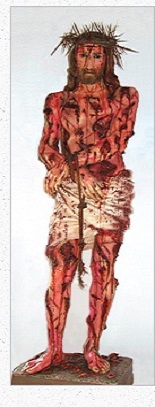 When Christ shed
His blood for us, He fulfilled a triple purpose. First, He gave us life—that is,
freedom from our bondage to Satan and sin. In His empathic sacrifice, He took upon
Himself all the sins of humanity—from the beginning of creation to the end of creation—and
healed them with the pure love of His own death. Christ’s death was a glorious mystery
that reverberated from Heaven down to earth, for “obliterating the bond [of
Original Sin] against us, with its legal claims, which was
opposed to us, He also removed it from our midst, nailing it to the cross” (Colossians
2:14). Second, this redemption worked in Christ’s
death was an example to us. It showed us, in a way that
no event in the world has ever shown before or since, how we, in our
hearts—the very hearts God has created—and through our own free
will, constantly injure others and defile, mock, and execute divine love
in every moment of our lives. Third, Christ died in order to be raised
again, to show us that God raises into His glory only those who, without
obstinacy or presumption, without cunning or intrigue, without strife or
schism, empty themselves of all their social
illusions in
humble, obedient service
to Him. When Christ shed
His blood for us, He fulfilled a triple purpose. First, He gave us life—that is,
freedom from our bondage to Satan and sin. In His empathic sacrifice, He took upon
Himself all the sins of humanity—from the beginning of creation to the end of creation—and
healed them with the pure love of His own death. Christ’s death was a glorious mystery
that reverberated from Heaven down to earth, for “obliterating the bond [of
Original Sin] against us, with its legal claims, which was
opposed to us, He also removed it from our midst, nailing it to the cross” (Colossians
2:14). Second, this redemption worked in Christ’s
death was an example to us. It showed us, in a way that
no event in the world has ever shown before or since, how we, in our
hearts—the very hearts God has created—and through our own free
will, constantly injure others and defile, mock, and execute divine love
in every moment of our lives. Third, Christ died in order to be raised
again, to show us that God raises into His glory only those who, without
obstinacy or presumption, without cunning or intrigue, without strife or
schism, empty themselves of all their social
illusions in
humble, obedient service
to Him.
F YOU WANT to live a Christian
life, then meditate on Christ’s Passion, fulfilling His commands,
participating in His mission, and, by repeating
what He suffered, being filled with Him, over and over, day after day, praying
for the salvation of all (even your enemies),
persevering until the
end, without respite, in the great battle against
evil.
Repentance and Penance
Through the sacrament of
baptism we
promise to accept the redemption brought about by
Christ. In baptism, the personal sins which have separated us from God are “washed away”—that
is, the sins are forgiven by God. This forgiveness means that God does not allow
those washed-away sins to keep a soul separated from Him. But even though the sins have
been forgiven, those sins have still caused much damage to others and to God, and so the
damage caused by those sins must be paid for. Furthermore, after baptism we can still
commit sin; this sin, too, causes damage to others and to God, and so we must seek God’s
forgiveness and pay for the damage we have caused by those sins.
Thus, through repentance and the payment
of penance we can be purified—starting in this life and then completed in
Purgatory—of all that is not holy.
Note that both in this life and in Purgatory
the “currency” of payment for sin is suffering, not money.
• |
The penance that we
do in this life is the willing acceptance of suffering, very similar to the penance
of suffering done in Purgatory. But in this life the suffering is the graceful and
uncomplaining acceptance of all the difficulties that we encounter in daily life, such
as ordinary obstructions to our plans; persecutions by others; the financial sting
of alms giving (not the money itself); and the physical and emotional pain of fasting,
whether from food (unless you are overweight and must fast for health rather than penance)
or from anything else (such as entertainment) that serves only sensual pleasure
and that we really do not need for survival. In this acceptance, we can say, “I accept
this distress as reparation for all the obstruction of and damage to God’s will that was
done by my past sins. My graceful acceptance of this suffering signifies my love for God
and is my voluntary expiation for my grievous offenses to God.” |
|
• |
Note carefully that, contrary to popular
belief, the purification in Purgatory is not punishment.
In its psychological sense, punishment is a technique to decrease specific
behavior. After death, however, there is no need to decrease sinful behavior.
There is, though, a need to purge from all souls the
desire to sin which is spiritually
bound to all the sins the souls have committed through the course of their lives.
This purging of a desire and all the harm brought into the world through its associated
sins has been falsely called “punishment,” but it is properly called
purification. |
|
• |
Furthermore, payment
for the damage done by your sins is not punishment either; it’s similar to the process of
paying for the items in your shopping cart in a store. That is, when you die,
the “shopping cart” of your life will contain all the spiritual damage caused by your
sins, and that damage, if not adequately paid for in this life, must be “paid for”
in Purgatory. Believe Me, you shall not be set at liberty until you have paid the
last farthing (Matthew 5:26). (Note that “last farthing” here is not about money;
it’s just a figure of speech meaning the “last bit.”) |
|
Thus, even though God forgives our sins
when we repent them while we are alive—that is, He constantly welcomes a repentant soul
back to Him regardless of its sins—the stain of our sins must be removed from us completely,
after death in Purgatory, before we can endure the fire of His love in Heaven. In Heaven,
any stain of impurity will burn and torment a soul, so an impure soul will fling itself
out of Heaven.
Yes, the purification process necessary to
remove the stain of our sins is painful suffering, just as Christ’s passion was painful
suffering. But the purification process of Purgatory is not arbitrary; the suffering is
as painful as it needs to be, and it takes as long as it needs to take, according to the
disposition of any particular soul. The “price” of a soul’s purification is penance
for all the accumulated spiritual damage caused by the sins that were committed by that
soul, and that penance is not something that can be evaded or simply dismissed. You can,
however, decrease the extent of your suffering after death if, before death, you follow
a spiritual life of holy penance that helps to make reparation for your sins and purge
from your heart the desire to sin. Then, depending on the price you pay in this life,
after death the remainder of the purging work will be done in Purgatory until your soul
becomes pure in its love for God.
But you can’t do any of this if you tell
yourself that the sins you are committing are not really sins! You can’t repent your
sins if you condone sin.
F YOU WANT to live a Christian
life, then recognize sin for what it is. Only the Catholic Church preserves
the teaching that tells us what
sin really is, so fidelity to the
tradition of Church teaching about sin, unless it is
absolute, is no faith at all.
Holy
Lifestyle—and Words to Avoid
Every sin you commit after your
baptism will be accounted for, and you will
pay for them all, either in Purgatory or
in hell, depending on whether you repent or
not. Seek, therefore, to purify your body, your mind, and your
words.
Words Every Catholic
Should Avoid
In Ephesians 4:17 Saint Paul warned Christians
not to live as the Gentiles do. Therefore, any use of the following Gentile words or phrases
is a grave offense to Christianity.
“Reach out” The
only proper use of the expression “reach out” is to refer first of all to the divine act
of God reaching out to us to give us His grace; second, to refer to our action of
reaching out to Him to accept His grace; and third, to refer to our reaching out in
compassionate assistance to others as a way of sharing the grace God gives us. All of
these acts of reaching out are holy acts. But in today’s world, our atheistic culture is
actively attempting to subvert everything holy. Hence the expression “reach out” is
commonly used as a politically preferred term that means “to communicate with someone.”
In this manner, the simple act of basic communication is fraudulently depicted as a noble
action, and it’s all a cunning way to obscure the fact that in a culture of
insanity even banal acts can be passed off as virtues.
“The F-word” Offensive
language in the past was, well, offensive, but today it’s commonplace. Nevertheless, the F-word (and
its minced oath variations: flipping, freaking, frigging) is a Satanic insult to the act of
procreation. God has no hatred for anything He created, but when you curse any aspect of His
creation—especially when you use a word that itself defiles the procreative act—you join with Satan
in cursing God. So think carefully: cursing God is a grave sin. Yet have you ever brought to confession
all the times you have uttered that blasphemous word as an emotional expletive? Woe to those who die in
mortal sin!
“Oh my god! (OMG)” If
you really knew who your God is, you would not treat Him with glib disrespect. If you
are astonished at something, just say, “That’s astonishing!” Or don’t say anything.
“Oh my gosh!” Who
is your “gosh”? Is it an ancient Chaldean demon or something? If you are astonished at
something, just say, “That’s astonishing!” Or don’t say anything.
“Minced oaths” Many
expressions commonly used to express annoyance are really “sanitized” oaths. But they are still an
offense to God: dag nab it means “the devil take it”; dang means “damn”;
darn means “damn”; doggone it means “God damn it”; fudge means “f--k”;
geez (or simply gee) means “Jesus”; gol or golly means “God”;
gol darn means “God damn”; gosh means “God”; my goodness means
“my God”; heck means “hell”; hocus pocus is a blasphemous parody of “Hoc est
[enim] Corpus [Meum]”; jeeze means “Jesus”; Jiminy Cricket refers to the
initials “JC” of Jesus Christ.
“Partner” Unless
the reference is to a business partner, a “partner” is a sex partner and therefore a
partner in sin. Even in Catholic marriages there are no partners but spouses; for example,
in prayer we refer to Saint Joseph as the spouse of Mary, not the
partner of Mary.
“Challenge” Nothing
about a Christian life is a challenge. A challenge is a taunt to prove strength, like challenging
someone to a fight. And yet we often hear people—especially priests—saying, “In this passage,
Christ challenges us to . . . .” Well, that’s a false belief. We don’t have to prove anything
to Christ. Christ simply poses a question of love to all of us: Will you or won’t
you?
“Emulate” This word
is often mistakenly used to mean “imitate,” but the word really means “to imitate with the intention
of competing with, surpassing, and triumphing over someone.” Consequently, emulation is a sin, as
Saint Paul said: Now the works of the flesh are manifest, which are fornication, impurity, immodesty,
luxury, idolatry, witchcraft, hate, strife, emulations, anger, quarrels,
dissensions, sects, envies, murders, drunkenness, carousing, and such like. Of the which I foretell
you, as I have foretold to you, that they who do such things shall not obtain the Kingdom of God
(see Galatians 5:19–21).
“Impact” This word
literally refers to what occurs when a projectile hits a target with destructive force, and so the
underlying connotation of the word is that of violence. Although the word is commonly used, especially
in business, to indicate that something has had an effect on something else, it is ridiculous to use
the word to refer to a positive effect rather than a destructive effect.
“Make
me” When people of little faith want to change their behavior, they
will say to God, Make me do such and such. “Make me stop masturbating.” “Make me stop
smoking.” “Make me stop sinning.” But God is not a cosmic magician. Magic is a pagan practice.
If we want to change our habits, we must desire change, pray for the courage to
achieve the change, and make sacrifices to confirm that our desire to change is serious.
Change doesn’t occur effortlessly.
“Come
Out” Hοmοsxuals who reject chastity do not “come out”
of anything; instead they willingly “enter into” wanton debauchery.
F YOU WANT to live a Christian
life, first repent and confess all of your past
sins and then do anything it takes thereafter
to avoid sin and remain pure of heart through surrender to the will of God. Well,
the only way to do this is to dedicate yourself to deep study
of the faith; to living in chastity,
humility, and modesty; to
praying constantly; and
to self-sacrificial service to others, in imitation
of Christ Himself through loving consecration to His mother, the Blessed Virgin
Mary.


Healing
|
Though
Demons
Gloat
|
Anger
&
Forgiveness
|
Falling
Families,
Fallen Children
|
Emotional
Trauma
|
Psychology
from the
Heart
|
 |
 |
 |
 |
 |
 |
Psychological Healing
in the Catholic Mystic tradition |
True Christian
Identity
In Confronting
Evil |
How to Turn the
Emotional Wounds
of Daily Life Into
Psychological Growth. |
The Psychological
and
Spiritual Remedy
For Our Cultural
Disintegration |
And Its
Psychological
and Spiritual
Nature |
Collected Texts
About the Spiritual Depth of
Clinical Psychology |
More information |
More information |
More information |
More information |
More information |
More information |
Desire
and
Distraction
|
Fear
|
Stopping
Smoking
|
Borderline
Personality
Disorder
|
Catholic
Compassion
|
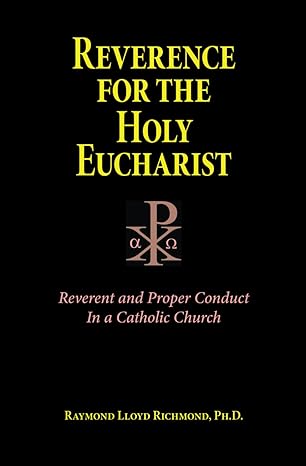
Reverence
for the
Holy Eucharist
|
 |
 |
 |
 |
 |
 |
A Catholic Perspective
On Behavioral Change
and Its Subversion |
A Catholic Explanation
Of a Universal
Problem |
Through
Faith
and
Prayer |
Healing
the
Rage |
When They Tell You
That the Moral Teachings of the
Catholic Church
Are Wrong |
Reverent and
Proper Conduct in
a Catholic Church |
More information |
More information |
More information |
More information |
More information |
More information |
|