|
|
|

Why
wasn’t I taught any of this in Church?
 ell, first of all don’t make
the mistake of confusing the Church with the Church. There are those
in the Church who call themselves Christian as a sort of stamp
of approval they can wear while they go about life as they want life to be.
They don’t come to Christ begging that their lives be changed;
they come seeking to have their lives validated. ell, first of all don’t make
the mistake of confusing the Church with the Church. There are those
in the Church who call themselves Christian as a sort of stamp
of approval they can wear while they go about life as they want life to be.
They don’t come to Christ begging that their lives be changed;
they come seeking to have their lives validated.
Then there are those who truly
understand Christianity and, being the mystical body of Christ, are
the Church. This Body of Christ has been living, teaching, and preaching
true Christianity for ages.
The
“Church” and “the Church”
This gulf between the
“Church” and “the Church” got started right from the
earliest days of the Church. It was one thing to convince Jews, who already
knew the Law, to live the Law from the heart, as a devout
lifestyle of a New Covenant through Christ.
But when Saint Paul started converting pagans, an entirely different situation
emerged.
“What is
the Least I Have to Do?”
Paganism,
after all, is all about making sacrifices to the gods to appease them. Granted,
Judaism also had a focus on sacrifice—sacrifice was one of the primary
purposes of the Temple—but Judaism understood God to be a personal God
who cares about His creation through divine love.
Jews had the tradition, through the Old Covenant, of being told,
“Therefore, you shall love the Lord, your God, with all your heart,
and with all your soul, and with all your strength.” Pagan gods were
essentially indifferent to humanity and loved only each other—when it
was convenient.
So when pagans heard the words
“salvation” and “eternal life”
preached, they converted in droves. But the primary question
for many of them was, “What do I have to do to make this God give me
eternal life?” Right from the beginning, the focus was on getting
something, and loopholes looking for the easy way
became the norm. Multitudes of souls who claimed to be in the Church started
asking, What is the least I have to do to get into heaven? Their main
thought was not on loving God with all their heart and soul and mind and
strength but on avoiding hell.
“Magical”
Salvation
“What is the least I have
to do to get into heaven?” You can find traces of this sort of question
between the lines of most of Saint Paul’s letters. If you read the letters
carefully, you will see that Paul had to argue endlessly against the idea
that Christianity was a magical form of
salvation—that is, that you could be saved just by saying the right
words or performing external actions. He kept preaching, over and over, in
one way or another, that Christianity is a total commitment to a new
lifestyle in Christ, by which the old lifestyle
of the world is crucified. That’s why he repeatedly
speaks of baptism as death—that is, death
to pride in one’s self and death to one’s
attachment to the unholy
social world around us.
This endless need to argue against
his opponents in this way explains why Paul’s letters put so much emphasis
on faith over works. Paul, always on the defensive against
heresy, had to focus more often than not on only one
side of the issue. But, realistically, how could anyone live the lifestyle Paul
described if, through faith, works were not made
manifest? But note carefully: manifest through love, not through magic.
Indifference,
Ingratitude, and Contempt
So, Saint Paul and the Church
taught the hard truth of a Christian lifestyle right from the beginning.
And that truth has always been taught by the Catholic
Church. And that truth has been confirmed by the personal experience of the
Catholic mystics through the ages. And that truth continues to this day,
despite those who treat it all—just as they treat the
Sacred Heart of Jesus—with indifference,
ingratitude, and contempt.
Sadly, as Christ described in the
Parable of the Weeds Among the Wheat (see Matthew 13:24–30), we will always have
a Church filled with weeds. In every parish today you will see an overwhelming
preoccupation with the flesh rather than the spirit. You will see immodesty, vanity
and pride, competition, impatience, intellectual arrogance, disunity and factions,
self-absorption with entertainment and sports—and resentment, victimization, and anger
galore. Yes, where is their faith?
And where are the priests? It would be
astonishing yet refreshing if a priest were to look out at his congregation one Sunday,
point to the people, and say, “Where is your faith? Most of you are dressed—or to be more
accurate, undressed—as if you just casually stopped in here on your way to the grocery
store!” It would be even more astonishing if, like Saint Paul, the priest then proceeded
to teach the people the truth about Christian morality, modesty, and reverence for the
holy.
• |
How many priests preach about
chastity as a core aspect of Christian identity and as
fundamental to the Christian way of life? |
• |
How many priests preach about
modesty as a core virtue in Christian identity? |
• |
How many priests preach about the Christian
obligation to renounce divorce and remarriage (see Matthew 5:31–32, Luke 16:18, and
1 Corinthians 7:10–11)? |
• |
How many priests preach about the Christian
obligation to renounce popular entertainment,
social media, and competitive
sports? |
• |
How many priests preach about the Christian
obligation to stay sober at all times (see 1 Peter 5:8–9a) and to renounce all drugs,
including tobacco, and especially
marijuana even if it has been “legalized”? |
• |
How many priests preach about the growing
crisis in the Church of falling families and fallen children (see my book
Falling Families, Fallen Children) because
parents have forsaken the responsibility of Christian guidance, protection, and
discipline? |
• |
How many priests preach to the people about
demonic influence working right under their noses to snatch their
souls—and the growing need for bishop-appointed exorcists to provide
deliverance prayer and exorcism? |
How many priests preach about these things?
Well, it’s rare, because it’s far easier, and safer, to preach a morally bland homily and
then head for the coffee and donuts. That’s why we’re in the mess we’re in today.
Listen carefully, therefore, to Christ’s own warnings:
|
Someone asked
Him, “Lord, will only a few people be saved?” He answered them,
“Strive to enter through the narrow gate, for many, I tell you, will
attempt to enter but will not be strong enough. . . .” |
|
|
—Luke 13:23 |
|
Nevertheless, Christ didn’t say
this to be discouraging. Just as David overpowered Goliath (1 Samuel 17:32–51),
the “strength” of which Christ spoke is the strength of trust and desire. If your
trust in God and your desire
to be saved are stronger than all your
temptations to be accepted by the
world, then it will be possible for you to enter through
the narrow gate.
The text of
this webpage, integrated with other material from my websites,
has been conveniently organized into a paperback book of 350 pages, including
a comprehensive index.
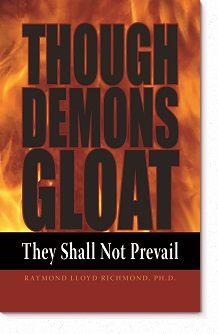 |
|
Though Demons Gloat: They Shall Not Prevail
by Raymond Lloyd Richmond, Ph.D.
Though we are attacked by liberal activists from without and by apostasy
from within, the true Church—that is, the body of those who remain
faithful to Church tradition—weeps, and she prays, because she knows
the fate of those who oppose God.
Our enemies might fear love, and they can push love
away, but they can’t kill it. And so the battle against them cannot be
fought with politics; it requires a profound personal struggle against
the immorality of popular culture. The battle must be fought in the
service of God with pure and chaste lifestyles lived from the depths of
our hearts in every moment.
Ordering Information |
|
|