|
|
|

Certainly
some forms of entertainment are salacious and must be avoided. Other forms
of entertainment may seem innocuous but are harmful when they divert our
vision from the accomplishment of God’s will. But can some forms of
entertainment such as wholesome movies and classical music provide a momentary
way to “chill out,” “escape,” or relax? What about watching
religious programming such as EWTN? What about news programs? How do you
suggest that people stay abreast of what is happening in the world around
them?
|
 s tempting as any entertainment might
seem, keep in mind that all entertainment is scripted, costumed, and choreographed.
What you are seeing or hearing in entertainment is not real; it is all an illusion
created in the mind of an author or an artist—or a script writer, a producer,
and a director. For the most part, the objective of the entertainment industry is to
desensitize you to seeing spiritually subversive behaviors so that you will be inclined
to accept it all uncritically. Moreover, if there is any sin in the hearts of the performers,
then the illusions they portray will be stained with sin, and you, the witness to the
illusions, will be vulnerable to having your heart stained with sin. Even “good Catholic”
movies, art, and literature can be stained with unconscious sins. That’s a sad and
tragic reality that very few persons today understand. s tempting as any entertainment might
seem, keep in mind that all entertainment is scripted, costumed, and choreographed.
What you are seeing or hearing in entertainment is not real; it is all an illusion
created in the mind of an author or an artist—or a script writer, a producer,
and a director. For the most part, the objective of the entertainment industry is to
desensitize you to seeing spiritually subversive behaviors so that you will be inclined
to accept it all uncritically. Moreover, if there is any sin in the hearts of the performers,
then the illusions they portray will be stained with sin, and you, the witness to the
illusions, will be vulnerable to having your heart stained with sin. Even “good Catholic”
movies, art, and literature can be stained with unconscious sins. That’s a sad and
tragic reality that very few persons today understand.
|
Only a fool would spend
money to support the sins of lost-soul celebrities. |
|
Genuine Retreat
Even Christ Himself needed time
away from His disciples to rest and pray. Thus, from His own example we can
see that “retreats” from daily work can be an important aspect
of our spiritual life. But we should keep in mind, according to Christ’s
own example, that a retreat must of necessity be grounded in prayerful
communion with God. Otherwise, a “retreat” loses its spiritual value and
becomes mere self-indulgence that leads you away from holy things and opens
your heart to the influence of evil. When you’re “chilling out,” your
guard against evil drops, and the demons gloat.
Prohibitions
and Loopholes
Now, in your asking multiple
questions about entertainment you have already lost your grounding in prayer
and have begun to fall into the trap of thinking that a Catholic mystic life
is a mass of legalistic prohibitions—and loopholes. If you follow
that path, you will end up in Puritanism, which is a
Protestant heresy.
|
When something
is forbidden to you, you desire it all the more unconsciously.
Spiritual growth,
though, is not a matter of forbidding pleasure; it’s a matter of pruning
away useless branches that bear no fruit.
Without pruning, the fruit is sparse and bitter; with pruning, the fruit
becomes abundant and sweet.
This is what
mortification means: to prune the
“vine” so that it becomes more productive. |
|
Spiritual
Pruning
To begin with—that is, to
begin to take up the process of your spiritual
healing—just follow the spiritual counsels
of this website so as to prune away every spiritually
unnecessary thing from your life and plunge into spiritual purity for
three months. After three months you will have a better idea of what Catholic
mysticism—and real prayer—is all about,
and you might see things differently. But right now you are so caught up in
the world—so overgrown with showy branches that
bear no spiritual fruit—that you
can’t see anything clearly, and so you lack the ability to discern what
is good for you and what isn’t.
I have a small collection
of opera from my student years before I became Catholic. But I don’t listen to
it anymore because it’s all stained with lust, adultery, and violence.
Now it seems empty in comparison to silent prayerful contemplation. Still,
you may not be ready yet for contemplative silence—the taste has to grow
in you over time, and it will grow in you if realize how spiritually subversive
entertainment actually is.
Gustato spiritu,
desipit omnis
caro.[1]
(Once I taste
of the spirit, everything carnal is foolish.) |
|
Note, however,
that some music can be used to assist private prayer, especially when it may be necessary
to block out environmental noise and distractions. Contemplative instrumental
music, whether secular or liturgical, is best, though vocal liturgical music
is also good, as long as you cannot understand the language. For example,
I sometimes pray (e.g., the Rosary, the Chaplet of the Divine Mercy, and the
Jesus Prayer) while listening to Russian chants because I don’t understand
Russian; but I avoid Gregorian chant (as a background for contemplative prayer)
because I understand the Latin and get distracted by the meaning of the
words when I want to focus on something other than the music. |
|
Wholesome, you
say. Really?
I have a collection of old comic
books that were called “wholesome” reading at the time. But as I
look at them now, I see that they all were stories about characters engaged in
competition with each other and that there was no mention,
let alone model, of genuine family life
(father, mother, and children), and not even a hint of dependence on God, let
alone any mention of worship and prayer.
This, however, was just the
beginning.
The subtle introduction of
non-Christian values and Disney “magic”
has been progressing for years now, and the entertainment
industry has been working subversively through movies, television, popular music,
magazines, and social media to destroy traditional Christian family values and to
glamorize the sin of lust in our
culture. For example, it may seem on the surface that “the woman”
has been idealized, but the underlying motive has been to defile feminine
modesty, stripping the female body of its holy
dignity and reducing it, often with violent overtones, to a soulless
sex object.
The end result is that our secular
culture worships sexuality as its goddess, and all
Christians are surrounded with temptation to abandon their
baptismal promises and to partake of the harlot’s
allure.
We have been duped by the
anti-Christian “progressive” liberal agenda of the entertainment
industry into believing that sin is normal and acceptable
and that sexual pleasure, along with the lust for power and revenge, is necessary
for our “happiness.” As a result, instead of taking personal responsibility
to detach themselves from social
illusions, Christians willingly consume
them.
Now, the best way to avoid infection
by the desire to sin is to avoid popular entertainment,
such as television (and the subversive commercial advertising that goes with it),
movies, social media, video games, sports, newspapers, magazines, music, and every
other aspect of “popular” culture; these things
are filled with a massive craving for everything unholy and have their basis in an
indifference and contempt for anything
holy.
|
We watch television
and sports and we read newspapers and magazines in the hope of seeing
something that will make us feel good about ourselves. We play sports and
video games in the hope of accomplishing something that will make
us feel good about ourselves. We listen to music and chat on mobile devices
in the hope of hearing something that will make us feel good about
ourselves. We make food into an addiction in the hope of smelling and
tasting something that will make us feel good about ourselves. We
strip sexuality of its reproductive responsibilities and make it into the
most pervasively sought-after entertainment of all, in the hope of seeing,
hearing, smelling, tasting, and accomplishing something that will make
us feel good about ourselves. Yet, in the end, we have really done nothing
but draw ourselves away from anything holy. |
|
So, be careful here not to deceive
yourself by attributing any meaning to these illusory “hopes.”
Don’t believe for a moment that there is such a thing as “wholesome
entertainment.” The desire to be entertained—to be soothed, satisfied,
and fulfilled—is, at its core, a social “religion” unto itself
that serves the god of narcissistic happiness in the frenzied quest to feel
good about our bodies while ignoring the most poignant hopes of our lost
souls.
|
We live now in
dire times, and every Christian must be engaged
in a profound spiritual battle against evil. Those who
waste their time searching for acceptance on social media, boasting over sports,
and watching television and movies are not fighting evil, they are feeding
it.
Whether in daily life or in a movie:
The way of the |
 |
leads to doom. |
|
—Psalm 1:6 |
|
|
Emptying, not
Emptiness
When Christ was born, He emptied
Himself for our redemption and entered this world
knowing that He was headed to the Cross, with no escape. So what gives us the
idea to think we have a right to “escape” from the constant
trials of a holy life? Moreover, Christ told us
to pray constantly. He didn’t say, “Well, pray at least 15 minutes a day.” No.
He said pray constantly. So what gives us the idea to think that we can
forsake prayer for empty “entertainment” that has no place in a holy
life? [2]
The only way for a Christian to “chill out,”
“escape,” or relax is to pray.
Therefore, turn away from self-satisfaction,
and learn to seek God alone. Once you have learned to seek God in all
things, through pure love, then you can deal with
the world as you need to, reflecting divine grace into the darkness
around you, using the resources of the world as tools for your ministry,
yet without craving the world and without danger of being snared by
it.
|
Jesus criticized
the Pharisees and Herodians for following the illusions of their own time.
But when He warned the disciples to beware “leaven” of the Pharisees
and the “leaven” of Herod (Mark 8:15), they didn’t
understand.
And so it is
today. Most Christians today just don’t get it when they are
warned—even on this very website—to guard against the leaven—the smoke
of Satan—in popular culture, and now even in the Church itself. |
|

Notes
1. I found this quote in The Ascent of Mount
Carmel by Saint John of the Cross, Book Two, Chapter 17, no. 5.
(The English translation is my own.) Saint John refers to it as “a
frequently quoted spiritual axiom.” Saint Bonaventure, in his
Commentaria in Quatuor Libros Sententiarum attributes the quote to
Pope Gregory the Great (cf. Opera Omnia S. Bonaventurae, Ad Claras Aquas,
1882, Vol. 1, p. 254), though the quote may actually have its origin in a
letter (Epistle 111) by Saint Bernard of Clairvaux.
2. Does this mean that recreation has no place
in Christian life? Not at all. Just make sure that everything you do is done
as pure love for the good (i.e., for the
salvation) of others, and, however you do it,
do it with prayer. If you need to take a hike to exercise your body and refresh
your mind from long hours of serving others, fine; pray the
Rosary while walking. Do you enjoy baking bread?
Embroidery? Woodworking? Gardening? Then pray the
Chaplet of the Divine Mercy or the
Jesus Prayer in the process. And, for that matter,
when you do anything, even menial labor, do it with prayer and it will
become the re-creation of your life.
Recommended Reading
 |
|
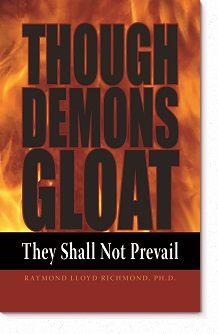
Though Demons Gloat: They Shall Not Prevail
by Raymond Lloyd Richmond, Ph.D.
Though we are attacked by liberal activists from without and by apostasy
from within, the true Church—that is, the body of those who remain
faithful to Church tradition—weeps, and she prays, because she knows
the fate of those who oppose God.
Our enemies might fear love, and they can push love
away, but they can’t kill it. And so the battle against them cannot be
fought with politics; it requires a profound personal struggle against
the immorality of popular culture. The battle must be fought in the
service of God with pure and chaste lifestyles lived from the depths of
our hearts in every moment.
More Information |
|
|




















 Read
an excerpt about spiritual blindness
Read
an excerpt about spiritual blindness Read an opinion of dissent
. . .
Read an opinion of dissent
. . .