On the
subject of purpose of marriage (procreation), how does it affect a married
couple whose children have grown and the wife is no longer of child-bearing
age? Is sex between the couple a sin? I am a Catholic and my husband is a
non-practicising muslim. This would make it a bit tricky explaining to him
why sex is not allowed anymore, as he is not bound by the Catholic faith.
But even if both of us were Catholic or Christian, do we need to refrain
from sex under pain of sin? I brought up this question because I could not
find a similar situation mentioned there. There were questions re couple
thinking of marrying at an elderly age, but none covering couples who were
already married.
|
 any individuals fail to understand
the essence of the Christian faith because they think about life issues in practical,
worldly terms. Hence they concern themselves more with outward behaviors—and to what
extent they can get away with them—than they are concerned with working out their
salvation with fear and trembling (Philippians 2:12b) by directing every aspect of
their inner motivation to protecting their souls from spiritual doom. The answer to
your question, therefore, does not require some statement about intercourse per
se; instead, it requires us to examine a deeper issue, the issue of
lust. any individuals fail to understand
the essence of the Christian faith because they think about life issues in practical,
worldly terms. Hence they concern themselves more with outward behaviors—and to what
extent they can get away with them—than they are concerned with working out their
salvation with fear and trembling (Philippians 2:12b) by directing every aspect of
their inner motivation to protecting their souls from spiritual doom. The answer to
your question, therefore, does not require some statement about intercourse per
se; instead, it requires us to examine a deeper issue, the issue of
lust.
Lust
We know that lust is a sin because
it is one of the seven deadly sins. Lust is
a sin precisely because it makes a person into an
object; that is, it sees another person in terms
of whatever pleasure that person can bring to you. Whereas
love wishes good to
someone,[1]
lust seeks your good at the use of someone. You can use a person
in actuality or in your imagination, but, either way, lust, being the opposite
of love, is an act of
hatred—and that obstructs a person’s
salvation.
Knowing this much about lust,
let’s ask a question: How is it possible to have intercourse without
making it into an act of lust?
How is it possible? Well, let’s
find out.
The
Possibility of Protection Against Lust
When a man and a woman engage
in intercourse within Holy Matrimony and with an openness to
procreation,[2]
(that is, with the desire to conceive a child) it is possible for them
to engage in a supreme surrender of the physical
to the spiritual and to a supreme yearning for the holy. This awareness of
the possibility of procreation, along with a profound spiritual
surrender, keeps God as the focus of their ecstasy,
and that holy focus on God banishes lust from the experience.
But notice that
possibility is one thing and actuality is another
thing.
For example, Christ told us to
love God with all our heart, with all our soul, and with all our mind (see
Matthew 22:34–40). Many Christians know this intellectually, but how
many of those who call themselves Christian actually
do this? How many of those who call themselves
Christian actually maintain a constant awareness of the presence of God and
pray constantly with their whole heart and their
whole soul? More often than not, prayer becomes a form of
duty rather than love from the heart. Consequently,
with constant prayer lacking, more often than not sexuality in marriage becomes a
form of lust, especially when the man demands it as an
act of marital
“service.”
So, in seeking an answer to the
question, How is it possible to have intercourse without making it into an act
of lust? ask yourself yet another question: Is my deepest
desire the purification of my heart and soul, or do
I seek merely the satisfaction of bodily pleasures?
Love and
Purification
The opposite of hatred (and lust)
is love, yet before we can enter into the pure love within the Kingdom of
Heaven we must be purified of all that is not genuine
love.[3]
Therefore, endeavor to make your mortal life a life of spiritual refinement,
directed to doing everything you can to grow in love and to avoiding
anything that contradicts love. This is important because after you die
you will have to pay for everything you have ever done that has contradicted
love.
No
Excuses
At the moment of your death,
you will find yourself standing before Christ in the light of divine truth.
Every act of your life will be accounted for. Truth will be absolute. There
can be no excuses, no deception.
|
Esau sold his
birthright for a serving of stew (Genesis 25: 29–34), and many Christians
today are just as willing to sell their birthright—their
baptismal birthright—for an
orgasm. |
|
So when you stand in the light
of that divine truth, will your baptismal promises be a shield for you or
will they be hanging from you uselessly in tatters?
In this regard, keep in mind
that right now your soul is your
responsibility. You will be held accountable
to the answers to those questions you asked yourself above.
Even if your husband is not Catholic,
you, as a Catholic, still have the obligation to live a holy life and
witness the Catholic faith, no matter what the
cost. You have the obligation to not let your husband tempt you into sin,
because, if you do, you will have to answer to Christ Himself, and there
will be no excuses.
Yes, you may be afraid of the cost
of choosing the holy path, but the cost you pay now to protect
yourself from lust will be hardly anything compared to the cost you will
have to pay later.
The Immaculate
Conception of Mary
The act of supreme yearning and
surrender to the divine has been expressed in beautiful theological precision
by the Venerable Anne Catherine Emmerich in her vision of the Immaculate
Conception of Mary. Mary was conceived in a moment of ecstasy between Anne
and Joachim—an ecstasy surpassing any physiological sign, an ecstasy
without lust, an ecstasy without sin.
|
 I
saw Joachim and Anne embrace each other in ecstasy. They were surrounded
by hosts of angels, some floating over them carrying a luminous tower like
that which we see in pictures of the Litany of Loretto. The tower vanished
between Joachim and Anne, both of whom were encompassed by brilliant light
and glory. At the same moment, the heavens above them opened, and I saw the
joy of the Most Holy Trinity and of the angels over the Conception of Mary.
Both Joachim and Anne were in a supernatural state. I learned that, at the
moment at which they embraced and the light shone around them, the Immaculate
Conception of Mary was accomplished. I was also told that Mary was conceived
just as conception would have been effected, were it not for the fall of
man.[4] I
saw Joachim and Anne embrace each other in ecstasy. They were surrounded
by hosts of angels, some floating over them carrying a luminous tower like
that which we see in pictures of the Litany of Loretto. The tower vanished
between Joachim and Anne, both of whom were encompassed by brilliant light
and glory. At the same moment, the heavens above them opened, and I saw the
joy of the Most Holy Trinity and of the angels over the Conception of Mary.
Both Joachim and Anne were in a supernatural state. I learned that, at the
moment at which they embraced and the light shone around them, the Immaculate
Conception of Mary was accomplished. I was also told that Mary was conceived
just as conception would have been effected, were it not for the fall of
man.[4] |
|

Notes.
1. St. Thomas Aquinas. Summa Theologica.
I-II, 26, 4.
2. Please note the word “openness” in
the phrase openness to procreation. This is not to say that every
sexual act must produce a child but that every sexual act should
express a desire to conceive a child. Without this desire to conceive a child the
sex act is merely an act of lust. Hence the fundamental meaning
of sexuality is in its procreative function—rather than as something
done for fun or sport or entertainment or to soothe feelings of loneliness.
To cast away the fundamental meaning of sexuality (as in masturbation, oral
sex, anal sex, artificial birth control, etc.) is to fall into grave sin. The
Catechism of the Catholic Church expresses it this way: “. .
. every action which . . . proposes, whether as an end or as a
means, to render procreation impossible is intrinsically
evil ”
(CCC 2370).
3.
Keep in mind this analogy: fire does not burn itself—only that which
is not fire is burned by fire. Thus, in the spiritual realm, God’s
love burns and torments whatever is not love. The fire of Purgatory
is God’s love purifying and burning out of repentant souls every worldly
attachment that is not love, until they become pure love. And the
fire of Hell is God’s love that burns and
torments unrepentant souls who are “not love” because in this life
they have chosen lifestyles defiant of love, thereby refusing the opportunity
to become love.
4.
The Life of Jesus Christ and Biblical
Revelations of the Venerable Anne Catherine Emmerich. Volume One, pp.
137–138. Text in public domain. Page citation from the edition by
TAN Books and Publishers,
Inc.
What the
Catechism of the Catholic Church says:
2351 Lust
is disordered desire for or inordinate enjoyment of sexual pleasure. Sexual
pleasure is morally disordered when sought for itself, isolated from its
procreative and unitive purposes.
Recommended
Reading
A treasure of a resource for psychological and spiritual healing. Information
gathered from my websites (including this webpage) is now available at your fingertips
in book form.
 |
|
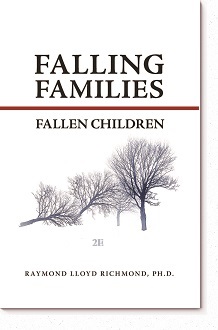
Falling Families, Fallen Children by Raymond Lloyd Richmond, Ph.D. Do
our children see a mother and a father both living in contemplative love for
God with a constant awareness of His presence and engaged in an all-out battle
with the evil of the world? More often than not our children don’t see living
faith. They don’t see protection from evil. They don’t see genuine, fruitful
devotion. They don’t see genuine love for God. Instead, they see our external
acts of devotion as meaningless because they see all the other things we do that
contradict the true faith. Thus we lose credibility—and when parents lose credibility,
children become cynical and angry and turn to the social world around them for
identity and acceptance. They are children who have more concern for social approval
than for loving God. They are fallen children. Let’s bring them back.
Ordering
Information |
|
|




















 Read
about Jesus’ teachings on marriage
Read
about Jesus’ teachings on marriage