|
|
|

Well,
then, are we justified by faith or by works?
 aint Paul says it quite clearly:
“. . . a person is not justified by works of the law
but through faith in Jesus Christ . . .” (Galatians 2:16).
And yet Saint James says, “What good is it, my brothers, if someone
says he has faith but does not have works? Can that faith save him?”
(James 2:14). Confused? Well, I don’t blame you. Let’s see, then,
what all this means in plain English. aint Paul says it quite clearly:
“. . . a person is not justified by works of the law
but through faith in Jesus Christ . . .” (Galatians 2:16).
And yet Saint James says, “What good is it, my brothers, if someone
says he has faith but does not have works? Can that faith save him?”
(James 2:14). Confused? Well, I don’t blame you. Let’s see, then,
what all this means in plain English.
Justification
Paul is speaking about
justification (which is also called
redemption). Our redemption is a gift from God
and totally unmerited on our part. There’s nothing we have to do—or can do—to earn
it or be worthy of it. To be redeemed is to be rescued—rescued from a life of slavery
to evil and sin. Thus no one can get into heaven through his or her own effort. God
is offering us a great gift of everlasting life, and only through faith in
Christ as the One who showed us the path to divine love can we receive that gift of
love.
Salvation
But notice that we are still
creatures of free will. Even with faith in Christ
we can still commit sin, if we will it. Saint James,
then, speaks about the matter of our
salvation. This amounts to saying that
even though we can’t get into heaven by our own efforts, we can easily
enough, through our own actions, send ourselves
right to hell. That’s why Saint Paul
tells us to “work out your salvation with fear and trembling”
(Philippians 2:12b).
Thus it can be said in summary
that redemption is a gift from God, worked
out through the sacrifice of Christ, while
salvation is a matter of our own personal
responsibility. If we accept the gift of redemption, renounce sin, and live a
holy lifestyle thereafter, until the
end, we will be saved from being excluded from
heaven.
The Truth that Refutes
False Beliefs
Persons who take statements from
the Bible out of context and therefore too literally can fall into a trap filled
with many false beliefs about the nature of our salvation. Below are some spiritual
truths that are often “disproved” by recourse to incorrectly understood
Biblical passages.
• |
God created us
good. Everyone is a sinner (Romans 3:23), dead in his sins (Ephesians 2:1),
full of evil (Mark 7:21-23), unable to understand spiritual truth (1 Corinthians 2:14),
does not seek for God (Romans 3:11), is a slave to his own sinful nature (Romans 6:14-20),
and is hostile in mind and deed to God (Colossians 1:21). These are all truths about
our fallen state, ut not about our true nature as created by God. It is a
Protestant self-deception to claim that we are inherently
evil. |
• |
Salvation is open
to all souls. When Saint John said that no one can come to God unless it has
been granted to him from the Father (see John 6:65), he did not mean that salvation is
open only to a select few predestined by God. He meant that we cannot fabricate our own
salvation and that we are all dependent on God’s grace, which is given to all.
Nevertheless, because of free will, not all of us are willing
to accept that grace. Those who do accept the grace of redemption can then take up the
task of working out their salvation with fear and trembling (Philippians 2:12b); hence
they are the “elect” in the sense that they belong to the community of
saints who through their free will have elected to seek their salvation from
hell. |
• |
Gender differences
are important in the Church. When Saint Paul said that there is neither Jew
nor Greek, neither bond nor free, and neither male nor female in Christ Jesus (see Galatians
3:28), he meant that there are no factions in the community of saints based in
nationality or race or gender. He did not mean that there are no differences in the
roles men and women have in the Church. |
• |
Salvation is not
guaranteed to any individual. When Christ said that His “sheep”
shall never perish and that no one can take them out of His hand (see John 10:27-28),
He did not mean that no Christian can fall away into doom.
He meant that those who stay faithful to Him will not perish;
hence, any Christian can perish who turns away from Christ through unrepentant
sin. Thus even though no exterior power can separate us from Christ,
when under the influence of temptation we can,
through our own free will, take ourselves out of His hands and send ourselves to
our doom. |
The Wedding
Banquet
Think of justification,
then, as a sort of ticket to the heavenly wedding banquet. Christ is our
ticket to that wedding banquet. He freely gives Himself to everyone. At the
door to the banquet, we are admitted when we present that ticket in faith.
No other ticket will be honored, nor can we earn a ticket through our own
efforts. But, even if we have a ticket, if we have not renounced sin and kept
His commandments to live a pure and fruitful
life—that is, if we have not put on the wedding garments
provided by Him—we will be thrown out of the banquet into the darkness
(see Matthew 22:1-14).
The Psychology
of Desire
Now, we might wonder why anyone
would refuse to put on the wedding garment that is so freely offered with
such grace. Well, here is where psychology comes into play. Our wills are
motivated by desire, and desire is largely
unconscious. In fact, it is through the “desire
of the Other”— such as in social media, movies, TV, music, and
advertising—that we become “infected” with the
evil of anti-Christian values
without even being aware of it. Moreover, there are
powerful, unconscious parts inside all of us that
are so terrified of abandonment and loss, and so caught up in
resentment and anger, that
they will refuse holiness itself in order to seize from the world any satisfaction
and pleasure they can get, pursuing their desires at all costs, even if the
ultimate cost is hell itself.
Well, that’s a terrifying
thought. It’s even more terrifying once you wake up and realize that
this sort of battle is really happening right now, right under your own
nose.
Spiritual
Battle
This battle, however, is not a battle
to overpower and defeat evil; the battle is a personal struggle to
keep evil out of your life. The entire Church Militant is faced with this spiritual
battle—but it cannot be fought just with a manual of prayers for you to
recite with your lips. Christ Himself taught us that the real weapon against evil must
come from deep within the heart: deny yourself.
Stop seeking self-gratification from secular pleasures and you will be immune
to the unholy desires of the corrupt world around you. As
you take up the humble task of
healing your darkest wounds by surrendering your
pride and defensive identity,
you can become aligned with God’s will. To do this, though, it will be necessary
to take hope in psychological purgation through
your own
dark night of soul.
That’s why Saint Paul, right
as he speaks about justification by faith, in the very same paragraph, emphasizes
this point: “I have been crucified with Christ” (Galatians 2:19).
Thus, unless your life ends in crucifixion—at
least, psychological crucifixion, the death
of ego and pride—you’re putting your salvation into your own hands,
not God’s. But if you accept your crucifixion freely and willingly
with chaste purity of heart and with ardent desire
for God’s love, you have all the hope and all the
mercy in the whole universe available to you in
the battle against evil.
Healing
Psychological Healing in the Catholic Mystic Tradition
by Raymond Lloyd Richmond, Ph.D.
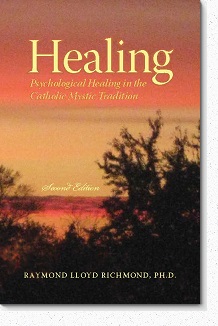 A treasure of a resource for psychological
and spiritual healing. Information gathered from my websites is now available at your fingertips
in book form with a comprehensive index. A treasure of a resource for psychological
and spiritual healing. Information gathered from my websites is now available at your fingertips
in book form with a comprehensive index.
Psychological defenses help to protect us from
emotional injury, but if you cling to the defense mechanisms that were created in your
childhood and carry them on into adulthood—as most everyone does unconsciously—your quest
for spiritual healing will be thwarted by overwhelming resentments and conflicts.
Still, God has been trying to show you that there is more to life than resentment and
conflict, something so beautiful and desirable that only one thing can resist its pull:
hate.
So now, and in every moment until you die, you will have a profound choice between your
enslavement to old defenses and the beauty of God. That decision has to come from you.
You will go where you desire.
More information
|