|
|
|

How
does one “give the pain to God”? Simply by praying those words?
How does one heal? What does “healed” mean—pain doesn’t
simply go away. It is the process of healing that I do not
understand.
 aying the words is a start, but
it’s not the whole process. So, to understand this, let’s look
first at what happens when you are hurt in some way. aying the words is a start, but
it’s not the whole process. So, to understand this, let’s look
first at what happens when you are hurt in some way.
Hurt
Most people react to hurt by immediately
trying to do something about it.
Physical injury often requires
some sort of physical treatment. Physical injury can also be treated, in
part, with mental imagery and prayer. A wound, for example, has to be cleaned
and bandaged and cared for with positive thoughts of its healing.
Emotional pain, however, presents
more of a problem. Many people treat emotional pain by hiding it; that is,
they do something self-gratifying—such as drink alcohol, use drugs,
have sex, gamble, watch TV or movies, eat sweets or fats, and so on—that
numbs the pain but that does nothing to heal it.
Many people also use anger and
revenge to respond to hurt.
Anger and
Revenge
We all feel hurt or irritated
when someone or something obstructs our needs or desires. Unlike the feeling
of irritation, though, anger is not truly an emotion. In its technical sense,
anger refers to the desire to “get even with”—that
is, to take revenge on—the cause of the hurt; revenge is an
act of carrying out that harm in some
way.[1]
|
Because anger
is not a feeling, it is possible to “be” angry even though you
do not feel anything. This is the problem with unconscious anger:
you don’t feel the anger, so, even as it works its poison in you, you
believe it isn’t even there. |
|
Revenge, therefore, can be enacted
both actively and passively. It can be enacted actively through hostility,
cursing, sarcasm, sexuality (adultery, promiscuity,
pornography, etc.), or disobedience. It can
also be enacted passively through disobedience as well as through
self-sabotage, drug or alcohol
abuse, obesity,
smoking, suicidality,
masturbation, or the
inability to achieve goals.
But, just as with hiding the
hurt, revenge does not heal the hurt either. That’s because all hurt,
at its core, is simply a reminder of your essential human
vulnerability and
helplessness. Even if you kill the person who
hurts you, you still remain vulnerable to another attack from someone else.
With all revenge, then, you might temporarily feel powerful, but the feeling
is just an illusion. No matter what you do,
you remain vulnerable to attack from anyone, anywhere.
Another
Option
 In contrast to all this
human illusion—and folly—you have another option. That is, when you are hurt,
you don’t have to fight back,
trying to hurt others as they have hurt you. If you trust in God’s
perfect justice to protect you, you can accept all
injury quietly, peacefully, and without grumbling or
protest. Despite your injuries, you can give patience,
understanding, compassion, forbearance,
mercy, and
forgiveness
to those who hurt you, all the while praying that
they will repent their wickedness. In contrast to all this
human illusion—and folly—you have another option. That is, when you are hurt,
you don’t have to fight back,
trying to hurt others as they have hurt you. If you trust in God’s
perfect justice to protect you, you can accept all
injury quietly, peacefully, and without grumbling or
protest. Despite your injuries, you can give patience,
understanding, compassion, forbearance,
mercy, and
forgiveness
to those who hurt you, all the while praying that
they will repent their wickedness.
Moreover, even if others continue to treat
you unfairly you can still achieve healing from your emotional and psychological wounds.
If you remember always that nobody—not even God—owes you anything, then you
will be able to grow in purity simply because you desire
healing, regardless of what others around you do.
So let’s learn the process by which
this can be done.
Transformation
Through Prayer
Emotional healing starts with your
taking up relentless, persistent prayer to God (and to the saints and angels
for their intercession) that you will grow in holiness; then it will be
necessary to force yourself to maintain a calm trust in God’s
protection and guidance despite your fears of admitting your own helplessness
and despite your impatience with things not happening as quickly
as you want.
HOW TO
STOP PANIC AND RAGE
The part of your brain
that pushes you into panic and rage when you experience emotional hurt is a primitive
part of the brain that understands behavior, not language, and that has been conditioned
by past traumas to equate emotional distress with
physical danger. When your body feels the first distress of emotional hurt, your
brain interprets it as a danger and sends a signal to your body to pump out fight-or-flight
chemicals that cause physiological arousal.
Now, if you believe that
there is a danger, and that you have to fight against it, you only encourage your
brain to keep on pumping out more fight-or-flight chemicals, and eventually this process
escalates and you succumb to an impulse of revenge. Moreover, you can’t stop the uproar
just by telling yourself to stop it. As I said before, the part of your brain that
pushes you into panic and rage when you experience emotional hurt doesn’t understand
language. It only understands behavior—and this brings us to the real solution to the
problem.
The only way to stop the
emotional uproar is to act deliberately in a way that tells your brain that there
is no danger. So, instead of fast, shallow breathing take long, slow, deep breaths. Instead
of staring around in a frenzy, close your eyes. Instead of clenching your muscles, loosen
them. Instead of allowing racing thoughts, set yourself some simple cognitive task,
such as counting backwards from 100—or pray the Jesus Prayer as described below. These
behaviors are body signals that tell your brain you are not in danger, and subsequently
your brain will shut down the fight-or-flight chemicals, and you will experience a calm
relief. |
To begin to heal your emotional wounds,
then, bow down before the Crucifix and, looking to divine
justice, surrender the pride of taking matters into
your own hands to avenge your hurts. In imitation of Him who accepted injury confidently,
quietly, peacefully, and, without grumbling or murmuring, say, “Lord, I am wounded.
I hurt. I am helpless. I am broken. I am vulnerable. Nothing I can do by my own hands can
protect me. Help me, for without your mercy and protection, I
will perish. Into your hands, O Lord, I commend my spirit. Help me to continue my work
in your service despite the fact that I feel [betrayed, abandoned,
unloved, insulted, falsely accused, etc.].”
Never forget that your tears are
prayers. Although your suffering does not have any
redemptive value—that is, it does not “make things right” between you
and God, nor does it make you “special” in God’s eyes—your ability
to suffer gracefully will lead to your spiritual growth. Let God, then, do what He
will to transform your suffering into courage and perseverance and trust.
VICTIMIZATION
AND CHILD ABUSE
Many persons,
especially those who have been abused emotionally, physically, or sexually
as children,[2]
tend to recoil from the idea of suffering, primarily
because they unconsciously
equate suffering with punishment—the
same unjust, unfair, and irrational punishment they received at the hands of their
abusers. It was this irrational punishment that caused their pain
to sink down into the terrifying depths of rage and
anger, to be hidden in the dark corners of the
unconscious, shrouded in victimization. Therefore, even as adults, there will
always be a child-like part of us who seeks some recognition of our pain and some
compensation for any hurt we suffer.
Consequently,
the resentment underlying this victimization can spawn either of two pernicious
attitudes to life: disobedience and false obedience.
In
disobedience, a person rebels openly against
authority, using tactics such as protest,
undermining of traditional beliefs, and
flouting of traditional moral values. Such
persons derive recognition from being seen as “free thinkers,” and
they derive compensation for their wounds from watching destruction come to others.
In false
obedience a person gives the appearance of obedience but instead of acting
from love acts from spite: “All right. So you’re going to
treat me miserably? Well, I’ll show you! I’ll take everything you can dish out and
I’ll take it without a murmur, even if it kills me. So there!” Such persons derive
recognition from seeing themselves as “victims,” and they derive compensation for
their wounds from unconsciously making destruction come upon themselves. Hence the danger here
is that such persons tend to slip into the belief that if only they suffer enough then those
who have been unfairly rejecting them will eventually be moved to accept them—and this
leads right into all the fruitless self-destruction of masochism.
 The biggest problem with masochism is
that it clings to the false belief that personal suffering is somehow redemptive, and so it
ignores the true redemption worked out in Christ’s passion, death, and resurrection.
Christ accepted all suffering willingly, not as a
victim,[3]
and, in carrying the cross, He bore for our sake the pain of all unfair, unjust,
and irrational punishment. He gave meaning to suffering. That is, He bore it all
openly and without anger for our redemption from
sin, and, in doing so, He showed us that real
love means the willingness to bear the emotional pain of others, suffering for them in
the hope of their salvation. The biggest problem with masochism is
that it clings to the false belief that personal suffering is somehow redemptive, and so it
ignores the true redemption worked out in Christ’s passion, death, and resurrection.
Christ accepted all suffering willingly, not as a
victim,[3]
and, in carrying the cross, He bore for our sake the pain of all unfair, unjust,
and irrational punishment. He gave meaning to suffering. That is, He bore it all
openly and without anger for our redemption from
sin, and, in doing so, He showed us that real
love means the willingness to bear the emotional pain of others, suffering for them in
the hope of their salvation.
If only you would
pray for others and take up your suffering as Christ did—not as
self-punishment, but as a gift of forgiveness to others—then you would
no longer need to hide your pain and you would no longer be
terrified of your own capacity for anger; then you
could listen honestly to your family and friends, to bear their anger without
flinching from it, and to help them heal their pain and take up their own
crosses.
This is hard work because
unconscious defensive patterns of behavior
get started in early childhood as protective mechanisms.
To fall into these patterns of behavior does not mean that you are “bad”; such
behavior can be changed through intense scrutiny (along with
psychotherapy, if necessary) and a constant
reliance on God’s mercy. |
Giving the Pain
to God
Pray, therefore, that the healing
process will happen within you. But pray for it
specifically:
• |
Ask God that you will be
enlightened. |
• |
Ask God for the courage to see
the truth of your life, especially its ugly and embarrassing resentments
and temptations, especially those that lurk in
the darkness of your unconscious. |
• |
Ask God for the strength to not
flinch from the pain of seeing the truth about yourself. |
• |
Ask God that everything you do
will be directed to your purification from anger and hostility and resentment
and victimization. |
Then, all it takes to give the
pain to God is to work through four successive phases of understanding whenever
you feel hurt.
Acknowledge
the Pain
Feel the hurt, rather than push
it out of awareness. Turn to Christ, and speaking to Him as you would speak
to another person, tell Him what happened, tell Him how you feel, and ask
Him for help.
If someone insults you, acknowledge
to yourself and to God
what that person did to you and admit that you feel belittled; if someone
cheats you, acknowledge to yourself and to God what that person did to you
and admit that you feel manipulated and vulnerable; if someone obstructs
you, acknowledge to yourself and to God what that person did to you and admit
that you feel helpless. And so on.
Admit your weakness, your
wretchedness, your
brokenness—and ask God for His
strength to carry you through despite your feelings.
|
I willingly boast
of my weakness, that the power of Christ may rest upon me. Therefore I am
content with weakness, with mistreatment, with distress, with persecutions
and difficulties for the sake of Christ; for when I am powerless, it is then
that I am strong. |
|
|
—2 Corinthians 12:9b-10 |
|
Mind you, this does not mean
disavowing human emotions; it’s a genuine
embracing of human emotional life in its full
reality—which leads us to the next
phase.
Relax
When you feel injured, it will
be humanly natural to want to take matters into your own hands to get revenge.
So pay attention to your fantasies of revenge.
Some of them will spring up right in front of you, but others will be hidden
in the depths of your unconscious, and you will be tempted to believe they do
not even exist and that you are “past” all
resentments. So use psychological and spiritual scrutiny to recognize those
fantasies, but resist the temptation to act on
them. When someone hurts you, resist the temptation to respond with sarcasm or
arguments or hostility or cursing—or self-blame
and self-punishment. Look to divine justice, not to bitter revenge.
And when things, rather
than other persons, obstruct you—such as traffic lights that turn red
when you’re in a hurry, or things that break when you’re under
pressure to get a job done—accept it quietly and
obediently as God’s wise intervention for your
guidance.
Just say, “All right. This
is teaching me something, and in due time I will understand. Right now I
don’t know why this is happening, but since this is what You want, then
I will accept it. I trust in You in all things. But it hurts! So please give
me the strength and courage to get me through this.”
|
What if it is
the devil tripping you up, rather than God intervening
for your instruction? How do you tell the difference? Well, you don’t
have to know the difference. Just accept everything gracefully as a glorious
act of obedience to God. If the devil trips you up and discovers that his
efforts result in glorifying God, he will get tired of you very quickly and
leave you alone. |
|
Be
Transparent
As you acknowledge and feel the
pain, let it pass through you into Christ’s hands, like sunlight through
a clean
window.[4]
Remember that whatever anyone does to you is done to Christ
Himself.[5]
When you are mocked, Christ is mocked; when you are cheated, Christ is cheated;
when you are abused, Christ is abused; when you are obstructed, Christ is obstructed.
Every sin inflicted on anyone is inflicted on Christ, and Christ alone has the power
to administer true justice for all injury. So put your wounds in His hands and
trust in His justice.
Healing is simply our return
to God in humility. There is no healing for our
brokenness except the broken bread of the Eucharist. There is no healing
except through Him who accepted all pain, quietly, peacefully, without grumbling
or murmuring—for our sake. There is no healing except in
forgiveness.
|
But if you do
not
forgive others, neither will your Father forgive your
transgressions. |
|
|
— Matthew 6:15 |
|
|
|
For the judgment
is merciless to one who has not shown
mercy. |
|
|
— James 2:13 |
Pray
After acknowledging and feeling
the pain, resisting the temptations to revenge, and letting the pain pass
through you, then pray. To give the pain to God is to stop trying to take
matters into your own hands—by hiding your pain, by dwelling on resentments,
by protest, or by plotting revenge—and instead
to pray for those who hurt you and to pray that you will learn to approach
God in humility so as to accept the true and perfect healing He offers us.
So pray for your enlightenment—and pray for the repentance of those
who hurt you.
|
 It is not always within
your power to control your feelings. You will recognize that you have
love if, after having experienced annoyance and
contradiction, you do not lose your peace, but pray for those who have made
you suffer and wish them well. It is not always within
your power to control your feelings. You will recognize that you have
love if, after having experienced annoyance and
contradiction, you do not lose your peace, but pray for those who have made
you suffer and wish them well. |
|
|
—as told to Saint Faustina,
Diary, 1628 |
|
Pray also for those around you.
For example, if you’re stuck in a long line at the post office because
of a rude clerk, pray for the clerk and pray for the persons in line
with you who have to suffer also. Good short prayers to be repeated over
and over would be
• |
Father, forgive
them, they do not know what they do.
(Luke 23:34) |
• |
Lord Jesus
Christ, Son of God, have mercy upon me.
or
Lord Jesus, have mercy upon me.
(The Jesus Prayer) |
• |
Holy God, Holy
Mighty, Holy Immortal, have mercy on me.
(The Trisagion prayer) |
• |
O Blood and
Water which gushed forth from the Heart of Jesus as a fount of Mercy for us,
I trust in You.
(Saint Faustina’s Diary, 187) |
A good longer prayer would be
the Chaplet of The Divine Mercy.
“Offer it
up!”
These three words—“Offer
it up!”—have probably done as much damage to the Catholic faith
as they have done good. In its purest sense, the expression “Offer it
up!” means the same thing as giving the pain to God. But “Offer
it up!” has also become a cliché. Most Catholics recognize the words,
and many Catholics say the words, but more often than not all they really “offer
up” to God is a shell of colorful piety filled with
hidden resentment for being a victim.
Unless you “offer up”
your pain with genuine love it is meaningless, and
you cannot offer it up with genuine love unless you have acknowledged your
helplessness and weakness, recognized the resentments that lurk deep within your
unconscious, rejected the urges to revenge that
tempt you, made the conscious and humble decision to trust in God’s
justice, and then have prayed for purification.
So beware. Real spiritual healing
is more than a cliché—it’s hard work.
It’s
Really Hard Work
It’s important to realize
here that when you feel an insult, it can actually take several hours to
calm down. Even though you acknowledge the feelings and the thoughts and
tell God that you want to pray for the person and don’t want to fall
into sin, you might still be assaulted with temptations to revenge for several
hours following the insult. It can become a huge battle, but every temptation
has to be met with the same technique: acknowledge the feelings and the
thoughts and tell God that you want to pray for the person and don’t
want to fall into sin. Over and over and over.
One additional technique I have
found that helps in such a circumstance is to say the
Jesus prayer (Lord Jesus Christ, Son of God,
have mercy upon me!) over and over as a way to prevent yourself from thinking
any other thoughts. So when you’re injured, make the initial acknowledgment;
refuse to do anything sinful, no matter how much the temptations intrude
into your mind; pray the Jesus prayer; continue to refuse to do anything
sinful, no matter how much the temptations continue to intrude into your
mind; and continue to pray the Jesus prayer; and keep doing it all for as
long as necessary. Eventually, the temptations will dissipate. Then give
thanks to God for helping you get through it. And give yourself credit for
persevering!

Notes.
1.
In all things, God desires us to treat each other with the same love He has
for us. Therefore, wanting someone to be emotionally or physically hurt removes
you from God’s service and places you in the service of the devil.
Consequently, just the thought of hurting someone is a sin—but being
a venial sin (so long as it is an inner
desire, rather than an outward act) it can be absolved with
perfect contrition. An actual act of
revenge toward another person that results in real harm is a
mortal sin, and must be absolved formally
through the Sacrament of Reconciliation.
Unrepentant sin will condemn a soul at the
Last Judgment. Note that this condemnation is a truthful assessment of the
soul’s unholy behavior, not a desire on God’s part for
revenge.
2.
Many persons have to struggle with the suspicion that they may have been
sexually abused in the past, and many of them will never know for sure if
any abuse actually happened. The psychological/spiritual task here is for
them to acknowledge the emotional pain they feel now, to recognize the conflicts
that the pain causes (e.g., impulses to promiscuity, pornography, masturbation,
etc.), and to then work to overcome the urge to take revenge on the world
now because of what they have suffered in the past.
Note that worrying about whether any abuse actually happened
won’t help you. Nor will trying to get the suspected person(s) to admit the
truth help you. The best thing to do is vow to yourself and to God that, regardless
of what others around you do, you will purge dishonesty
and lust from your life.
3.
Christ was, and is, a victim in the ancient sense of the term,
which referred to an animal offered in sacrifice: as the Paschal Lamb, Christ
willingly offered Himself in sacrifice on the cross for our
salvation. Keep in mind, though, that in His
sacrifice, Christ neither lost anything nor was He cheated or duped. He did,
however, “cheat” death of its power over us, and, in that sense,
death itself was made a “victim” of His sacrifice.
4.
The more clean the window, the less the glass will heat up from the light.
But no window can be perfectly clean. The more dirt on the window, the more
it will heat up—that is, the more unconscious anger there is hidden
in your heart, the more emotional anguish and turmoil you will feel because
of any injury. Conversely, the more psychological work you have done to clean
out your unconscious resentments, the more confidently and gracefully you
will bear the Cross.
5.
“Then He will say to those on His left, ‘Depart from Me, you accursed,
into the eternal fire prepared for the devil and his angels. For I was hungry
and you gave Me no food, I was thirsty and you gave Me no drink, a stranger
and you gave Me no welcome, naked and you gave Me no clothing, ill and in
prison, and you did not care for Me.’ Then they will answer and say,
‘Lord, when did we see You hungry or thirsty or a stranger or naked
or ill or in prison, and not minister to Your needs?’ He will answer
them, ‘Amen, I say to you, what you did not do for one of these least
ones, you did not do for Me’” (Matthew 25:41-45). Remember, too,
that, at the height of Saul’s persecution of Christians, Christ asked
him, “Why are you persecuting Me?” (Acts 9:4).

Healing
Psychological Healing in the Catholic Mystic Tradition
by Raymond Lloyd Richmond, Ph.D.
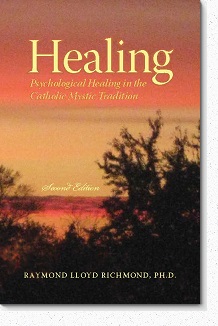 A treasure of a resource for psychological
and spiritual healing. Information gathered from my websites is now available at your fingertips
in book form with a comprehensive index. A treasure of a resource for psychological
and spiritual healing. Information gathered from my websites is now available at your fingertips
in book form with a comprehensive index.
Psychological defenses help to protect us from
emotional injury, but if you cling to the defense mechanisms that were created in your
childhood and carry them on into adulthood—as most everyone does unconsciously—your quest
for spiritual healing will be thwarted by overwhelming resentments and conflicts.
Still, God has been trying to show you that there is more to life than resentment and
conflict, something so beautiful and desirable that only one thing can resist its pull:
hate.
So now, and in every moment until you die, you will have a profound choice between your
enslavement to old defenses and the beauty of God. That decision has to come from you.
You will go where you desire.
More information
|






















 Read
the story of Saint Francis of Assisi
Read
the story of Saint Francis of Assisi