|
|
|

I am
a Presbyterian minister and found your comments and statements very illuminating
in my study of the book of Jonah. When I preach through a book, I always
try to ask “why” questions, to get beyond the surface issues to
the truth that sometimes hides on a deeper level. Jonah is certainly a book
about following God’s direction and leading, but I wanted to know why
Jonah made so many suicidal references in this short book.
I found in your comments about Depression and Suicide a helpful description
of Jonah. From a pastoral perspective, my observation is that Jonah definitely
had suicidal attitudes throughout the book. But the encouraging thing is
that even with Jonah’s sometimes skewed perspective, God used him to
communicate a very helpful message to the Ninevites. They heard Jonah’s
warnings and desired to make moral sense of their lives and to respond to
God’s mercy. Having at least two people in my congregation who have
attempted suicide, it will be an encouraging message (to them and others
in the congregation) that God often makes our lives a blessing to others,
even when we can’t see past our own struggles.
|
 ou’re welcome. ou’re welcome.
Actually, the full theological
value of the story of Jonah goes deeper even than your interpretation. Look
at the part about the gourd plant near the end of the story. Jonah was
“happy” when it was growing; he became “angry” when it
died. This is a perfect example of the “love-hate flip-flop” that
I describe on the
Sexuality—and Love
page of A Guide to
Psychology and its Practice. When the infant’s needs are met,
it “loves” the mother; when its needs are frustrated, as when the
mother gives attention to something—or someone—else, the infant
“hates” the mother. Moreover, this throws the infant into a profound
conflict. To hate someone it needs puts it at risk of being abandoned by that
person; therefore, as I say on the
Depression and Suicide
page of A Guide to Psychology and its Practice, the infant will
feel guilty and decide that it is really to blame and therefore is worthless and
deserves to die. Then all that anger and hate
gets turned against itself in depression and suicide.
In the story of Jonah, this
“love-hate flip-flop” was directed at God.
Anger at
God
So why was Jonah
angry with God? Well, let’s go back to the
beginning of the story. Jonah was jealous that God would want to show mercy
to Nineveh. He was jealous that God would turn His attention away from Israel
and show concern for another people. So Jonah ran from God, in
anger—and with feelings of suicide. The suicidal feelings, if put into
words, would have said, like a jealous child, “I’m angry that I
am not the center of Your attention. If You can care about Nineveh, then
I am worthless and deserve to die.”
|
A suicide
attempt—whether completed or not—is therefore a
sin against the Holy Spirit because it amounts
to a refusal to believe God’s offer of mercy to all sinners and
a refusal to listen to God who, through the death—and resurrection—of
His very Son, has sealed the Word of His promise forever. Hence Jonah’s suicidal
feelings were in effect a refusal of mercy. |
|
A Mission of
Love
Hence God, in His mercy, gave
Jonah a bitter taste of the death he thought he wanted: he was swallowed
by a fish. Then God rescued him. Momentarily encouraged by this, Jonah went to
Nineveh as he was commanded and called the city to
repentance as he was commanded. Astonishingly,
everyone in Nineveh actually repented. They repented even before Jonah got
a third of the way through the city. Jonah was shocked; and then he fell back
into jealousy.
|
This explains
the essence of jealousy: in your fear of losing what you desperately
want, you hate any person who might come
between you and what you want.
But in real love
there is no jealousy. Real love is a matter of giving, not getting. So when
you have nothing to lose, and nothing to gain, how can you fear a
“rival”? |
|
Jonah, therefore, needed to learn
something about real love. God, then, had to use the gourd plant to show Jonah
what the mission was all about. It was about
love. “As you loved that plant, so I love the
world,” God told him. “And I love Nineveh, and I love even the
cattle of Nineveh.” And we can understand here God’s unspoken
implication to Jonah: “And I love you.”
Thus the true nature of
mercy was revealed: To deny mercy to others
is to deny it to yourself.
But this isn’t
all.
True Love Calls
Us to Repentance
Mercy—and love—are
not just a matter of all-inclusive acceptance. It’s not just a psychological
matter of saying, “I’m OK, you’re OK.” Yes, God loves
us, but our sins separate us from Him.
True love, therefore, calls us away from sin and
into repentance. True love doesn’t just say, “Come, and join us.”
It also calls people to repent their sins and to
live a pure and holy life thereafter. God
used Jonah to preach to Nineveh, and then, using the gourd plant as a metaphor,
He preached to Jonah himself. Real love calls people to you so that you can preach
to them to change their behavior; real love wishes the good of others; real
love is about giving, not getting.
This is a very heavy obligation
for anyone who claims to live the Gospel today.
It really means that you have to stand up to everything in the entire
society—to all of “Nineveh,” even the cattle—and preach
the truth about sin. Remarriage after divorce is legal,
but it’s still a sin. Abortion is legal in many places, but it’s still a sin. Artificial
contraception is legal, but it’s still a sin. Sodomy is legal, but it’s
still a sin. Even pornography is legal, but it’s still a sin. Our whole
culture is rooted in sin.
Thus you, being an instrument
of God like the worm in the gourd plant, must show people that the things
they “love” are, first of all, just
illusions that hide their unconscious resentment
and anger at God. In addition, all these illusions
are just a way to deny God’s mercy to others. Because if you fail to
tell others that they are living in sin they can’t repent, can they?
If you fail in this, they will be destroyed—and you, through your obstinate
disobedience, will die a slow spiritual suicide
and will be destroyed as well.

Healing
Psychological Healing in the Catholic Mystic Tradition
by Raymond Lloyd Richmond, Ph.D.
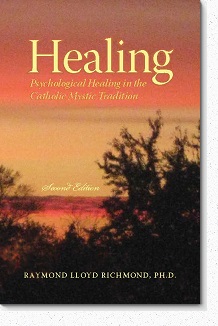 A treasure of a resource for psychological
and spiritual healing. Information gathered from my websites is now available at your fingertips
in book form with a comprehensive index. A treasure of a resource for psychological
and spiritual healing. Information gathered from my websites is now available at your fingertips
in book form with a comprehensive index.
Psychological defenses help to protect us from
emotional injury, but if you cling to the defense mechanisms that were created in your
childhood and carry them on into adulthood—as most everyone does unconsciously—your quest
for spiritual healing will be thwarted by overwhelming resentments and conflicts.
Still, God has been trying to show you that there is more to life than resentment and
conflict, something so beautiful and desirable that only one thing can resist its pull:
hate.
So now, and in every moment until you die, you will have a profound choice between your
enslavement to old defenses and the beauty of God. That decision has to come from you.
You will go where you desire.
More information
|