|
|
|

One
question... not to challenge you... I am looking for understanding. You write
that saints love in a real way meaning they give up all carnal things in
the world, even identification about themselves, even anger at God which
is a human emotion at times. Then, your psychology website consistently talks
about acknowledging human feelings or emotions to heal fragmentation but
on the other hand, you write that feelings of simple love, defenses, bribery,
victim thinking, etc. are illusions opposed to real love. So what are saints
giving up if everything in the world is an illusion and that our very humanness
itself is to be denied as an illusion? It would seem harder (greater love)
to acknowledge such gifts from God, such difficult choices as being fully
human as God created us and loves us instead of denying their existence as
though we are not human.
 ctually, our very humanness itself
is not to be denied as an illusion. Christ made that perfectly clear
to us: ctually, our very humanness itself
is not to be denied as an illusion. Christ made that perfectly clear
to us:
Though He was
in the form of God,
Jesus did not deem equality with God
something to be grasped at.
Rather, He
emptied [1]
Himself
and took the form of a slave,
being born in the likeness of men.
He was known to be of human estate,
and it was thus that He humbled Himself,
obediently accepting even death,
death on a cross! |
—Philippians 2:6-8 |
So, given that the humanity of Jesus
is both theologically and psychologically true, what do the saints give up when
they give up “carnal things in the world” if they aren’t denying the humanity that
Christ embraced for our redemption?
Psychological
Defenses
Well, when the Saints—or any
Christians—give up “carnal things in the world,” they are not denying their
humanity; instead, they are giving up their
psychological defenses, because psychological
defenses [2] are illusions. They are illusions
because they are based in all the “carnal things in the world”
that we use to cover over and hide our weakness
and vulnerability—the truth about our humanity—rather than accept
our cross and turn to God for protection.
The psychoanalyst Jacques Lacan
taught that “I” is an illusion. Illusions fill a person with repetitive assertions
of what “I want” and what “I need” and what “I deserve” and what “I fear.” To overcome
these illusions, individuals must turn their attention to what they can give to
others—that is, to all the emotionally wounded individuals in this world—through
personal sacrifice and prayer. This, after all, is what true love is all about, and
illusions, in one way or another, do their psychological best to maintain the
fear of love.
|
In the field
of psychology and psychoanalysis, only one psychoanalyst,
Jacques Lacan, clearly understood and
articulated the
unconscious
aspects of our human brokenness. Psychoanalysis, though, can offer no healing
from this wretched state of being; all psychoanalysis can do is encourage us
to face our being through an honest awareness of its lack. Real
healing for our brokenness comes only from Christ
in the broken bread of the Eucharist, but as long
as we keep defending our own unconscious attempts to protect ourselves from
emotional pain, we will never be able to allow Christ to heal us. |
|
Therefore, in turning to illusions
to protect what “I” want, we turn away from true
love. And when we turn away from true love we
hide from God in sin. And
when we hide from God, we aren’t fooling anyone but
ourselves.
|
Most of us have
more psychological defenses than we have faith. Just try telling some of
those “devout Catholics” that they are lacking in faith, and the
anger, bitterness, and
victimization that they spew back at you only prove
the point that their faith is really lacking. |
|
The saints are those who have
simply decided to stop fooling themselves. They have repented the folly of
defensive illusions and have embraced the true Faith.
And embracing the true Faith they embrace their humanness fully, freed from
slavery to sin, as God intended our humanness to be embraced: by pure, divine
love.
Becoming a
Saint
So how do you become a saint?
Is it even possible? Of course it’s possible—and everyone
is called to it.
|
Whoever wishes
to come after Me must deny himself, take up his cross, and follow Me. For
whoever wishes to save his life will lose it, but whoever loses his life
for My sake will find it. |
|
|
—Matthew 16:24-25 |
|
|
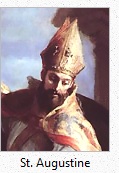 This is not a command for
virgins to obey and brides to ignore, for widows and not for married women,
for monks and not for married men, or for the clergy and not for the laity.
No, the whole Church, the entire body, all the members in their distinct
and varied functions, must follow Christ. . . . They must
take up their cross by enduring in the world for Christ’s sake whatever
pain the world brings. This is not a command for
virgins to obey and brides to ignore, for widows and not for married women,
for monks and not for married men, or for the clergy and not for the laity.
No, the whole Church, the entire body, all the members in their distinct
and varied functions, must follow Christ. . . . They must
take up their cross by enduring in the world for Christ’s sake whatever
pain the world brings. |
|
|
—from a sermon
by St. Augustine, bishop
Office of Readings, Common of Holy Men |
|
Therefore, if you really want
to be a Christian, you must lose your life for Christ’s sake—you
must “die” to yourself in baptism and remain faithful thereafter
to your baptismal promises.
And most likely you were baptized
as an infant and have long since forsaken those
promises.
Now, then, it’s time to
turn back to those promises before it’s too late.
|
Every sin you
commit after your baptism will be accounted for, and you will
pay for them all, either in Purgatory or in hell,
depending on whether you repent or not.
It’s all your choice. |
|
Dying to the
Self
You can begin this process
psychologically by acknowledging your “human
feelings or emotions”—all of them: the good, the bad, and the
“ugly”. See them for what they are in their full
reality. Look clearly at the childhood wounds you
have suffered from family dysfunction: the
lies, the game-playing, the manipulation, the hypocrisy.
Then see your psychological
defenses—the defenses that protect you from honestly acknowledging the
truth of your emotional pain—for what they are, in their
full reality. Open your eyes and stop hiding from yourself: stop defiling
your own body, and stop using other persons as
objects for your own
narcissistic fulfillment.
Then
detach yourself from all the self-indulgent
satisfactions of the social
world that, until now, have pushed God out of your life, causing you,
despite your baptism, to live just as any other
“Gentile” in a world of modern “Gentile”
impurity.
|
So I declare
and testify in the Lord that you must no longer live as the Gentiles do,
in the futility of their minds; darkened in understanding, alienated from
the life of God because of their ignorance, because of their hardness of
heart, they have become callous and have handed themselves over to licentiousness
for the practice of every kind of impurity to excess. That is not how you
learned Christ—assuming that you have heard of Him and were taught in
Him, as truth is in Jesus, that you should put away the old self of your
former way of life, corrupted through deceitful desires, and be renewed in
the spirit of your minds, and put on the new self, created in God’s
way in righteousness and holiness of
truth. |
|
|
—Ephesians 4:17-24 |
|
This, then is what
“dying to the self” and being
“born again” is all about: putting
away the old self, along with all its illusions, and putting on a new self
in Christ. But beware—this is not a mere intellectual idea;
it’s something you must do from
the depths of your being. It means becoming an instrument of God’s will,
dedicating your being and your talents completely to the salvation of
others.
Furthermore, to remain pure,
remain obedient to the
teachings of the Church, even though the
world—and other Catholics—will crucify you for your
faith. Feel all the pain of the
broken human
world that will persecute you for your fidelity to
the Truth, and then, without seeking revenge for your injuries, entrust the
pain to God’s justice. Turn to God in all things;
pray constantly for God’s
mercy, and give mercy to others.
If you do all this you will be
living a chaste and pure life of
humility, freed from illusions, and capable of
true love.
It’s all very simple, it’s
all very real, it’s all very true to the human experience—and it
all derives from divine love.
Blessed are the
pure of heart, for they will see God. |
—Matthew 5:8 |

Notes.
1. The Greek word translated
here as “empty” is kenosis, a great mystery that illustrates
the process of divine love seen not just in the Incarnation but also in the
giving of the Holy Spirit. And, behind all of this, stands God’s emptying
of Himself in His act of creation, a pure act of love.
2. Sadly, persons untrained in
psychology have a tendency to scoff at the idea of unconscious defenses.
“That’s ridiculous. My life isn’t controlled by
defenses. I’m not secretly afraid of the world!” Therefore,
such persons have three choices. They can enter psychotherapy and find out
for themselves that what I say is true. Or they can submit to spiritual
purgation, as described by Saint John of the Cross, and as I explain on this
website, let the Holy Spirit show them what is true. Perhaps, like Saint
Catherine of Genoa, they will find “many natural desires destroyed within
me which had previous seemed to me very good and perfect; but when they were
thus removed I saw that they had been depraved and faulty,
and . . . which, being hidden from me, I had not supposed
myself to possess” (Life and Doctrine, XXIV). And the third option?
They can continue to believe that saintliness is a “denial of
humanity,” and in the process they can essentially deny their capacity
for holiness. In that case, they will have to stand on that terrible day
before Christ the Judge and find out the hard way what’s true and what
isn’t.
Healing
Psychological Healing in the Catholic Mystic Tradition
by Raymond Lloyd Richmond, Ph.D.
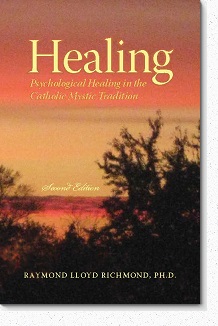 A treasure of a resource for psychological
and spiritual healing. Information gathered from my websites is now available at your fingertips
in book form with a comprehensive index. A treasure of a resource for psychological
and spiritual healing. Information gathered from my websites is now available at your fingertips
in book form with a comprehensive index.
Psychological defenses help to protect us from
emotional injury, but if you cling to the defense mechanisms that were created in your
childhood and carry them on into adulthood—as most everyone does unconsciously—your quest
for spiritual healing will be thwarted by overwhelming resentments and conflicts.
Still, God has been trying to show you that there is more to life than resentment and
conflict, something so beautiful and desirable that only one thing can resist its pull:
hate.
So now, and in every moment until you die, you will have a profound choice between your
enslavement to old defenses and the beauty of God. That decision has to come from you.
You will go where you desire.
More information
|




















 Read an excerpt about spiritual blindness