|
|
|
Most Catholics
have some knowledge of the Faith.
Some Catholics have much knowledge of the Faith.
But very few Catholics have faith. |
 |
Fear |
Reverence for the Mass |
Spiritual Counsels |
Books |
About CSF
 NITY
. It sounds like a
nice concept. We pray for it in every
Mass. We hold it up today as a concept to be defined
by scholars and ecclesiastics through theological dialogue. But what is
unity? Does it mean that with one mind we should embrace a multitude
of realities, truths, beliefs, faiths, and doctrines? Well, no. Unity does
not come through heresy and
disobedience. Unity—real unity—comes
from one thing and one thing alone: oneness. That is, Christian unity comes
from oneness with God as expressed by one reality, one truth,
one belief, one faith, and one doctrine. NITY
. It sounds like a
nice concept. We pray for it in every
Mass. We hold it up today as a concept to be defined
by scholars and ecclesiastics through theological dialogue. But what is
unity? Does it mean that with one mind we should embrace a multitude
of realities, truths, beliefs, faiths, and doctrines? Well, no. Unity does
not come through heresy and
disobedience. Unity—real unity—comes
from one thing and one thing alone: oneness. That is, Christian unity comes
from oneness with God as expressed by one reality, one truth,
one belief, one faith, and one doctrine.
 here is only one
REALITY: God, the creator of heaven and earth,
who has revealed Himself to us as the Trinity of Father, Son, and Holy
Spirit. here is only one
REALITY: God, the creator of heaven and earth,
who has revealed Himself to us as the Trinity of Father, Son, and Holy
Spirit.
here is only one
TRUTH: that no soul can stand in God’s
presence unless, purged of all self-interest and
impurity, it becomes love, as God is
love.
|
All religions
have some truth to them. Through natural human reason even non-Christian
religions have independently discovered elements of truth. But every soul,
no matter what religion it practices in this life, will, at the moment of
its death, be judged according to its fulfillment
of the commands of Christ. Therefore, only the Catholic Church, which has
faithfully preserved the teachings of Christ, has all the
truth.[1]
Some persons
say, “There is no absolute truth.” Yet that statement in
itself is a declaration of absolute truth. Therefore, object as they
will to the absolute truth preserved by the Church, these persons make objections
that invalidate only themselves. |
|
here is only one
BELIEF: that Jesus is the Christ: the Messiah,
the Son of God (John 11:27; 20:31).
here is only one
FAITH: that Jesus the Christ died for our sins;
that by repenting our
sins and being baptized
in the name of the Father and of the Son and of the Holy Spirit we are cleansed
of past sins; and that by living a holy life
thereafter and persevering to the end we will
be given to enter into God’s presence.
|
Nor did the Lord
need our service. He commanded us to follow Him, but His was the gift of
salvation. To follow the Saviour is to share in
salvation; to follow the light is to enjoy the light. Those who are in the
light do not illuminate the light but are themselves illuminated and enlightened
by the light. They add nothing to the light; rather, they are beneficiaries,
for they are enlightened by the light.
The same is true of service to God: it adds nothing to God, nor does God
need the service of man. Rather, He gives life and immortality and eternal
glory to those who follow and serve Him. He confers a benefit on His servants
in return for their service and on His followers in return for their loyalty,
but He receives no benefit from them. He is rich, perfect and in need of
nothing.
The reason why God requires service from man is this: because He is good
and merciful He desires to confer benefits on those
who persevere in His service. In proportion to God’s need of nothing
is man’s need for communion with God.
This is the glory of man: to persevere and remain in the service of God.
For this reason the Lord told His disciples: You did not choose Me but
I chose you. |
|
|
—from the treatise Against
Heresies
by Saint Irenaeus, bishop
Office of Readings,
Saturday after Ash Wednesday
|
|
God, therefore, does not need
our praises. But we need our praises of Him. So
even though, in our wretched sin, we really deserve
nothing but
condemnation [2]—Christ
has told us what we must do to claim this unfathomable gift:
deny yourself, take
up your cross, and follow Me (Matthew 16:24).
True faith, therefore, is not
blind faith. Faith is not just a deadening of emotions, a
defense created in childhood as a response
to feelings of rejection. True faith requires that you can say, consciously
and willingly, “Despite what I’m feeling—despite the
fact that I feel [uncertain, confused, vulnerable, inadequate,
etc.]—I trust in You, Lord.”
|
Consider the
difference between the blind man of Bethsaida (Mark 8:22–26), whose
cure required that Christ lay His hands on him a second time, and the woman
with a hemorrhage (Mark 5:25–34) who was cured instantly by merely touching
Jesus’ cloak. What was the difference between them, such that one cure
took repeated effort, and the other cure happened immediately? Their depth
of faith.
|
|
here is only one
DOCTRINE: the doctrine
of the Catholic Church, by which Reality, Truth, Belief, and Faith are preserved
and taught.

 HIS IS ALL
SO SIMPLE that
one has to wonder why Christianity has become such a cause for schism and
protest and so encrusted with academic
intellectualism. HIS IS ALL
SO SIMPLE that
one has to wonder why Christianity has become such a cause for schism and
protest and so encrusted with academic
intellectualism.
So why is the Church stained
with schism and heresy? Well, the answer can
be found in one word: love.
In its essence,
love requires that we not use others for our personal
pleasure but that we forsake our own pleasures in order to seek the good
of others. And the “good” of others means their
salvation through their
“death” to the sins of the world.
After all, that’s how Jesus lived his public ministry, right? In His
journey to the Cross, as He called us to repent our sins—for our
good—He had no possessions and no place to lay His head. He was even
buried in a tomb prepared for someone else. In His life and death Jesus proved
to us that love is self-sacrifice.
But to most persons today
“love”
means satisfaction. It means
happiness. It means having one’s emotional
emptiness filled with, well . . . just about anything, as
long as it’s filling. It means “I’m OK, you’re OK.”
In all its meanings, “love” means self-indulgence.
But in this definition of
“love” cleverly constructed to suit popular
culture, something is missing: sin. In a popular
culture of narcissism in which anything that serves the “self”
is acceptable, sin—the narcissistic preoccupation with immediate desires
that leaves little, if any, altruistic awareness of anyone or anything else
in the environment—is robbed of its definition And that’s precisely
where everything goes wrong; when anything is socially permissible, real
love is trumped and defiled by common love.
Many persons can accept the one
Reality, for it’s easy enough merely to acknowledge that God
exists. These persons, however, will use every psychological
defense mechanism in the book to
avoid seeing the
TRUTH, because, if they did see it, they would
have to repent and change their lives—and
that’s just too . . . well, inconvenient. So once we
hide sin to remove it from the picture, then
TRUTH becomes
diversity. “What’s
impurity?” we say. “God is love. God created everything. Everything
is good and pure.” And with purity diluted to the point of irrelevance,
then
BELIEF collapses. “Jesus was a good man,
like Buddha and John Lennon . . .”
So there you have it. When Truth
becomes diversity, we have schism and protest.
When
BELIEF collapses into relativism, we need academics
to offer clever interpretations of the rubble. And where, then, does that
leave
FAITH? That’s what Jesus asked. “But
when the Son of Man comes, will He find faith on earth?” (Luke
18:8).
|
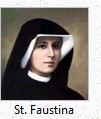 |
How sad it is,
O Jesus, when we ourselves are the cause of the loss of graces. Whoever
understands this is always faithful. |
|
|
—Saint Faustina
(Diary, 690) |
|

Notes.
1.
Nevertheless, many, if not most, so-called Catholics today disavow the teaching
of the Church and live in a pathetic state of
unforgivable sin. But this is not the fault
of the Church herself. It is the fault of bishops,
priests, and deacons who refuse to preach and teach the true faith; it is
the fault of the laity who refuse to study and learn
the true faith; and it is the fault of parents who allow their children to
be brainwashed by the heathen
society around them.
2.
Because our souls do not perish at the death of our bodies, each soul must
seek out it’s own fitting place in the spiritual realm. Souls who separate
themselves from God in this life by persisting in sin and refusing to repent
of it will have no choice but to hide themselves from God in the
afterlife—and that “place” of eternal separation from God,
to which the soul’s own sins condemn it, is called
hell. Souls who do repent of their sins in
this life and seek reparation through Christ’s mercy will, after first
being cleansed in Purgatory, be received into
God’s presence—and that “place” is called
Heaven.
The text of
this webpage, integrated with other material from my websites,
has been conveniently organized into a paperback book of 350 pages, including
a comprehensive index.
 |
|
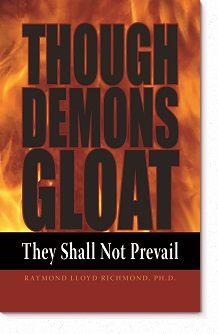
Though Demons Gloat: They Shall Not Prevail
by Raymond Lloyd Richmond, Ph.D.
Though we are attacked by liberal activists from without and by apostasy
from within, the true Church—that is, the body of those who remain
faithful to Church tradition—weeps, and she prays, because she knows
the fate of those who oppose God.
Our enemies might fear love, and they can push love
away, but they can’t kill it. And so the battle against them cannot be
fought with politics; it requires a profound personal struggle against
the immorality of popular culture. The battle must be fought in the
service of God with pure and chaste lifestyles lived from the depths of
our hearts in every moment.
Ordering Information |
|
|




















 Read
an excerpt from a letter about the Trinity
Read
an excerpt from a letter about the Trinity