|
|
|

I wonder,
“What, then, is the purpose in suffering?” I believe, especially in
Job’s case, the point to which God was driving Job was to recognize the
self-righteousness under which he was living and to drive Job to seek a righteousness
outside himself—a foreshadowing of justification and redemption in
Christ.
We live in a fallen world,
and so suffering is inevitable.
Our salvation depends on our willingness to suffer gracefully.
 ctually, Job wasn’t a
self-righteous man. He was a man of faith, innocent of
guilt. Satan inflicted suffering
upon him—with God’s permission—as a test of Job’s
faith and loyalty to God. ctually, Job wasn’t a
self-righteous man. He was a man of faith, innocent of
guilt. Satan inflicted suffering
upon him—with God’s permission—as a test of Job’s
faith and loyalty to God.
Nevertheless, Job’s friends
tried to convince him that he was at fault in some way. In fact, much of
the suffering in this world is the result of personal behavior. Even
Christ, after healing someone, often said, “Go, and sin no more.” In all of
this, however, God does not allow us to suffer because He is being
mean to us; He allows us to suffer in order that we might admit our ultimate
helplessness in this world, recognize our sins, and
turn back to Him in true devotion.
But
Job remained adamant in his innocence. And throughout all the suffering heaped
upon his head, he did not commit sin.
So, what was the purpose of it
all?
Beyond Our
Comprehension
Well, notice what God said in
answer to Job’s demand for an explanation of what was happening to him.
God made no attempt to defend Himself. He simply said that He could do what
He wants.
Now, that kind of statement might
sound arrogant—that is, if it came from anyone but God. So what was
God getting at here? He meant that He could do what He wants because He has
reasons for doing what He wants—working always in pure love
for the good of all things—even if we cannot
comprehend those reasons.
A Dilemma—and
a Mystery
This, though, leaves us with
a dilemma. How do we know for sure whether our suffering, which is sometimes
the result of our own sin and yet sometimes may not be
related to any personal responsibility, may be serving some unfathomable purpose
of God? To anyone but a Christian, the answer to this question remains a mystery.
But all Christians have the answer hanging right before them: the divine Mystery
of Christ crucified. In Christ on the Cross, we comprehend
perfect obedience to God’s deepest motives. On our crosses, even innocent suffering
serves God’s will, for our graceful endurance of the suffering leads us to
persevere in love despite all the opposition
the world can inflict on us.
Anger at Suffering
When most people are afflicted with suffering,
their first impulse is to get rid of it. They ask, in desperation, “How do I stop the pain?”
Yet in reacting this way they forget a fundamental reality of Christianity.
Through His Passion and Cross, Christ
encountered and accepted all suffering from the beginning to the end of creation. In
willingly taking all suffering into Himself, He gave it meaning. That is, He defeated
the power of Satan, through whose agency suffering entered creation. Satan’s intent was
to obstruct God by throwing a stain of discord onto the purity of creation so that humanity
would turn against God and blame Him for their pain. But through His Passion and Cross,
Christ overturned Satan’s discord with love. Christ gave us the reassurance that when we
suffer He is present to take our suffering into His own hands, the only hands capable of
defeating Satan.
Christ, then, gave us a magnificent message:
You don’t have to fear suffering. Of course you can’t handle it, but I can.
So, when we suffer, it’s a mistake to get angry
and try to stop the pain. Instead, we can realize that the suffering isn’t our suffering
because it belongs to Christ Who has claimed it for Himself. So, instead of trying to get rid
of our suffering in anger, we can say, “Let it pass through me to Christ.” And that will be the
continued defeat of Satan.
A Testament and
a Penance
So when Christians suffer,
it doesn’t matter whether the suffering is the consequence of their
personal sins or not. All that matters is that all suffering be allowed to pass through
them to Christ. Let their suffering be a testament to God’s glory
and their personal penance for all the sins that
nailed Christ to the Cross. Christ endured all suffering for our
redemption, so, as we bear our suffering gracefully, we share the
burden of the Cross with Christ. Let all suffering cause us to be attentive to the presence
of God. Let all suffering lead us to deep sorrow for sin. Let all suffering end
in love.
|
Yes, suffering
can produce spiritual growth but only in those who have done their psychological
work to overcome their anger at suffering resulting from their mistreatment in their
dysfunctional families. Failing this work, suffering
will seem like punishment, and it will be received with anger,
not love. |
|
Therefore, note carefully: Your suffering
does not belong to you. Let your suffering pass through you into the hands of Christ.
Moreover, never forget that your tears are
prayers. Although your suffering does not have any redemptive value—that
is, it does not “make things right” between you and God, nor does it
make you “special” in God’s eyes—your ability to suffer
gracefully will lead to your spiritual growth. Let God, then, do what He will to
transform your suffering into courage and perseverance and trust.
|
There is but
one price at which souls are bought, and that is
suffering united to My suffering on the cross. Pure
love understands these words; carnal love will never understand
them. |
|
|
—told to St.
Faustina by Jesus
(Diary, 324) |
|
Obedience Lets
all Suffering End in Love
Let all suffering end in
love.  That’s how the Book of Job ends. Job recognizes his
mistake of falling into distress because of his suffering. He submits to God’s
will in total obedience. He therein discovers love, because
an essential aspect of love is obedience. Christ told His
Apostles that, if they loved Him, they would keep His commandments (John
14:15). And, as He told Saint Margaret Mary, He loves obedience, and no one
can please Him without it (Autobiography, 47). Love means to accept
God’s will totally, without complaining that it is too difficult, or
too inconvenient, or not “relevant” to the modern world.
That’s how the Book of Job ends. Job recognizes his
mistake of falling into distress because of his suffering. He submits to God’s
will in total obedience. He therein discovers love, because
an essential aspect of love is obedience. Christ told His
Apostles that, if they loved Him, they would keep His commandments (John
14:15). And, as He told Saint Margaret Mary, He loves obedience, and no one
can please Him without it (Autobiography, 47). Love means to accept
God’s will totally, without complaining that it is too difficult, or
too inconvenient, or not “relevant” to the modern world.
|
 If, when we shall
arrive at St. Mary of the Angels, all drenched with rain and trembling with
cold, all covered with mud and exhausted from hunger; if, when we knock at
the convent-gate, the porter . . . refuse to open to us, and leave
us outside, exposed to the snow and rain, suffering from cold and hunger till
nightfall—then, if we accept such injustice, such cruelty and such contempt
with patience, without being ruffled and without murmuring . . .
write down, O Brother Leo, that this is perfect joy. And if . . .
taking a knotted stick, he seize us by the hood, throwing us on the ground,
rolling us in the snow, and shall beat and wound us with the knots in the
stick—if we bear all these injuries with patience and joy, thinking
of the sufferings of our Blessed Lord, which we would share out of love for
him, write, O Brother Leo, that here, finally, is perfect joy. If, when we shall
arrive at St. Mary of the Angels, all drenched with rain and trembling with
cold, all covered with mud and exhausted from hunger; if, when we knock at
the convent-gate, the porter . . . refuse to open to us, and leave
us outside, exposed to the snow and rain, suffering from cold and hunger till
nightfall—then, if we accept such injustice, such cruelty and such contempt
with patience, without being ruffled and without murmuring . . .
write down, O Brother Leo, that this is perfect joy. And if . . .
taking a knotted stick, he seize us by the hood, throwing us on the ground,
rolling us in the snow, and shall beat and wound us with the knots in the
stick—if we bear all these injuries with patience and joy, thinking
of the sufferings of our Blessed Lord, which we would share out of love for
him, write, O Brother Leo, that here, finally, is perfect joy. |
|
|
—Saint Francis of Assisi
The
Little Flowers of St. Francis of Assisi
Chapter VII |
|
A Deliberate
Decision of Free Will
Job was chosen by God to teach us
an important lesson about suffering: suffering cannot end in love unless
it begins as a deliberate decision of
free will. Therefore—and pay
attention here, because this is subtle, but important—unless you understand how
much you don’t want to do
something, your doing it is not an act of love.
|
This fact was
made evident by Christ in the Garden of Gethsemane when He stated
to the Father that He did not want to take up the cup of His Passion,
but that, if it were the Father’s will, He would do it
anyway (Matthew 26:36-46; Mark 14:32-42;
Luke 22:39-46). |
|
Now, for most individuals who
think they know how to love, and who think they live holy lives,
they still
resist [1]
doing the will of God. Moreover, this resistance will be expressed
unconsciously—that is, outside their conscious
awareness. This is what makes the resistance so insidious; on the surface,
everything seems perfectly “loving,” and yet grave impediments
to charity lurk silently in the dark corners of their hearts.
|
These impediments
can be uncovered only through careful psychological attention to the
fantasies that run constantly through your mind.
It’s hard work, because most of those fantasies seem so ugly that you
would not want to confess them even to a confessor
or psychotherapist. But if you face up to them, and if you do the work to
overcome them, you are laying the foundations of real love.
Therefore, whenever something unpleasant befalls you, rather than complain in
anger saying, “God, why did You let this happen?!” say instead, “What do I need
to learn from this?” |
|
Remember, then, that to produce spiritual
growth, suffering must be accepted willingly and with a pure heart free from anger.
Penances, for example, may be undertaken willingly,
but, when the heart is not pure, these penances can be acts of hidden
masochism and self-hatred, rather than love for
God.
All of this was made clear when Christ
told us to turn the other cheek or carry the soldier’s baggage for two miles
instead of one mile. He didn’t say this to make us meek doormats; He said it to
strengthen us for battle. If we can willingly accept any suffering inflicted on us
unjustly, and if we can do it without anger, we will grow spiritually—and we will rise
in triumph over the oppression inflicted on us. But if we resent the suffering, we will
stew in anger and self-hatred, and our lives will be crippled.
The Subversion
of Obedience: Quietism
It’s simply a psychological
fact that no one enjoys suffering. Even
masochists, who seem to enjoy pain, don’t
really desire pain per se; they really desire the hope of being admired
because of their willingness to allow themselves to be humiliated. Moreover,
not only do we not enjoy suffering, we make heroes of those who seem
to escape it. Our personal fantasies and
social entertainments glamorize martial arts,
fierce warriors, and mythical sorcerers. The
psychological appeal of such figures is that they appear to possess an otherworldly
power that transcends personal weakness.
When expressed spiritually, this
desire to transcend personal limitations has been exemplified through the
ages by a doctrine called Quietism. And, through the ages, the various forms
of Quietism have been condemned by the Church as false
doctrines.
•
|
On the one hand,
Quietism is exemplified by non-Christian philosophies such as Buddhism
and all other natural philosophies that attempt to avoid suffering as something
evil and that teach an indifference to personal experience as a way to attain
“enlightenment.” |
• |
On the other hand,
Quietism is exemplified in so-called Christian thought by
“mystics” who advocate self-abandonment
to inner illumination, along with a passive acceptance of everything, considering
the entire process to be a veiled “purification” of the soul. |
Whatever its outward form, Quietism
essentially teaches that a person can attain to identification with the divine
by living totally in the moment with indifference to all worldly
experiences—even with indifference to the
responsibility for distinguishing right from
wrong.
|
Thus you can
find even “Catholic” writers claiming that a person may be moved
by feelings contrary to virtue—feelings such as obstinacy, disobedience,
troublesomeness, contempt, and indignation—and yet be passively
participating in God’s design for union with
Him.[2] |
|
Well, this sort of thinking only
makes you a dupe of your unconscious such that you lie to yourself
psychologically. All the while that you are praising yourself for being detached,
obedient, and holy, you have a tempest of non-virtuous behaviors pouring
from your heart, protesting God’s will.
Therefore, the error of Quietism
should be apparent: indifference leads to ignorance, ignorance of your
motivation makes love impossible, and, when
love is impossible, “obedience” is obedience only to
Satan.
“Offer it
up!”
These three words—“Offer
it up!”—have probably done as much damage to the Catholic faith
as they have done good. In its purest sense, the expression “Offer it
up!” means the same thing as giving the pain to God. But “Offer
it up!” has also become a cliché. Most Catholics recognize the words,
and many Catholics say the words, but more often than not all they really “offer
up” to God is a shell of colorful piety filled with
hidden resentment for being a victim.
Unless you “offer up”
your pain and suffering with genuine love it is meaningless,
and you cannot “offer it up” with genuine love unless you have acknowledged your
helplessness and weakness, recognized the resentments that lurk deep within your
unconscious, rejected the urges to revenge that tempt you, made the conscious and
humble decision to trust in God’s justice, and then have prayed for
purification.
When you offer up your pain and suffering
with genuine love, you are offering up to God your holy service in the great
spiritual battle against evil. That is, when you encounter suffering, instead of
griping, complaining, and cussing—and thereby bringing spiritual darkness into the
world for demons to feed on—you are gracefully saying, “OK, God, although it hurts,
I accept this,” and so, in your willing service to God in the battle against darkness
and evil, you bring spiritual light into the world.
The Defeat of
Satan’s Bet
Therefore, when suffering becomes
love, all of Satan’s tricks and
temptations get thrown right back into his face. And that’s why God
accepted Satan’s bet and allowed him to put Job to the test. Job
wasn’t self-righteous—Satan was. Satan, in all his “roaming
the earth and patrolling it,” sought nothing but his own glory. The
defeat of Satan’s self-righteous wager by Job’s obedience was the
perfect foreshadowing of Christ’s perfect obedience in His Passion and
His final victory over sin and death and all the
suffering they cause.
|
Yes, when you
are obedient I take away your weakness and replace it with My strength. I
am very surprised that souls do not want to make that exchange with
Me. |
|
|
—told to St.
Faustina by Jesus
(Diary, 381) |
|
Postscript:
Wisdom
In the Gospels, Jesus spoke about
willingly going two miles with a Roman soldier who commands you to carry
his baggage for one mile. Christ is describing here an impossible
circumstance; that is, in world of His time, an individual had no choice
but to obey a Roman soldier.[3]
Nevertheless, there are circumstances
other than impossible circumstances, circumstances in which we do have the
power to change things. Consequently—especially in regard to our
suffering—it is important to have the wisdom to know the difference
between what you can change and what you cannot change.
For example, on the one hand,
when another driver does something rude to you on the road, it is best to
remain quiet and suffer (and pray for the repentance of the offender) in
silence because you have no way of communicating politely with the other driver.
On the other hand, if you buy
an item that turns out to be defective, you can return it and ask for a refund
or exchange. You don’t have to be a “doormat” and let others
walk all over you; such behavior is masochism, not
humility.
|
When you accept
suffering patiently and willingly for the sake of the salvation of others,
that is love. When you bring suffering on yourself in order to win
the approval of some other person, that is masochism. |
|
Or, again, when others next
to you in church are speaking loudly, you can tell those persons to be quiet.
If they apologize and quiet down, then all is well, and you have exercised
your wisdom. If they tell you to go to hell, however, then a circumstance
in which you originally had the power to do something has suddenly become
an impossible circumstance, and it would be best now to suffer in
silence and pray for the enlightenment and repentance of the
others.
Therefore, in all things, pray
for the wisdom to know the difference between what you can change and what
you cannot change. When you find yourself in circumstances that you can change,
go about the work with kindness and
patience. And when you find yourself in circumstances that you cannot
change, learn to suffer obediently, with love.
|
Consider it all
joy, my brothers, when you encounter various trials, for you know that the
testing of your faith produces perseverance. And let perseverance be perfect,
so that you may be perfect and complete, lacking in nothing. |
|
|
—James 1:2-4 |
|

Notes.
1. “And here it ought to be pointed out why
so few reach this high state of perfect union with God. It should be known
that the reason is not that God wishes only a few of these spirits to be
so elevated; he would rather want all to be perfect, but he finds few vessels
that will endure so lofty and sublime a work. . . . There
are many who desire to advance and persistently beseech God to bring them
to this state of perfection. Yet when God wills to conduct them through the
initial trials and mortifications, as is necessary, they are unwilling to
suffer them and they shun them, flee from the narrow road of life [Mt. 7:14]
and seek the broad road of their own consolation, which is that of their
own perdition [Mt. 7:13]; thus they do not allow God to begin to grant their
petition. They are like useless containers, for although they desire to reach
the state of the perfect they do not want to be guided by the path of trials
that leads to it. They hardly even begin to walk along this road by submitting
to what is least, that is, to ordinary sufferings” (Saint John of the
Cross: The
Living Flame of Love, Stanza 2.27).
2. See Jean-Pierre de Caussade, The Joy of
Full Surrender (Paraclete Press: 2008), p. 113. (Note that the original
title of Caussade’s work had a Quietist sound:
Abandonment to Divine Providence.)
3. Willingly carrying the soldier’s baggage
for two miles, rather than the one mile demanded of you, gives you psychological
command of the situation and thus saves you from falling into the trap of
victimization.
Healing
Psychological Healing in the Catholic Mystic Tradition
by Raymond Lloyd Richmond, Ph.D.
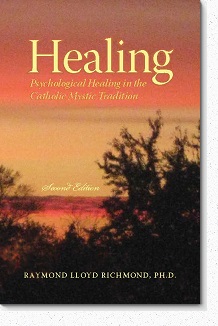 A treasure
of a resource for psychological and spiritual healing. Information gathered from my
websites is now available at your fingertips in book form with a comprehensive index. A treasure
of a resource for psychological and spiritual healing. Information gathered from my
websites is now available at your fingertips in book form with a comprehensive index.
Psychological defenses help to protect us from
emotional injury, but if you cling to the defense mechanisms that were created in your
childhood and carry them on into adulthood—as most everyone does unconsciously—your quest
for spiritual healing will be thwarted by overwhelming resentments and conflicts.
Still, God has been trying to show you that there is more to life than resentment and
conflict, something so beautiful and desirable that only one thing can resist its pull:
hate.
So now, and in every moment until you die, you will have a profound choice between your
enslavement to old defenses and the beauty of God. That decision has to come from you.
You will go where you desire.
More information
|






















 Read an excerpt from a
commentary by Saint Augustine
Read an excerpt from a
commentary by Saint Augustine