|
|
|
Psychological
Healing
in the Catholic Mystic Tradition

Tradition
For the
time will come when people will not tolerate sound
doctrine
but, following their own desires and
insatiable curiosity,
will accumulate teachers and will stop listening to
the truth
and will be diverted to myths. |
—2 Timothy 4:3 |
Fear |
Healing |
Therapy |
Spiritual Counsels |
Books |
About CSF
Introduction |
Two Meanings of Tradition |
Rejecting Tradition |
Let’s Suppose It Could Be Wrong |
Let’s Suppose It’s True |
Maybe versus Maybe:
Gains and Losses |
Do You Really Love God?
 O MATTER how
much you study the Bible, it is still important to
understand that there is more to Christianity than the Bible itself. The
tradition of the Catholic Church, in fact, has as much value as the Bible.
Why? Well, Church tradition determined which books constitute the Bible in
the first place. O MATTER how
much you study the Bible, it is still important to
understand that there is more to Christianity than the Bible itself. The
tradition of the Catholic Church, in fact, has as much value as the Bible.
Why? Well, Church tradition determined which books constitute the Bible in
the first place.
Two Meanings
of Tradition
When speaking about
tradition, it will help to understand that the word actually has two
meanings relevant to the Church:
1. |
In its most simple sense,
tradition refers to a particular manner of doing something. For example,
the Byzantine rite of the Catholic Church is a traditional way of celebrating
the Eucharist that differs from the traditional way of celebrating the Eucharist
in the Roman rite. Both rites—along with all the other rites of the
Catholic Church—are equally “right” because they all preserve
the same basic doctrine of what constitutes
Christianity. |
|
2. |
In its broadest and most profound
sense, tradition refers to all the knowledge and practices by which
a doctrine is preserved. Thus, when we speak of the Tradition of the Catholic
Church, we are referring to everything that the Church has done, beginning
with the teaching and acts of Jesus Himself, to expound the fundamental meaning
and practices of Christianity. |
|
Rejecting
Tradition
During the Protestant Reformation,
beginning with Martin Luther himself, Protestants criticized various Church
traditions (in the simple sense), and, in revising those disputed traditions,
they created an entirely new tradition (in the broad sense). Thus, in
rejecting the traditions of the Catholic Church, the Protestants created
an entirely new doctrine. Even though they continued to call themselves
Christians, they formulated ideas and practices that departed from and completely
missed the point about true Christianity.
Sadly, many persons today who
call themselves Christian, even many Catholics, blatantly reject Catholic Tradition,
saying that traditional beliefs of faith are no longer
relevant to today’s enlightened and “liberated” world.
These persons may believe that
they are merely tinkering with unwanted “traditions,” but they
are in danger of rejecting fundamental Christian doctrine itself. Still,
I know that arguing with anyone about any of this won’t get us anywhere.
So let’s try something different. Let’s look directly at doubt
itself.
Let’s Suppose
It Could Be Wrong
Let’s suppose that the Tradition
of the Catholic Church could be wrong. Maybe the Church’s teaching
about morality—such as artificial birth
control and abortion, for example—that
isn’t found explicitly in the Bible is wrong. And maybe Christ’s
teaching about divorce (Matthew 5:31–32;
Mark 10:11–12; Luke 16:18)—even though it is explicitly
stated in the Bible—comes from an archaic culture and really doesn’t
apply to today’s “liberated” modern world. Maybe the
Church’s teaching about the Trinity is wrong.
Maybe the Church’s fidelity to Christ’s own actions in not ordaining
women to the priesthood is all wrong. Maybe the Church’s understanding
of the real presence of Christ in the Eucharist
is wrong, and maybe we should be celebrating Communion with something—like
coffee and donuts—that is relevant
to the modern world.
Maybe the Tradition of the Catholic
Church is all wrong, maybe it doesn’t have any relevance to Christianity,
and maybe God doesn’t care about any of it.
Maybe.
All right. And now that we are
on an equal footing here, consider the other “maybe.”
Let’s Suppose
It’s True
Maybe the Tradition of the Catholic
Church is true. Maybe there are ideas and practices which Christ handed
on to the Apostles that didn’t get recorded in the Bible. Maybe the
Tradition of the Catholic Church has been inspired by the wisdom of
the Holy Spirit over the ages, even if to the eyes of modern logic it seems
restricted and conservative.
So what is a rational, enlightened
person to do in the face of one “maybe” versus the
other?
Maybe versus
Maybe: Gains and Losses
Well, consider, then, what you
have to gain by rejecting the Tradition of the Catholic Church,
regardless of whether it really matters or not. You would gain personal convenience
and self-gratification, perhaps, but nothing more.
So now consider what you have
to gain by accepting the Tradition of the Catholic Church—that
is, if the Tradition of the Catholic Church really does matter: you could
gain everlasting life.
And what do you have to
lose by accepting the Tradition of the Catholic Church—that is,
if it really doesn’t matter? Well, you would lose only some personal convenience
and self-gratification—yet you would still have all the psychological benefits
of living a chaste and holy life.
And what do you have to
lose by rejecting the Tradition of the Catholic Church—that is,
if it really does matter? You could be thrown out of the
wedding banquet and into the darkness because
you refused to put on the wedding garments provided for you. You could,
therefore, lose everlasting life.
Do You Really
Love God?
So think about this now. If you
have turned your life over to Jesus—that is, if you truly love God above
all else and seek to live a holy life as Christ
taught us—then wouldn’t you do anything to avoid violating
God’s will? Wouldn’t common sense—if not
love itself—say, “I can’t risk doing
anything that will offend Him, even if there’s only the slightest chance
that it might be wrong”?
|
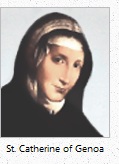 And if a soul, retaining
the slightest stain, were to draw near to God in the beatific vision,
it would be to her a more grievous injury, and inflict more suffering, than
Purgatory itself. Nor could God Himself, who is pure goodness and supreme
justice, endure her presence. She would be out of place, and the sight of
God, not yet entirely satisfied (so long as the least possible purification
remained to be accomplished) would be intolerable to her, and she would cast
herself into the deepest Hell rather than stand before Him and be still
impure. And if a soul, retaining
the slightest stain, were to draw near to God in the beatific vision,
it would be to her a more grievous injury, and inflict more suffering, than
Purgatory itself. Nor could God Himself, who is pure goodness and supreme
justice, endure her presence. She would be out of place, and the sight of
God, not yet entirely satisfied (so long as the least possible purification
remained to be accomplished) would be intolerable to her, and she would cast
herself into the deepest Hell rather than stand before Him and be still
impure. |
|
|
—Saint Catherine of Genoa
Treatise on Purgatory, Chapter XIV |
|
In the end, therefore, isn’t
your rejection of the Tradition of the Catholic Church proof in itself that
you haven’t really turned your life over to Jesus? In your rejection
of the Tradition of the Catholic Church, aren’t you saying psychologically
that you’re willing to risk everything, even everlasting life, for the sake
of nothing more than your own personal convenience and self-gratification, and
that you value your own reason more than you value love of God? And, in doing and
saying all this, isn’t your so-called “faith” really just a veiled
form of pride, the great sin of placing progressive
liberalism above God’s holy will?
|
Anyone who is so
“progressive” that he does not remain rooted in the teaching of Christ
does not have God with him, while anyone who remains rooted in the teaching possesses
both the Father and the Son. If anyone comes to you who does not bring this teaching,
do not receive him into your house; do not even greet him, for whoever greets him
shares in the evil he does. |
|
|
— 2 John 9–11 |
|
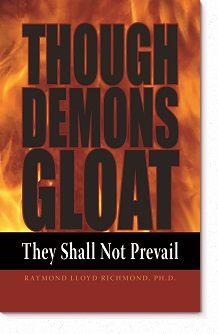
The text of
this webpage, integrated with other material from my websites,
has been conveniently organized into a paperback book of 350 pages, including
a comprehensive index.
 |
|
Though Demons Gloat: They Shall Not Prevail
by Raymond Lloyd Richmond, Ph.D.
Though we are attacked by liberal activists from without and by apostasy
from within, the true Church—that is, the body of those who remain
faithful to Church tradition—weeps, and she prays, because she knows
the fate of those who oppose God.
Our enemies might fear love, and they can push love
away, but they can’t kill it. And so the battle against them cannot be
fought with politics; it requires a profound personal struggle against
the immorality of popular culture. The battle must be fought in the
service of God with pure and chaste lifestyles lived from the depths of
our hearts in every moment.
Ordering Information |
|
|