|
|
|
If you
have died to sin
how can you continue to live in it? |
Fear |
Healing |
Therapy |
Spiritual Counsels |
Books |
About CSF
Introduction |
Explaining and Communicating |
Heresies and Creeds |
The Point of Doctrine |
Corruption and Hypocrisy
 HO
was Christ? Who is Christ? These are
questions that remove us from an immediate experience and demand an intellectual explanation
of that experience. HO
was Christ? Who is Christ? These are
questions that remove us from an immediate experience and demand an intellectual explanation
of that experience.
Explaining and
Communicating
Now, imagine how it was for the
Apostles and disciples who lived with and followed Jesus: they had intimately
experienced Him in their lives. They knew His
compassion, His wisdom, His
love, His divinity. They felt Him in their hearts,
and they didn’t have to ask themselves anything more than, “Do
I believe in Him?”
But after His death an entirely
new situation opened. As the Church grew, and in order to spread the Gospel,
the Apostles had to start explaining Jesus to persons who had never
seen or heard of Him. And that’s where all the problems
began.
How could three years of experience
be communicated? Which events were more important than others? And how should
any particular event be interpreted?
Heresies and
Creeds
No wonder we have the admonition
from Hebrews: Do not be carried away by all kinds of strange teaching
(13:9). No wonder creeds had to be composed and heresies stamped out. Experience
is pure, childlike and innocent, but the explanation of it has to flow through
the briars and thorns of language and intellect that shred purity into tatters.
The psychology of teaching the Faith is not simply
a matter of knowing the love of following Jesus
in person; it also becomes necessary to answer the questions, “Who was
Christ?” and “Who is this Christ?” And in doing so, we enter
the realm of doctrine.
The Point of
Doctrine
So what’s the point of doctrine?
Many persons today talk of developing “Christ consciousness” or
of making use of “Christ energy”—as if these were commodities
of some sort—and they see Jesus as a man who achieved the highest level
of humanity, just like Buddha or other wise teachers. But, quite frankly,
in Catholic doctrine, Jesus didn’t achieve anything of His
“own,” really—His life in this world was an act of God. And
that makes all the difference in the world.
As an “act of God,”
Christ doesn’t come into our hearts through meditation or ascetic
practice—or through political acts of social
justice. He comes to us when we choose to die to sin and give ourselves
to Him in love. It’s an act of surrender. A
serious Christian doesn’t seek Christ to get something but instead
simply offers Christ everything. After all, Christ, as true God and true
Man, offered us everything.
|
Though He was
in the form of God,
Jesus did not deem equality with God
something to be grasped at.
Rather, He emptied Himself
and took the form of a slave,
being born in the likeness of men. |
|
|
—Philippians 2:6–7 |
|
An experience of sacrifice—of
love—does not need explanation. It simply
is, just like God says, “I am that I am.” But without
doctrine—however tattered—we lose the understanding of the
“act” of God, thereby also losing the meaning of holy
sacrifice—and all of our own sacrifices then become only an act of the
self. Lost in pride,
with divine meaning lost, with no sense of doctrine to guide us, we pull
everything with us back into the darkness.
|
The real point
of rules is to help us stay in an enlightened place of humble obedience to
love. When you say, “I won’t do this!” or “I’ll
die if I have to do that!” or “I want to do it my way!” every
I-I-I from your mouth is a defiant expression of Self-Self-Self which flows
from Pride-Pride-Pride, and it all plunges you, like a reverse-baptism, into
the arrogance of Sin-Sin-Sin. |
|
Corruption and
Hypocrisy
Now, it’s true that the
Catholic Church through the ages has had its share of individuals—laity,
religious, and clerics alike—who have been corrupted with
hypocrisy. And even today hypocrisy, along
with heresies of progressive liberalism,
New Age impiety, feminixm,
and lifestyles defiant of chastity, continue to
undermine the true teachings of the Church. Nevertheless, anyone who calls
himself or herself Christian has an obligation to return always to
the truth that is the same yesterday, today, and
tomorrow. It’s the truth that Christ revealed, that the Apostles preached,
that the Fathers defended, that the Catholic mystics have confirmed—and
that Catholic psychology now helps to explain.
The
Tradition of the Catholic Church has preserved
the essential instructions Christ gave to the Apostles, but the Bible itself
records only a small portion of what Jesus did and said during His ministry
in the last years of His life.
Much happened,
therefore, that never got recorded.
 But, “through the
remarkable visions that God granted to Anne Catherine Emmerich, people of
today are allowed to witness some of these profound and stirring events”
(TAN Books and
Publishers). But, “through the
remarkable visions that God granted to Anne Catherine Emmerich, people of
today are allowed to witness some of these profound and stirring events”
(TAN Books and
Publishers).
These visions
are so psychologically astute, and they so astonishingly explain the divine
mystery in all of Christ’s actions, that any serious reader will discover
an entirely new dimension to his or her faith. |


The text of
this webpage, integrated with other material from my websites,
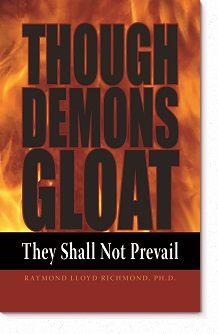
has been conveniently organized into a paperback book of 350 pages, including
a comprehensive index.
 |
|
Though Demons Gloat: They Shall Not Prevail
by Raymond Lloyd Richmond, Ph.D.
Though we are attacked by liberal activists from without and by apostasy
from within, the true Church—that is, the body of those who remain
faithful to Church tradition—weeps, and she prays, because she knows
the fate of those who oppose God.
Our enemies might fear love, and they can push love
away, but they can’t kill it. And so the battle against them cannot be
fought with politics; it requires a profound personal struggle against
the immorality of popular culture. The battle must be fought in the
service of God with pure and chaste lifestyles lived from the depths of
our hearts in every moment.
Ordering Information |
|
|




















 Why go to Church if it is