Reverence for the Mass |
Spiritual Counsels |
Books |
About CSF
Introduction |
Basic Old Testament History |
The Psalms |
Reading the Psalms |
Advanced Reading |
Practical Commentary
 ANY Catholics have never made a thorough
study of the Bible. If you were to decide to read it carefully, however,
you could make the mistake of trying to read it straight through, right from
the beginning. You might start eagerly at Genesis, but then, once
you get to all the abstract legalism in Leviticus, you will get bogged
down and give up, saying it doesn’t make any sense. ANY Catholics have never made a thorough
study of the Bible. If you were to decide to read it carefully, however,
you could make the mistake of trying to read it straight through, right from
the beginning. You might start eagerly at Genesis, but then, once
you get to all the abstract legalism in Leviticus, you will get bogged
down and give up, saying it doesn’t make any sense.
Therefore, if you’re a real
beginner, you might just begin by reading the Gospel of Mark in the
New Testament; it’s the earliest and shortest Gospel, or story of Christ
(gospel comes from the Middle English word godspell and means
“good news”). Mark’s Gospel should give you a basic sense
of what Jesus was all about.
Still, anyone, beginner or not,
needs to understand Jewish history, or Jesus Himself can’t be understood.
After all, when Jesus talked about Scripture, He was referring to what we
now call the Old Testament.
Basic Old Testament
History
The book of Genesis tells
the story of creation, the story of the Fall of Man (“Original Sin”),
and the story of the great flood (and Noah’s ark). Then it introduces
Abraham, the spiritual grandfather of salvation history. The end of
Genesis tells the story of Joseph, the son of Jacob (of the famous
ladder to heaven), son of Abraham, who is sold by his brothers into
slavery.
The book of Exodus tells
the story of how the ancient Hebrews, Joseph’s descendants who had been
enslaved in Egypt, were led by Moses out of Egypt into their own land. Here
you will find the story of the first Passover (which you need to understand
in order to make sense of Christ’s Last Meal, itself a Passover meal).
The whole story of the journey through the desert, aside from its historical
meaning, is a spiritual metaphor for our own call out of our “slavery
to sin,” and our hard journey through the “desert” of our
penance and temptations and on toward the “promised land” as we
still confront tests of obedience and
faith.
The book of Leviticus
continues the story of the journey into the promised land under the leadership
of Joshua. When Leviticus gets legalistic, you can stop
reading.
Then turn to reading the story
about David son of Jesse (see 1 Samuel 16:1ff through the end of
2 Samuel), You don’t have to pay attention to all the names and
battles; just get the basic idea of who David was, because prophesy about
his lasting dynasty (the “root of Jesse”) was fulfilled in Christ.
You can continue a bit into 1 Kings for the story of Solomon, David’s
son, who, despite his great wisdom, fell into impiety.
David and Solomon represented
the height of the kingdom, but after them everything started falling apart.
People forgot the Law and turned away from God and went off after the customs
of the pagan culture around them—much like today; in fact, such is human
nature.
Anyway, through all the kingdoms
following Solomon all the great prophets kept saying one thing: turn back
to God or else. Of course, most everyone ignored the prophets, so the “or
else”—the exile—eventually happened.
The two kingdoms of Israel and
Judah fell apart. The people were conquered first by the Assyrians and then
by the Babylonians and sent away into captivity. After the fall of Babylon,
they came back from captivity and tried as best as possible to re-establish
the true religion and rebuild the temple. Then they got conquered by the
Greeks under Alexander the Great (the two books of Maccabees tell
of the revolt led by Judas Maccabeus against the Greeks). Then, after the
Greeks, came the oppression by the Romans.
And that brings us to Jesus Christ.
(Jesus lived in the time of Tiberius Caesar, the son of Augustus Caesar;
Augustus was the first Roman emperor after the Triumvirate that overthrew
Julius Caesar.) Christ gave the gospel message to the Jews, and then, when
many of them rejected it, it passed to the gentiles.
So there you have it: a
common-sense synopsis of ancient Jewish history.
The
Psalms
King David himself wrote some
of the Psalms (poems meant to be sung) in which he praised God and gave thanks
for his victories over his enemies. Other Psalms were written at various
times through Jewish history after David, in which the Psalmist speaks from
his heart as a man of faith living in exile. The exile is at times spiritual
(that is, in the midst of his own people who have fallen into impiety and
sacrilege) and at other times literal (that is, in Babylon
itself).
As you read the Psalms (and you
will read them daily if you keep the Liturgy
of the Hours) you will encounter allusions to such things as Meriba and
Massah (Psalm 95; see Exodus 17:7), the Jordan turning back on its course
(Psalm 114; see Exodus 14:21 ff), and “a priest like Melchizedek of
old” (Psalm 110; see Genesis 14:18-20). Therefore, unless you understand
the basics of Jewish history you will miss the meaning of such evocative
images.
Reading the
Psalms
Considering all that I have said
above, to read the Psalms productively you should read them on three
levels:
1. |
The historical, human level
understands the Psalm as an expression of human joy and suffering in response
to its contemporary Biblical world. If you understand Jewish history, you
can place the Psalm in its proper context. |
2. |
The Christian level shows
us how Christ took on Himself—and fulfilled—all the human sentiments
expressed through Jewish history in the Psalms. |
3. |
The personal level allows
you to experience in your own current life the same sentiments expressed
by the Psalmist and fulfilled in Christ. Thus, as you struggle to cope with
your own personal trials, the Psalms can be
a source of both comfort and inspiration. |
Advanced
Reading
Once you have a basic understanding
of the Bible, then you can begin the continuous task of Biblical study. For example,
as you pray the Liturgy of the Hours, you will encounter
many Biblical references you don’t recognize, so, if you are praying
in private recitation, just take a short “time out” from the formal
prayer (per General Instruction of the Liturgy of the Hours,
203) and look up those references in the Bible. A good
Catholic Bible will have an introductory section to each book, so you can
set the text in its proper historical context. Meditate on it a bit, and
then return to the formal prayer. When you have more time, you can go back
to the Bible and read more of the passage in question, and you can explore
cross-references through the footnotes. If you do this on a regular basis,
through repetition alone you will become very familiar with many Biblical
texts.
Practical
Commentary
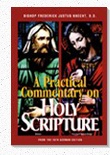 A Practical Commentary on Holy Scripture, by Bishop Frederick
Justus Knecht, D.D., has been reprinted from the Fourth English Edition of
a work first published in German in 1893. A Practical Commentary on Holy Scripture, by Bishop Frederick
Justus Knecht, D.D., has been reprinted from the Fourth English Edition of
a work first published in German in 1893.
This is a truly excellent book
combining narrative, explanation, and commentary. It leads the reader through
the entire Bible, from the beginning to the end, without the risk of getting
lost or bogged down. And it provides brilliant explications of pure Catholic
theology along the entire journey. Although the APPLICATIONS
sections were originally written for older children, the book is suitable
for anyone in today’s world, especially considering that back in 1893
older children had more common sense than most adults in today’s
world.
TAN Books and
Publishers


Healing
|
Though
Demons
Gloat
|
Anger
&
Forgiveness
|
Falling
Families,
Fallen Children
|
Disasters
and
trauma
|
Psychology
from the
Heart
|
 |
 |
 |
 |
 |
 |
Psychological Healing
in the Catholic Mystic tradition |
True Christian
Identity
In Confronting
Evil |
How to Turn the
Emotional Wounds
of Daily Life Into
Psychological Growth. |
The Psychological
and
Spiritual Remedy
For Our Cultural
Disintegration |
The Struggle For
Psychological
and Spiritual
Growth |
Collected Texts
About the Spiritual Depth of
Clinical Psychology |
More information |
More information |
More information |
More information |
More information |
More information |
Desire
and
Distraction
|
Fear
|
Stopping
Smoking
|
Borderline
Personality
Disorder
|
Catholic
Compassion
|
 |
 |
 |
 |
 |
A Catholic Perspective
On Behavioral Change
and Its Subversion |
A Catholic Explanation
Of a Universal
Problem |
Through
Faith
and
Prayer |
Healing
the
Rage |
When They Tell You
That the Moral Teachings
of the Catholic Church
Are Wrong |
More information |
More information |
More information |
More information |
More information |
|