The Blessed Virgin and Saint Anne, adapted from a photo by Paul Flores; used with permission.

Home

Introduction

The Beginning

Guidelines for Mystic Spirituality

Self-help

Doctrine

Prayer

Recommended Readings

Spiritual Counsels

Consultation

Questions and Answers

Subject Index

Contact Me

Related Links

Psychological Healing
in the Roman Catholic Mystic Tradition

A Guide to the
Liturgy of the Hours

 
Introduction
Preliminary Remarks (Sections of the LOH, Glory to the Father,
Postures, Sign of the Cross, Languages)
General
Invitatory
Office of Readings
Morning Prayer
Daytime Prayer
Evening Prayer
Night Prayer
Memorials
Invitatory
Office of Readings
Morning Prayer
Daytime Prayer
Evening Prayer
Night Prayer
Feasts
Invitatory
Office of Readings
Morning Prayer
Daytime Prayer
Evening Prayer
Night Prayer
Solemnities
Invitatory
Office of Readings
Morning Prayer
Daytime Prayer
Evening Prayer
Night Prayer


Also available as a book

 
Introduction

Our Lord Jesus Christ told us to pray constantly (Luke 18:1). The Liturgy of the Hours (or The Divine Office) provides one way to fulfill this obligation in a structured format. But, for the laity especially, without special instruction, praying the Liturgy of the Hours can be confusing and difficult.

Actually, everything you need to learn the format of the Liturgy of the Hours can be found in the volumes themselves.

The General Instruction of the Liturgy of the Hours (GILH) can be found in Volume I of the four-volume set. It can also be found online: General Instruction of the Liturgy of the Hours.

The section called the Ordinary in each volume provides complete instructions for the entire office.

Nevertheless, “digesting” all this information can be difficult for someone without a liturgical background, and this fact alone can prevent many persons from learning a beautiful form of Catholic prayer. 

Therefore, on this page I have organized all the information you will need to learn to pray the Liturgy of the Hours in individual recitation, step-by-step, as simply as possible, with the four-volume set. (The single volume Christian Prayer will follow the same basic format, with simplifications.)

Download a supplement that has
the Gospel Canticles with simple chant tones


Everything is really much more simple than it seems. Most of the material on this page is commentary, not instructions, and it is meant to help you understand why and how you must do the “page flipping.” But once you have “walked through it” a couple times and catch on to the basic concepts you will find yourself moving through the Hours with ease and confidence.
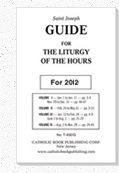
It will be essential, however, that you use the St. Joseph Guide for the Liturgy of the Hours (hereafter referred to as SJG), a small booklet that serves the entire calendar year. You should be able to buy the guide in any good Catholic bookstore, or direct from the publisher’s website. It’s available for both the four-volume set and the one-volume Christian Prayer.

The Liturgy of the Hours has been designed to be sung; however, the words recited, said, and sung can be interchanged, and it is allowable, especially in individual recitation, to simply “recite” the hours.


Preliminary Remarks

 
Each volume of the Liturgy of the Hours has several basic sections:

The Proper of Seasons is found at the beginning of each volume. It follows a one-year cycle beginning with Advent and progressing through Christmas, Ordinary Time, Lent, Easter, and another period of Ordinary Time. It contains material specific to each day of the current season.
 

A short description of
Liturgical Seasons


The Ordinary contains the basic instructions for each celebration: the invitatory, the Office of Readings, Morning Prayer, Daytime Prayer, Evening Prayer, and Night Prayer.

The Psalter contains all the basic psalms, readings, and intercessions.

A common-sense guide to
Reading the Psalms


Night Prayer follows a simple daily cycle through the week.

The Proper of Saints contains material specific to celebrations of various holy days (memorials, feasts, and solemnities) throughout the year.

The Common of Saints contains material common to celebrations of various kinds of saints: martyrs, pastors, virgins, and so on.

Locate each section of your volume and place a ribbon there to mark the place for daily reference. I keep the ribbons for the Ordinary and Night Prayer fixed, since, when we need to go to those sections we always start at the beginning of them, but I move the other ribbons as I progress through each day of prayer.

Throughout the Liturgy of the Hours, every psalm and canticle is concluded with the Glory to the Father unless otherwise indicated.

Glory to the Father, and to the Son, and to the Holy Spirit:
As it was in the beginning, is now, and will be for ever. Amen.

The recitation of each psalm (or canticle) therefore takes this order: antiphon, psalm, Glory to the Father, and antiphon. The psalm-prayer, which is optional, traditionally follows an interval of silence after the repetition of the antiphon at the end of the psalm (GILH 202).

Postures during the Office:

All taking part stand (a) during the introduction to the Office and the introductory verses of each hour; (b) during the hymn; (c) during the Gospel Canticle; (d) during the intercessions, the Lord’s Prayer, and the concluding prayer (GILH 263).

All should sit to listen to the readings (GILH 264).

When the psalms and canticles are said, the assembly either sits or stands according to local custom (GILH 265).

In individual, private recitation you may use whatever posture(s) you prefer, including sitting through the entire Office.

Making the Sign of the Cross during the Office:

All make the sign of the cross, from forehead to breast and from left shoulder to right (a) at the beginning of the Hours, when God, come to my assistance is being said; (b) at the beginning of the Gospel Canticles of Zechariah, of Mary, and of Simeon (GILH 266).

The sign of the cross is made on the mouth at the beginning of the invitatory, at the words Lord, open my lips (GILH 266).

The sign of the cross can be made at the dismissal/final blessing. (The GILH does not say anything specific about this.)

Sign of reverence during the Office:

A bow of the head is made when the three Divine Persons are named (e.g., Glory to the Father . . . ), at the name of Jesus, of the Blessed Virgin Mary, and of the Saint in whose honor the Liturgy of the Hours is celebrated. (See Ceremonial of Bishops, 68; General Instruction of the Roman Missal, 275).

Languages during the Office:

Different languages (e.g., English and Latin) may be used for various parts (e.g., saying the Gospel Canticle of Mary [Magnificat] and the Lord’s Prayer [Pater Noster] in Latin) at one and the same celebration. (See GILH 276).

 
Many persons, especially in individual recitation, prefer to celebrate the Office of Readings immediately before Morning Prayer. That preference will be followed in this guide. Actually, the Office of Readings can be celebrated at any time of the day, even the evening before, as circumstances require.


In General

 
We will begin with those days on which no solemnities, feasts, or obligatory memorials are celebrated. These days all follow the same basic format.

Sundays are always celebrated as solemnities.

Remember: At the beginning of each day, check the day in the SJG, and orient yourself to the day’s location in both the Psalter and the Proper of Seasons. Then check the day’s calendar date with the Proper of Saints; if the day is not a special celebration, as this example assumes, then leave the ribbon between the last celebration and the next, for future use.

 
The Invitatory

 Graphic Summary

The invitatory belongs at the beginning of each day of prayer. (It’s always found at the very beginning of the Ordinary, so keep a ribbon permanently at that place. You will begin here every morning.) The invitatory begins as follows:

Lord, open my lips.
And my mouth will proclaim your praise.
 
(Make the sign of the cross on your lips with the side of your thumb as you say these words, per GILH 266.)

Then Psalm 95 (or, if preferred, Psalm 100, 67, or 24) and its antiphon follows.

The antiphon is taken from the current weekday of the Psalter.

Notice how SJG says “ALL” plus a number referring to the appropriate page in the Psalter.

Outside of Ordinary Time (i.e., during Advent, Christmas, Lent, and Easter), the antiphon will be given in the Ordinary according to the calendar dates within that season. To remind you of this, in the Psalter you will see the rubric, “Antiphon, as in the Ordinary” with the page number.

The antiphon is recited and immediately repeated, then the psalm is said, followed by the Glory to the Father, and then the antiphon is recited again at the end of the psalm.

In individual recitation, the antiphon need not be said after each strophe of the psalm (as indicated in the Ordinary).


The Office of Readings

 Graphic Summary

The hymn, antiphons, psalmody, and verse are found in the Psalter.

Notice how SJG says, “ALL” plus a number referring to the appropriate page of the Psalter, to remind us that everything comes from the Psalter.

When the Office of Readings comes immediately before Morning Prayer, the hymn designated for the latter may be used in place of the hymn at the beginning of the Office of Readings. (See GILH 99.)

Preferably, the hymn should be sung, but, as circumstances require, it may be recited.

The readings and prayer are found in the “Office of the day” (i.e., in the Proper of Seasons).

Notice how SJG says “Rd & Pr” plus a number referring to the appropriate page of the Proper of Seasons.

When Morning Prayer follows immediately, the prayer and acclamation at the end of the Office of Readings are not used. (See GILH 99.)

 
Morning Prayer

 Graphic Summary

Morning Prayer begins as follows, while making the sign of the cross (from forehead to breast and from left shoulder to right) at the words, “God, come to my assistance,” and while bowing the head at the words, “Glory to the Father, and to the Son, and to the Holy Spirit”:

When Morning Prayer follows immediately after the Office of Readings, the introductory God, come to my assistance and the Glory to the Father are omitted, as per the Ordinary.
 

God, come to my assistance.
Lord, make haste to help me.
 
Glory to the Father, and to the Son, and to the Holy Spirit:
as it was in the beginning, is now, and will be forever. Amen. Alleluia.

For musical purposes, the invocation "God" may be expanded, for example, “O God,” etc. as per the Ordinary.

Alleluia is omitted during Lent.

The hymn is omitted here, of course, if the hymn for Morning Prayer was sung at the beginning of the Office of Readings immediately prior to Morning Prayer.

The antiphons, psalmody, reading, responsory, antiphon for the canticle of Zechariah, intercessions, and prayer are found in the Psalter.

Notice how SJG says, “ALL” plus a number referring to the appropriate page of the Psalter, to remind us that everything comes from the Psalter.

Outside of Ordinary Time, the reading, responsory, antiphon for the canticle of Zechariah, intercessions, and prayer are found in the “Office of the day” (i.e., in the Proper of Seasons). A note in the Psalter will remind you of this. SJG will say, “Ant, Rd, etc.” plus a number, to direct you to the appropriate page in the Proper of Seasons.

The sign of the cross is made at the beginning of the canticle of Zechariah, and the canticle concludes with Glory to the Father.

In the absence of a priest or deacon, the conclusion (as found in the Ordinary) is as follows:

May the Lord bless us,
protect us from all evil
and bring us to everlasting life.

Amen.

 
Daytime Prayer

 Graphic Summary

Daytime Prayer begins as follows, while making the sign of the cross (from forehead to breast and from left shoulder to right) at the words, “God, come to my assistance,” and while bowing the head at the words, “Glory to the Father, and to the Son, and to the Holy Spirit”:

God, come to my assistance.
Lord, make haste to help me.
 
Glory to the Father, and to the Son, and to the Holy Spirit:
as it was in the beginning, is now, and will be forever. Amen. Alleluia.

For musical purposes, the invocation "God" may be expanded, for example, “O God,” etc. as per the Ordinary.

Alleluia is omitted during Lent.

The hymn is found in the Ordinary. Everything else is found in the Psalter.

Notice how SJG says, “ALL” plus a number referring to the appropriate page of the Psalter, to remind us that everything comes from the Psalter.

Outside of Ordinary Time, the antiphon for the psalmody, and the reading, verse, and prayer are found in the “Office of the day” (i.e., in the Proper of Seasons). A note in the Psalter will remind you of this. SJG will say, “Ant, Rd, etc.” plus a number, to direct you to the appropriate page in the Proper of Seasons.

The conclusion (as found in the Ordinary) is as follows:

Let us praise the Lord.
And give him thanks.

 
Evening Prayer

 Graphic Summary

If a solemnity follows the current day, then Evening Prayer I of the solemnity is celebrated, not the Evening Prayer of the current day. Remember, Sundays are always celebrated as solemnities, so Evening Prayer on Saturdays is always Evening Prayer I of the following Sunday.

Evening Prayer begins as follows, while making the sign of the cross (from forehead to breast and from left shoulder to right) at the words, “God, come to my assistance,” and while bowing the head at the words, “Glory to the Father, and to the Son, and to the Holy Spirit”:

God, come to my assistance.
Lord, make haste to help me.
 
Glory to the Father, and to the Son, and to the Holy Spirit:
as it was in the beginning, is now, and will be forever. Amen. Alleluia.

For musical purposes, the invocation "God" may be expanded, for example, “O God,” etc. as per the Ordinary.

Alleluia is omitted during Lent.

The hymn, antiphons, psalmody, reading, responsory, antiphon for the canticle of Mary, intercessions, and prayer are found in the Psalter.

Notice how SJG says, “ALL” plus a number referring to the appropriate page of the Psalter, to remind us that everything comes from the Psalter.

Outside of Ordinary Time, the reading, responsory, antiphon for the canticle of Mary, intercessions, and prayer are found in the “Office of the day” (i.e., in the Proper of Seasons). A note in the Psalter will remind you of this. SJG will say, “Ant, Rd, etc.” plus a number, to direct you to the appropriate page in the Proper of Seasons.

The sign of the cross is made at the beginning of the canticle of Mary, and the canticle concludes with Glory to the Father.

In the absence of a priest or deacon, the conclusion (as found in the Ordinary) is as follows:

May the Lord bless us,
protect us from all evil
and bring us to everlasting life.

Amen.

 
Night Prayer

You should have a permanent ribbon marking this section.

Night Prayer begins as follows, while making the sign of the cross (from forehead to breast and from left shoulder to right) at the words, “God, come to my assistance,” and while bowing the head at the words, “Glory to the Father, and to the Son, and to the Holy Spirit”:

God, come to my assistance.
Lord, make haste to help me.
 
Glory to the Father, and to the Son, and to the Holy Spirit:
as it was in the beginning, is now, and will be forever. Amen. Alleluia.

For musical purposes, the invocation "God" may be expanded, for example, “O God,” etc. as per the Ordinary.

Alleluia is omitted during Lent.

A brief examination of conscience may be made as one reviews the events of the day.

Everything is found in the Night Prayer section, according to the day of the week.

If the following day is a solemnity, use the section of Night Prayer called “After Evening Prayer I on Sundays and Solemnities.”

Notice how SJG says, “NP” plus a number referring to the appropriate page of the Night Prayer.

The sign of the cross is made at the beginning of the Gospel canticle, and the canticle concludes with Glory to the Father.

The conclusion for Night Prayer is as follows:

May the all-powerful Lord grant us a restful night and a peaceful death.
Amen.

Then one of the antiphons in honor of the Blessed Virgin Mary is said; these antiphons are found at the very end of the Night Prayer section.


Continuation:
Memorials, Feasts, and Solemnities


Graphic Summary


INVITATORY
General


Proper of Seasons

Ordinary

Psalter

Proper of Saints

Commons


Antiphon


Psalm


OFFICE OF READINGS
General


Proper of Seasons

Ordinary

Psalter

Proper of Saints

Commons


Hymn, antiphons, psalmody, and verse


Readings and prayer


MORNING PRAYER
General


Proper of Seasons

Ordinary

Psalter

Proper of Saints

Commons


Hymn, antiphons, psalmody, reading, responsory, antiphon for the canticle of Zechariah, intercessions, and prayer


DAYTIME PRAYER
General


Proper of Seasons

Ordinary

Psalter

Proper of Saints

Commons


Hymn


Antiphons, psalmody, reading, responsory, and prayer


EVENING PRAYER
General


Proper of Seasons

Ordinary

Psalter

Proper of Saints

Commons


Hymn, antiphons, psalmody, reading, responsory, antiphon for the canticle of Mary, intercessions, and prayer


Also available as a book


No advertising—no sponsor—just the simple truth . . .

DID MY WORK help you? Have you found insight into your behavior? Have you found information unlike anywhere else? Then why not make a Quick & Easy donation to this freewill website to express your gratitude for my labor in creating something substantial, something that can change your life for the better?

Huh? Donations? Freewill website?
What’s this about?

 
Additional Resources
   
The Liturgy of the Hours
General Instruction of the Liturgy of the Hours  from The Catholic Liturgical Library.
Catholic Book Publishing Corp.  publishes the four-volume set of the Liturgy of the Hours, the one-volume Christian Prayer, and the St. Joseph Guide for the Liturgy of the Hours.

 
On “Chastity – In San Francisco?”:

The Sweet and Easy Way . . . but beware . . . the only escape from the darkness of sin is in seeking the light of the cross.
 
The Basic Concepts of Self-help —Sacrifice, Obedience, and Prayer
Spiritual Healing —how to heal emotional wounds the Christian way
Why San Francisco?
   
QUESTIONS AND ANSWERS
 
INDEX of all subjects on this website
 
CONTACT ME
 
Related pages within “A Guide to Psychology and its Practice”:
Anger: Insult, Revenge, and Forgiveness
Death—and the Seduction of Despair
Depression and Suicide
Dream Interpretation
Fear of Psychotherapy
Forgiveness
Identity: Pride and prejudice, loneliness and encounter
Sexuality and Love
Spiritual Healing
Spirituality and Psychology
The Unconscious
 
INDEX of all subjects on A Guide to Psychology and its Practice
 
SEARCH A Guide to Psychology and its Practice


Chastity

In San Francisco?

www.ChastitySF.com

CATHOLIC PSYCHOLOGY

in association with
A Guide to Psychology and its Practice
 
Copyright © 1997-2008 Raymond Lloyd Richmond, Ph.D. All rights reserved.
San Francisco, California USA


All material on this website is copyrighted. You may copy or print selections for your private, personal
use only. Any other reproduction or distribution without my permission is forbidden.