|
|
|

How
do I undo a vow of celibacy? I made a personal vow not to have sexual
relationships but it is too hard to keep. Now I am miserable. What can I
do now?
 personal vow is not really a
vow in the formal sense, so to undo it all you have to do is tell
God that you made a mistake. God can forgive any of our mistakes; all He
asks of us in return is that we learn from them in
humility, so that we continue to grow in holiness
no matter what mistakes we make. personal vow is not really a
vow in the formal sense, so to undo it all you have to do is tell
God that you made a mistake. God can forgive any of our mistakes; all He
asks of us in return is that we learn from them in
humility, so that we continue to grow in holiness
no matter what mistakes we make.
Now, if you want to understand
what a formal vow is all about, read the beginning of the story of Isaac
and Rebekah:
|
Abraham had now
reached a ripe old age, and the LORD had blessed him in every
way. Abraham said to the senior servant of his household, who had charge
of all his possessions: “Put your hand under my thigh, and I will make
you swear by the LORD, the God of heaven and the God of earth,
that you will not procure a wife for my son from the daughters of the Canaanites
among whom I live, but that you will go to my own land and to my kindred
to get a wife for my son Isaac.” The servant asked him: “What if
the woman is unwilling to follow me to this land? Should I then take your
son back to the land from which you migrated?” “Never take my son
back there for any reason,” Abraham told him.
“. . . If the woman is unwilling to follow you, you will
be released from this oath. . . .” So the servant put
his hand under the thigh of his master Abraham and swore to him in this
undertaking. |
|
|
—Genesis 24:1-9 |
|
Making a
Vow
Although nobody knows what put
your hand under my thigh actually meant to Abraham and his servant, scholars
speculate that it may have implied that the servant would bring a
curse—perhaps of sterility—on himself if he failed to fulfill his
promise. And in this we see the whole point of making a vow.
•
|
First, a formal vow properly
occurs between at least two human persons. Even though service to God may
be a part of the vow, the contract stays between the persons directly involved.
For example, religious vows are not made directly between an individual and
God; the vows are made before a priest, the religious superior, and the entire
community. In the above example from Genesis, the vow was made between
Abraham and his servant. |
•
|
Second, the vow serves to support
an external mission; in the above example from Genesis, the vow supported
the mission to procure a wife for Isaac. |
•
|
Third, we see that the vow can
be cancelled legitimately if for some external reason the mission is thwarted;
in the above example from Genesis, the refusal of the woman to follow
the servant back to the land of Isaac would release the servant from his
vow. |
•
|
Finally, the person making the
vow understands that something bad—something very, very
bad—will happen if the vow is merely abandoned, rather than cancelled
legitimately. |
Considering these three points,
it should be clear that a personal vow of which you speak is really not a
vow at all, for two reasons.
Confusing Celibacy
with Chastity
First of all, you’re confusing
celibacy with chastity.
• |
Celibacy
refers to being unmarried. |
•
|
Chastity
refers to abstinence from all sexual activity outside of Holy Matrimony and
a commitment to the holiness of sexuality within matrimony. |
Therefore, a personal vow of
celibacy would not serve any external mission; you can live a Christian life
whether you’re married or unmarried, and if you want to remain unmarried
you do not need to make any vows—you just don’t get
married.
Your Baptismal
Vows
Secondly, a “personal vow
not to have sexual relationships” is redundant, because it is preempted
by other vows you have already made, vows that serve a very serious mission:
your baptismal vows to renounce Satan, to
turn away from evil and sin,
and to turn to Christ in chaste and holy service.
Through the indelible spiritual
mark of baptism you became incorporated into the Church, the Body of Christ,
against which “the gates of the netherworld shall not prevail”
(Matthew 16:18). Thus, at baptism, you were bound to the mission of attaining
everlasting life, and you received Christ’s personal promise that nothing
external would ever thwart that mission.
Now, should you so chose, you
could fulfill this mission through the additional vows of the sacrament of
Holy Matrimony. But, if you don’t choose Holy Matrimony, you have no
other option besides celibacy (Matthew 19:12-14). And celibacy must be lived
in chastity because at the moment of your baptism
you were pledged to live your life in chastity (Catechism of the Catholic
Church § 2348).
Furthermore, you could take religious
vows to fulfill your Christian mission within a religious order in celibacy,
but ultimately these are formal vows, not a personal vow.
So, outside of Holy Matrimony,
there can be no sexual relationships. And if you
“undo” your baptismal vows and fail
in your mission, well, then, just be warned: no sexual “partner”
will be able to protect you when, at your judgment after death, the glaring
light of divine truth illuminates the abhorrent unholiness of your behavior
and you sink down, forever separated from God, into something very, very
bad.
Feeling
Guilty?
I don’t say this to make
you feel guilty, because the true Catholic Faith has nothing to do with
guilt. I say these things because they are true,
and the true Catholic Faith is all about truth. I am the way, and
the truth, and the life. Baptism is about life, and the only way to
preserve that life is to remain faithful to your
baptismal vows.
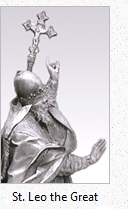 Christian, remember your
dignity, and now that you share in God’s own nature, do not return by
sin to your former base condition. Bear in mind who is your head and of whose
body you are a member. Do not forget that you have been rescued from the
power of darkness and brought into the light of God’s kingdom. Christian, remember your
dignity, and now that you share in God’s own nature, do not return by
sin to your former base condition. Bear in mind who is your head and of whose
body you are a member. Do not forget that you have been rescued from the
power of darkness and brought into the light of God’s kingdom.
Through the sacrament of baptism you have become a temple
of the Holy Spirit. Do not drive away so great a guest by evil conduct and
become again a slave to the devil, for your liberty was bought by the blood
of Christ. |
—From a sermon by Saint Leo
the Great, pope
Office of Readings, December 25 |

What the
Catechism of the Catholic Church says:
The various forms
of chastity
2348 All
the baptized are called to chastity. The Christian has “put on
Christ,” the model for all chastity. All Christ’s faithful are
called to lead a chaste life in keeping with their particular states of life.
At the moment of his Baptism, the Christian is pledged to lead his affective
life in chastity.
2349 “People should cultivate [chastity] in the way that
is suited to their state of life. Some profess virginity or consecrated celibacy
which enables them to give themselves to God alone with an undivided heart
in a remarkable manner. Others live in the way prescribed for all by the
moral law, whether they are married or single.” Married people are called
to live conjugal chastity; others practice chastity in
continence. . . .
|




















 Read
an excerpt from a writing about baptism
Read
an excerpt from a writing about baptism