When
I yield to my spirit’s yearning for intimacy with the divine, I feel
driven to purge from my life anything that might be idolatrous, that is,
anything with which I identify that might be a hindrance to intimacy with
God—friends, affections, habits, my name, my membership to certain
organizations (i.e. the military), essentially, most of what makes me
me.
While
there is obviously Biblical merit to separating from sin and idolatry in
the pursuit of God and realizing by faith our identity in Him, it is the
draconian and ruthless manner in which I feel driven toward such separatism
by what I perceive to be God’s Spirit that unsettles and repulses
me.
The
fruits of the Spirit and the wisdom and will of God, as detailed by the New
Testament writers, are expressed through agape love and are “heavy”
on gentleness, compassion, truth spoken in love and an effort to only do
what is honorable and good in the eyes of all. So why do I sense a calling
to tell others whom I have shared a spiritually errant past that they are
dead to me and then treat them as such, and speak the “truth” without
tact, consideration and thought of its “benefit” for others in
my dealing with the world?
I have
read countless spiritual works over the past decade by those who made
“knowing God” their single-minded desire. The guiding principle
for these men and women seems to be an uninterrupted receptivity to His presence
and hearing His voice. Many seem to echo my own spirit’s desire to cast
aside with severity anything that would distract this singleminded attention
to the indwelling Spirit of Christ.
When
I read the Scriptures, however, love for God is to be expressed through love
for our neighbor. Even abiding in Christ, as portrayed in the Vine and the
Branches metaphor in John 15, seems contingent upon obeying the command to
love our fellow believers. While the love of God for us is the driving force
for love for our neighbor, the pervading theme of the New Testament seems
to be that it is through love for humanity, particularly other believers,
that we experience this love.
This
is the paradox of love which first drew me to seek out Christ in
earnest.
My basic
dilemma: I “want to want” to yield to, receive and reflect God’s
love for a the world through the selfless avenues of truth, gentleness,
compassion, grace, sacrifice, and wisdom, but I sense in my spirit that I
am being led to cast those considerations aside in drawing close to
God.
It is
as if God is asking me to unlearn my conception of love, which is rooted
in my own insecurities and brokenness, and while I welcome such healing,
I resist, stating in my heart that while I may not know what love is, I
“know what it ain’t,” specifically, a cold and callous treatment
of others, even in the pursuit of God. While I realize a relationship with
God isn’t based on the law, I fail to understand why intimacy with Him
would contradict the law of love.
I long
to experience the love of God through love for others, not at their expense,
and so I press on in self-effort and erratic spirituality, rather than
receptivity to His Spirit. This is not a “dark night of the soul,”
but more a cathartic and at times blasphemous wrestling with God.
I fully realize that at the root of my resistance is something self-protective
and distrustful of God, where my deepest healing and liberation needs to
take place, but that does little to negate the reality that treating others
in an unloving manner seems uncharacteristic of Christ, no matter how impure
or insecure my motive. If I am honest, I essentially refuse to believe
that the end (intimacy with God) justifies the means (draconian separatism
and emotional insensitivity toward others). Moreover, I refuse to follow
that God in intimacy even though I know this is the only God I
have.
|
 ou speak very well, from your own
experience, about a core psychological problem in living a genuine Christian
life. In fact, I have reproduced your long question almost in its entirety
so that others may be able to recognize the basic problem about detachment
from the world. To help you grasp the solution to this problem, consider
a similar problem from medicine. ou speak very well, from your own
experience, about a core psychological problem in living a genuine Christian
life. In fact, I have reproduced your long question almost in its entirety
so that others may be able to recognize the basic problem about detachment
from the world. To help you grasp the solution to this problem, consider
a similar problem from medicine.
Infection
When an epidemic breaks out in
a society, individuals must do what they can to protect themselves from
contamination by infectious viral or bacterial agents. Because these agents
are passed on through physical contact with infected sources, the best method
of protection usually amounts to some form of isolation from individuals
already infected.
Notice carefully, however, that
protection from infection derives from separation from infectious agents,
not from other persons in and of themselves. It should be clearly understood
that other persons, even those infected, are not
“bad.” But, since they carry infection,
they must be avoided in order to avoid infection.
Detachment from
the Desire to Sin
Now, to live a holy life, we
must avoid contamination by anything unholy. Unlike medical infection, however,
spiritual “infection” does not come specifically from physical
contact with other persons. Nor does it come from physical contact with
“unclean” things; in fact, Saint Peter had a vision (Acts 10: 9-16)
in which this was made clear to him. Spiritual infection comes from contact
with the desire to sin.
Please understand here that
desire is not a bad thing. God created
us so that we could desire Him through pure love.
But, because of Original Sin, human desire has been
corrupted; when we are outside a state of grace, our desire for God is obscured
by our desire for sin. And so, to live a holy life we must detach ourselves
from the desire to sin while simultaneously nurturing an ardent desire for
the holy.
Click here
to go to the web page about Motivation
where you can learn how to nurture a desire for the holy.
Detachment from the desire to sin, though, does not mean that you are necessarily
obligated literally to avoid those persons caught up in
sin [1]—and
it certainly does not mean that you should hate or despise others. Instead,
you should endeavor to avoid the sinful desires of other persons while
also praying for their
repentance and conversion out of love for
them.
Now, the best way to avoid infection
by the desire to sin is to avoid social media, popular
entertainment (such as television—and the
subversive commercial advertising that goes with it—movies, sports, newspapers,
magazines, music), and every other aspect of
“popular” culture; these things are filled
with a massive craving for everything unholy and have their basis in an
indifference and contempt for anything
holy.
No Discrepancy
Between Detachment and Love
Thus you can see that there is
no discrepancy between detachment from the
corrupt social world around us and love for others
lost in the sins of the world.
To love others with divine love,
endeavor to pray constantly for their conversion,
and, in order to be able to pray constantly, endeavor to remain detached
from all the desire for sin that is not conducive to holy prayer.
There’s nothing ruthless
or cold-hearted about any of this.
The Danger of
Pride
If any discrepancy does arise
between detachment and love, it’s the result of
pride. Pride is simply the
narcissistic desire to stand apart from others so
that you can think of yourself as being “special.” As you mention,
pride can trick us into believing we are doing God’s will when really
we are serving our own self-interests.
You can best protect yourself
from the sin of pride by cultivating the opposite virtue:
humility. To live in humility is to live always
in confidence of God’s love, protection, and guidance and therefore to not
be concerned when others insult you—or praise you. Secure in God’s love, you
don’t have to base your identity on whether or not others acknowledge you,
and so you don’t have to compete with them and beat them down to make
yourself feel bigger.
Humility does not have anything
to do with humiliation or self-defilement; we have an obligation to serve
Christ effectively and joyfully in pure love. Therefore it is important that
we never relinquish the noble responsibility of developing our talents to the
fullest. Our self-development is a spiritual necessity, and it won’t become
an act of selfishness if we seek it with proper humility.
Pride seeks only
its own glory. Pride may accept the idea of serving God, intellectually,
but it rejects the personal suffering of carrying that service deep into
the heart. Therefore, pride does not know how to pray for others, and, though
it might cause you to speak words of prayer, your heart will remain cold,
hard, and aloof.
Summary
Therefore, you certainly can
“yield to, receive, and reflect God’s love for the world through
the selfless avenues of truth, gentleness, compassion, grace, sacrifice,
and wisdom.” You do this by a humble detachment from the desire to sin
while praying constantly for those caught up in the desire to sin. That’s
love. It’s not a paradox, but it is often
misunderstood by those who don’t want to do the hard work of
praying constantly with the mind in the heart
because, in not detaching themselves from their pride, they continue in their
desire to sin—and thus they are self-deceived.

Notes.
1. Saint Paul, however, commanded Christians to avoid
other Christians who departed from the true faith. He said this in the strongest
language possible: “We command you in the name of the Lord Jesus Christ.”
|
We command
you, brothers, in the name of the Lord Jesus Christ, to avoid any brother
who wanders from the straight path and does not follow the tradition you received from
us (2 Thessalonians 3:6). |
|
Additional Resources
Though Demons Gloat
They Shall Not Prevail
by Raymond Lloyd Richmond, Ph.D.
 Though we are attacked by liberal activists
from without and by apostasy from within, the true Church—that is, the body of those who remain
faithful to Church tradition—weeps, and she prays, because she knows
the fate of those who oppose God. Though we are attacked by liberal activists
from without and by apostasy from within, the true Church—that is, the body of those who remain
faithful to Church tradition—weeps, and she prays, because she knows
the fate of those who oppose God.
Our enemies might fear love, and they can push love away, but they can’t kill it. And so
the battle against them cannot be fought with politics; it requires a profound personal
struggle against the immorality of popular culture. The battle must be fought in the
service of God with pure and chaste lifestyles lived from the depths of our hearts in every
moment.
More information
Healing
Psychological Healing in the Catholic Mystic Tradition
by Raymond Lloyd Richmond, Ph.D.
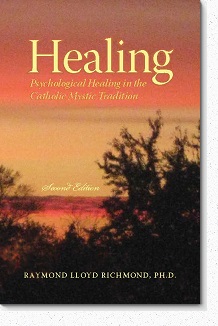 A treasure of a resource for psychological
and spiritual healing. A treasure of a resource for psychological
and spiritual healing.
Psychological defenses help to protect us from
emotional injury, but if you cling to the defense mechanisms that were created in your
childhood and carry them on into adulthood—as most everyone does unconsciously—your quest
for spiritual healing will be thwarted by overwhelming resentments and conflicts.
Still, God has been trying to show you that there is more to life than resentment and
conflict, something so beautiful and desirable that only one thing can resist its pull:
hate.
So now, and in every moment until you die, you will have a profound choice between your
enslavement to old defenses and the beauty of God. That decision has to come from you.
You will go where you desire.
More information
|