|
|
|

I am
from an alcoholic family, had my own problems with alcohol, married an alcoholic.
i believe God helped me to no longer desire alcohol. i have been told by
counselor that i am codependent and should go to al-anon. have been for awhile
but cant seem to stick with it. what do you think of aa and al-anon? i was
born and raised catholic and know it is the true church. i have been trying
to do Gods will for years and years now. some of the aa and alanon seem catholic,
and some of it seems anti-christian. i very much agree with what you say
though i havent read it all, i think God led me to it. my husband is drinking
again and is physically addicted but not violent. his daughter has a lot
of problems. i just want to help people. do you think al-anon is okay? the
catholic church seems to say aa and alanon are okay but i still dont
know?
|
 lcoholics Anonymous (AA) groups
(and Al-Anon groups for the family of an alcoholic) can be useful to an
extent. The problem is that these groups simply offer a watered-down, secular
version of Catholic Christianity, and many people who don’t really know what
religion is make such groups into their own
“religion.” Therefore, as you have seen, some meetings are as far
from Catholicism as hell is from
heaven. lcoholics Anonymous (AA) groups
(and Al-Anon groups for the family of an alcoholic) can be useful to an
extent. The problem is that these groups simply offer a watered-down, secular
version of Catholic Christianity, and many people who don’t really know what
religion is make such groups into their own
“religion.” Therefore, as you have seen, some meetings are as far
from Catholicism as hell is from
heaven.
|
All 12-Step programs
begin with two steps whose essential purpose is to admit one’s total helplessness
and to make a total surrender to a “higher power”. But, oh, many persons have gone through
all twelve steps—sometimes several times—and have given only a tacit nod to the
first two steps.
And the reason? It’s because
of the missing Third Step. It’s one thing to admit that you
can’t heal yourself and that you are dependent on a higher power, but it’s something else
to take the (missing) Third Step: I
must love God with all my mind, all my heart, all my soul, and all my
strength. |
|
The truth is, if anyone actually took the
(missing) Third Step and lived in love for God as love is
supposed to be lived, there wouldn’t be any problems
with addictions in the first place. Why? Because any addiction amounts to worshipping
something other than God.
Addictions: Their
Core and Strength
Well, the
core of any addiction involving intoxication
or euphoria is your feeling so deprived of your primal
desire—real love from your
parents[1]
—and being so angry about it, that you use the addiction to
hide (i.e., deny) the cause of the anger: your parents. Thus you settle for
any satisfaction of intense excitement to stifle the truth of your parents’
failures—and then, because the intensity of the satisfaction is, according to
its own materialism, short-lived, you crave it more and more, over and over. All
of this is a way to avoid facing a truth that, despite your unconscious
awareness of it, you secretly fear.
|
If a father fails
in his role as a proper father, then he will also fail
in his duty to separate the child from its infantile yearning for a mother’s love.
In distress and anger at this failure, the child will desire to return to a fantasy
of an idealized mother, thus setting up the dynamic of an addiction.
Addictions can
therefore serve the unconscious purpose of numbing emotional pain. Such pain could
be the result of the absence of a mother’s gentle love because the mother was
physically absent or because she was emotionally absent due to her being either
emotionally cold or being controlling and domineering. Such pain could also be the
result of the absence of a father’s guidance and protection, especially in regard
to learning how to contain a domineering mother. |
|
Addictions
draw their strength from your lack of
trust in God. When you lack trust in God, and when despair is therefore the
unconscious essence of your life, then nothing in you can stand up to the
overwhelming urge for momentary pleasure and say, “Wait! This isn’t
right.”
|
Many women alcoholics
have had an abortion at some time in the past (or
their mothers had abortions), and this secret
thorn-in-the-flesh only adds to the woman’s
self-loathing, guilt, and despair, especially if she
abandoned her faith in the first place because of her parents’
hypocrisy. |
|
Therefore, any addiction is in
itself proof that you are preoccupied with the immediate sensory gratification
of your own body—desiring to escape the demands
of personal responsibilities and return to an idyllic
infantile feeling of care-free bliss—as a
psychological defense against your lack
of belief in something greater than your own
body.[2]
And what could this “something
greater than your own body” be? Simple. It’s the Body and Blood of Christ. When
you have within you the Body of Christ and the Blood of Christ—which is
faith and love—there is nothing
you lack. The entire meaning of life is mystically embodied in the
Eucharist, not in the revered Blue Book of AA.
Social
Support
Nevertheless, AA offers something in
which the Catholic Church often fails: intense social support in avoiding specific
behaviors. People go to AA meetings because each meeting focuses on doing whatever
it takes to avoid alcohol. This amounts to a functional sobriety. That is,
it’s effective for as long as the support lasts.
But if bishops and priests could preach
about living a genuine holy lifestyle the way AA “preaches”
about day-to-day life without alcohol, there would be mystical sobriety based
on total surrender to God, and the Church wouldn’t be in the
mess it’s in today.
|
It’s true
that some persons have a predisposition (a) to craving alcohol as
a defense against emotional vulnerability or
(b) to becoming addicted to alcohol once it is used as such a defense. And
once addicted, such persons can be subjected to changes in body chemistry
that are beyond their control.
Still, if alcoholism is a disease, it’s an unusual one. A person with
cancer, for example, can’t just wake up one morning and say, “You
know, I’m sick of this illness. Today I’m going to stop having
cancer.” And yet an alcoholic has to do almost precisely that. He or
she has to say, “Today I’m going to stop drinking. And if I can’t
do it myself, I will get into a treatment program that will force me to stop
drinking.” In other words, treatment for alcoholism is behavioral. If
you’re an alcoholic, your behavior has to change. You have to stop drinking.
Then, once you have stopped running from the truth of your emotional pain,
you can start to see the spiritual matter clearly, and so you can start the
inner work of psychological and spiritual change in regard to facing, and not
running from, the lack of trust in God that underlies your addiction. It’s all
a matter of your personal responsibility
to God, regardless of any genetics or brain chemistry that have contributed to,
but not caused, the addiction. |
|
Purging Disordered
Desire
As much as AA puts an emphasis on overcoming
an addiction through the 12 Steps, a different and all-encompassing “step” is more
important: the process of purging disordered desire. That is, for true healing,
we must do more than suppress disordered behavior through “functional sobriety”—we must
purge the desire that underlies the disordered behavior. Essentially, our entire attitude
to the disordered behavior must change—and this is true in regard to any sinful behavior,
not just in regard to alcoholism.
For example, to be free of alcoholism,
the attitude of thinking of alcohol as a means to avoid responsibility must be purged.
To be free of an eating disorder, the attitude of thinking of food as a means of
comforting oneself when under emotional strain must be purged. To be free of sexual
sins, the attitude of thinking of sexuality merely as a physical pleasure must be
purged. In short, even though we stop committing a particular sin, we are not spiritually
free of that sin until we purge from ourselves the desire to commit that sin. We can’t
“get over” a sin just by forcing ourselves to not commit the sin because we have to go
down “underneath” the sin—that is, to go down deep inside ourselves to see the dark
desire to sin that lurks in the depths of our
unconscious.
|
Note carefully that
confessing merely that you “used” or “got drunk” does
little to free you from the grave sin in which you are stuck. Your real sin is in
your lack of trust in God that causes you to worship a substance rather than God;
that is, your sin is in using alcohol to deaden your emotional pain rather than turning
to God in heartfelt prayer when you need comfort. Until you confess the real sin,
your desire for the addiction will torment you with temptations regardless of how many
times you confess the act of “using.” |
|
In Canto I of Book I (Hell) of Dante’s
Divine Comedy, Dante finds himself lost in a dark woods (symbolizing the
spiritual blindness of a heart hardened by sin). He tries to escape by climbing up
a beautiful mountain, but he is driven back to the woods by three animals, a leopard
(symbolizing lust), a lion (symbolizing violence) and a wolf (symbolizing malice).
Back in the woods he meets the shade of Virgil, an ancient Roman poet, who proposes to
guide Dante down through Hell to get to Purgatory and ultimately
Paradise.
|
The Mountain, which on
the mystical level is the image of the Soul’s Ascent to God, is thus on the moral
level the image of Repentance, by which the sinner returns to God. It can be ascended
directly from the “right road” but not from the Dark Wood because there the soul’s
cherished sins have become, as it were, externalized, and appear to it like demons
or “beasts” with a will and power of their own, blocking all progress. Once lost in
the Dark Wood, a man can only escape by so descending into himself that he sees his
sin, not as an external obstacle, but as the will to chaos and death within him (Hell).
Only when he has “died to sin” can he repent and purge it. Mount Purgatory and the
Mountain of Canto I are, therefore, really one and the same mountain as seen on the
far side, and on this side, of the “death unto sin.” |
|
|
Dorothy
Sayers [3] |
|
Sadly, most persons resist this process of
purging. They cling to the comforting belief that changing behavior is all that matters.
But it’s not.
The True Catholic
Perspective
To approach your problem from
a true Catholic perspective, then, it will be necessary to confront the fact
that unless you thirst for Christ—and the living water He offers—more
than any pleasure in this world, you can never be
healed from your childhood emotional
wounds.
Overcoming an addiction to any
substance, therefore, is not a matter of constantly resisting the
substance by staying in an AA program for the entirety of your life. Overcoming
an addiction is a matter of understanding that, compared to Christ, any substance
(when used as a psychological defense) is about as desirable
as putrid, muddy water. Anyone who understands this will never drink putrid,
muddy water.
|
My love so delights
the soul that it destroys every other joy which can be expressed by man here
below. The taste of Me extinguishes every other taste . . . |
|
|
—as told to Saint Catherine
of Genoa
Spiritual Doctrine, Part III, Chapter VII |
|
Deliverance Prayer
Recite the following prayer as often as needed
to resist temptations as they arise.
|
In the name of our Lord Jesus
Christ I renounce the spirit of [alcohol addiction / yearning for comfort /
avoidance of emotional pain / avoiding responsibility / hiding truth] and the bondage
it has over me. And I ask our Lord Jesus to send it to the foot of the Cross.
I affirm my love for God and my trust in His
perfect justice and providence. Amen. |
Co-dependence
Co-dependent behavior
is a matter of someone enabling (e.g., making excuses for, or lying
for) someone whose social life is crumbling because of an addiction. The
sad truth is that whenever you have “too much to lose” to take
up the cross and be honest about the addict’s behavior, then you are
essentially as dependent on the addiction as the addict.
You can overcome your tendency
to co-dependence by placing your dependence totally on Christ, not on the
affection or attention of another person.
|
Whoever loves
father or mother more than Me is not worthy of Me, and whoever loves son
or daughter more than Me is not worthy of Me; and whoever does not take up
his cross and follow after Me is not worthy of Me. |
|
|
—Matthew 10:37-38 |
|
Therefore, if you are truly willing
to overcome the fear of taking up your cross and
dying to yourself, and if you live this truth
in your heart, you will have all the strength you need to cope with an addict
in your midst. Remember, Christ will never abandon you: I will not leave
you orphans (John 14:18). Secure in this knowledge, you can
witness the truth of their dysfunctional behaviors to
others without being paralyzed by the fear that they might abandon you. And
bye-bye co-dependency.

Notes.
1. True love is not just a matter of food and
shelter. True love is a process of giving—not the giving of material
things that merely bribe others to like us, but the giving of qualities such
as patience, kindness, compassion, understanding, mercy, forbearance, and
forgiveness, qualities whose ultimate purpose is the salvation of other souls.
If your childhood was not grounded in these noble values, such that you grew
up with a pure and humble faith in God, then—sad to say—your parents
did not love you.
2. Here we can see the role that a
father’s lack plays in an addiction. Trust
requires that the child grow to depend on and respect the father as a teacher
and protector, through his being different from the mother from whom the
child originated; that is, the father is a different body and a
different gender from the mother. The father—and only a
father—can therefore teach the child to enter the world and encounter
difference safely and confidently. But if your father is lacking,
you will grow up lacking trust in anything other than your own immediate
sensory experience.
And if your father failed in his duty and left you
emotionally crippled, then how do you remedy the mess you’re in now?
Well, you surrender to the spiritual healing process
and pray earnestly for Christ to lead you to God the Father.
3. From her commentary on Canto I of Cantica I: Hell
(L’Inferno) in Dante’s The Divine Comedy, trans. Dorothy Sayers
(Baltimore, MD: Penguin Books, 1949).
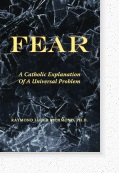
Fear
A Catholic Explanation of a Universal Problem
by Raymond Lloyd Richmond, Ph.D.
Includes the text of this webpage plus much additional information.
 |
|
Fear. One small word, and yet so much hangs on it.
Fear keeps alcoholics drinking, addicts addicted, and wretched sinners
stuck in sin like quicksand. In fearing the darkness of the human psyche
you never get to feel the true joy of real light. Because, after all, the
light of truth illuminates the dark and shows the darkness for what it is.
So there you are, in full irony: in your fear of the dark, you end up
fearing love itself.
Still, despite the fear, there is hope. The shards of broken love can be
repaired.
More
Information |
|
|