|
|
|
How to
shift the emphasis on
sin
to a
focus on healing. |
Love |
Fear |
Guilt |
Sexuality and
Romance |
Books |
About CSF
Compassion |
Chastity |
Responsibility |
Serving the Self |
Disobeying God |
Same-sex Attraction |
Identity |
Obedience to False Authority |
Duped |
To Die in All Things |
The Proof |
The Call |
Blessings
 HE
stood in silence, smoldering in anger at the smug self-assuredness of her accusers.
She knew in her heart why she had committed such an act. Surrounded with hypocrites,
she was angry with the world, and she was angry with God. She was fed up
with the misery she had to endure and wanted some excitement, some satisfaction,
some sense of something for herself. HE
stood in silence, smoldering in anger at the smug self-assuredness of her accusers.
She knew in her heart why she had committed such an act. Surrounded with hypocrites,
she was angry with the world, and she was angry with God. She was fed up
with the misery she had to endure and wanted some excitement, some satisfaction,
some sense of something for herself.
Still, she felt a strange curiosity
about that man squatting on the ground in front of her. “What is he
going to do?” she wondered. She cast quick glances at him, yet she never
caught him looking at her.
She waited for what seemed like
an eternity. People were shaking their heads and walking away, muttering
to themselves. She looked at him. He didn’t look at her. He just scratched
in the dust with his finger.
Then, with a mysterious calmness,
he looked up and asked her a question. She shrugged and shook her head, almost
whispering, “No. No one sir.”
For the first time she felt him
looking at her—not just at her, but into her. His next
words stunned and confused her. “Neither do I condemn you.” Her
heart quivered as it tried to comprehend what was occurring.
Yes, what was occurring? Call
it compassion. But note something carefully. He had something else
to say.
“Go, and from now on do
not sin anymore.”
Many persons who retell this
story neglect these final words. They try to make it seem that compassion
amounts to a broad-minded acceptance of anything. But that misses the
point.
Jesus came to us to save us from
our sin. His mission was not to condone sin and pretend
it didn’t exist. His mission was to show us how much we do sin, how much our sin
hurts us, how much it hurts others, and how much we will lose if we persist in
it. He knew that all sin will be accounted for in His
perfect justice, but he wanted us to know that we
have an opportunity to repent our sins and call upon His
mercy. Thus His mission was a mission of compassion: to
call us away from sin and into holiness, and to cause our hearts to quiver in awe
at the idea of it all.
Moreover, as this story of A
Woman Caught in Adultery (John 8:1–11) makes clear, sexuality and
sin are closely entangled. A holy life depends on sexual purity. A holy life
calls us to chastity.
Chastity
Sin feels good. Period.
Sin
gives us raw physical pleasure. It can be intense and intoxicating. But sin is
not bad because someone in authority, for some arrogant and mysterious
reason, says so. Sin is not bad because the Catechism says so. Nor is sin
bad because it feels good. Sin leads you away from the goal of holiness and
into the empty pleasures of merely feeling good. Sin misses the point of
life.
God is the point of life, and, in
regard to sexuality, He gave us genitals so that we could bring new life into
the world. Note that we aren’t creators; God is the Creator and we are
procreators—that is, we stand in the place of the Creator. Our genitals
therefore serve the purpose of
procreation [1].
They serve love by bringing children into the world who will learn to love
Love—God Himself—to become love themselves.
Regardless of its intensity of feeling, sin
defiles love. Sin is the hatred of love. Sin makes pleasure its own end, and so it
ends in failure.
Still, sin feels good—and that
points to the ultimate spiritual battle. Regardless of the throbbing intensity of
sin’s attraction, we have to struggle against its pleasures to remind
ourselves that, even though it has so much allure, sin is the hatred of love.
The battle against sin can be fought only
with love, and chastity is one powerful weapon in
our hands.
|
Chastity is not
the repression of sexuality, it is the purifying transformation of
desire into
love. |
|
As the full human
response to divine love, chastity encompasses
all the psychological, social, and physical consequences of accepting that
the body is the temple of the Holy Spirit (1 Corinthians
6:19). In chastity we renounce lust, dress
modestly, set aside our
illusions about the “self”, and
distance ourselves from—or, in scriptural
language, die to—the corrupt social world
in which we all live, to prepare ourselves for holy service in the Kingdom
of Heaven.
|
When every child
is born, it is in danger of being devoured by demons, who feed especially on
lust. Children conceived in lust as accidents of pleasure are deprived of the
blessing of a chaste and holy conception, and so through their lives they will
be crippled in their ability to resist demonic temptations to lust. |
|
Chastity is not just an attitude
toward human sexuality, it is the full acceptance
of the human responsibility to the holy lifestyle
that Christ preached—and lived in His body—and that contemporary
society, in all its psychobabble about happiness and
self-fulfillment, tries its best to subvert.
Chastity, then, is a way of
life—the way of life, the only lifestyle, the only
“orientation”—for anyone who would follow Christ and claim
to be Christian. And woe to the soul that spurns chastity. Love is
chaste, and to spurn chastity is to spurn love. If you spurn love, you will
find that in the end you are left with nothing
but everlasting broken emptiness. To
spurn chastity is to spurn Christ Himself, who, in His real and physical
suffering on the Cross—truly present to us in
the broken bread of the Eucharist—offers
the only means to heal our human
brokenness.
|
There is but
one price at which souls are bought, and that is
suffering united to My suffering on the cross. Pure
love understands these words; carnal love will never understand
them. |
|
|
— as told to St.
Faustina
(Diary, 324) |
|
Chastity is also a choice, a
choice of love. Moreover, just as chastity is a choice, the rejection of
chastity is also a choice, a choice of
hatred.[2]
Those who ridicule the Church for its teachings about chastity, saying, for
example, that the Church has a phobia about sexuality, are those who themselves
have a phobia: the fear of choosing to live a
holy life with all the
suffering, all the
sacrifices, and all the
love a holy life entails.
Still, we have an obligation—an
obligation that ensues from having chosen to follow Christ in the way of
the cross—to not hate those who hate chastity, to not fear those who
fear suffering, to not reject those who reject holiness itself. And even
if they close their ears to our words, we have a compassionate obligation
to pray that they might someday, before they die, make the choice to listen
to, rather than reject, the Holy
Spirit.
Responsibility
It was almost the end of his
shift. He was off at noon that day; a game was on TV early that afternoon,
and he wanted to get home as soon as possible. He saw the bag on the floor.
There were several men standing by a distant window talking on their cell
phones.
“It’s a nice bag. It must belong to one of them,”
he told himself, as he walked by.
Later, as he was watching the game, he saw the news item: the
bomb had killed and injured dozens of tourists.
When he was called before his boss, he stammered, trying to
justify his actions.
“What do you mean, you didn’t think it was anything
serious?” His boss glared at him. “We have procedures to follow!
You’re fired! Get out of my sight!”
It’s a horrific
story.
But what if this were your teacher,
a priest—or you—who, having disregarded responsibility to defend the
Tradition of the Church, had to stand before Christ in final judgment?
Depart from Me, you accursed,
into the eternal fire prepared for the devil and his angels (Matthew
25:41).
Serving the
Self
Because chastity is a matter
of respect for our bodies, we must be responsible caretakers of our bodily
sexuality. Saint Paul said (1 Corinthians 6:12–20) that a lack of respect
for sexual and reproductive functions are offenses against one’s own
body, the temple of the Holy Spirit. Psychologically,
these offenses are acts of
narcissism,[3]
and narcissism, by definition, is the psychological
defense of self-gratification.
Self-gratification is a rupture with
the divine because it offends real love: it places
one’s self above love of God, Who made heaven and earth—including our
bodies. The offense of self-gratification makes the temple into a brothel, so to
speak.
Any activity that reduces the
sexuality of the body to something no more than a
form of entertainment is narcissism because
it seeks to make yourself seen through your
desire for another person. When you look at another
person with desire, you do not see a soul enrobed in chaste beauty; you see
only the exuberant fantasy that your aching throb of loneliness might be
alleviated through someone’s body. Narcissism makes your pleasure
in having your body fondled the focus of your satisfaction.
It makes your pleasure in playing with the body of another
person—turning God’s temple into your toy—into the
focus of your satisfaction. That’s self-love placed above
love of God, isn’t it?
So where does all this
self-gratification placed above love of God lead us?
Well, let’s find out.
Disobeying
God
In order to understand how friends,
teachers, “therapists,” the entertainment industry—and even priests—can
lead you away from God, under the guise of “being compassionate,”
consider how the serpent tempted Eve to disobey God (Genesis
3:1-6).
• |
First, he led her to doubt God
by making Him seem irrational: “Did God really tell you not to
eat from any of the trees in the garden?” |
• |
Then he led her to doubt that
God was being honest with her: “You certainly will not
die!” |
• |
Consequently, Eve saw that the
fruit was good for food and looked really nice. It was
natural, so it had to be good for her, she thought.
So, persuaded by disobedience itself, she disobeyed God’s command and
satisfied her desire. |
Moreover, we continue to be tempted
in the same way today by those who convince us to doubt God so that we will
ultimately disobey God’s commands. Today, we
are induced to look with desire at behaviors that separate us from a holy
life, saying to ourselves, “How can there be anything wrong with something
that seems so nice?”
Yes, how can there be anything wrong
with something that seems so nice? Well, God
knows.
Neither shall you
allege the example of the many as an excuse for doing wrong. |
— Exodus 23:2
|
Thus we are drawn away from God
by so-called “well-meaning” persons who—as odd as it sounds
to say it—lack compassion for us. They lack compassion for us
because they seek only their own self-gratification.
Same-sex
Attraction
The need for compassion
and the danger of being led away from God find a particularly poignant
merger in regard to feelings of same-sex attraction (SSA). These feelings
can occur in children because of dysfunctional
family dynamics that affect a child
unconsciously.[4]
For example, a girl whose mother jumps to conclusions, is emotionally cold or distant,
and does not listen with tender compassion to her daughter, and whose father does not
demonstrate an authority of competent justice tempered with considerateness,
can be attracted to the emotional openness of another girl’s personality.
Likewise, a boy whose mother tends to be angry, critical, and demanding, and
whose father does not demonstrate an authority of emotional understanding,
confidence, and protection, can be attracted to feelings of acceptance and
protection from another boy. In these cases, the fantasies of attraction are
not natural expressions of the girl’s or boy’s being; instead,
the fantasies point to the psychological truth of what is missing in the
family structure.
|
Note carefully that
homosexual refers to someone who has erotic desires for persons of the same gender.
Gay refers to a man who is engaging in sexual activity with another man.
Lesbian refers to a woman who is engaging in sexual activity with another
woman.
Note also that, because of cultural indoctrination to accept the ideology of
homosexuality as a normative identity of life, today the term gay is commonly
not restricted to men but is applied to everyone of homosexual desires, even to women,
so as to enmesh both genders in the same delusion. |
|
Homosexual desires,
therefore, are not something a person is born with; these desires are created as a
psychological defense against unhealed emotional wounds. Because of cultural brainwashing
in our current societies, and because parents shudder at the idea that their children
have become homosexual because of parental failures, the idea is now propagated that
individuals are homosexual rather than that they have been shaped by parental failures
and social lies.
Consequently, having same-sex attraction
fantasies does not indicate anything about a person’s being. Such fantasies do
not mean that a person is homosexual. Nor do such fantasies mean that the person is gay
or lesbian, because gay and lesbian lifestyles are conscious choices of behavior.
Same-sex attraction fantasies indicate only one thing: that a person is being influenced
by cultural propaganda.
Children, therefore, need competent,
emotionally-sensitive psychological explanations of their feelings
of same-sex attraction. But if children do not trust their parents to understand
their confusing and embarrassing feelings, the children will be afraid to go to
their parents for guidance. Thus, lacking any psychological resources, the
children will be driven into shameful isolation
and will eventually end up in the hands of sexual predators and
political activists
who, instead of offering psychological truth, will direct the children into a
political agenda with its purpose of undermining the Catholic faith.
When this occurs, conditions
are ripe for a crisis of identity.
Identity
Halloween. Mardi Gras. Masquerades.
Our cultures are full of ways we pretend that we can change our identities
by changing our outward appearances.
In times past,
a person’s hat really did identify a profession. And even today we
wear secular uniforms (uni- means “one” and form
means “shape” or “outward appearance”)—as well as
religious habits and liturgical vestments—which give one common appearance
to all who perform a particular function.
Most of us, however,
understand full well that a uniform, in itself, does not mean anything. Unless
you have been trained to perform a job, no matter what uniform you put on
you won’t be able to perform that job.
Nevertheless,
there is one uniform which does define us absolutely and which can never
be changed. This is the uniform of the body, and it defines us sexually
according to reproductive function.
Reproductive
sexuality is a pure function of biology. The problems
with gender identity begin in the
unconscious.
Notice how children tend to believe that what is seen is real.
If a child sees a man wearing a Santa Claus costume, the child will think,
“That is Santa Claus.” In the same way as a child attributes
reality to appearance, individuals will unconsciously confuse sexual
functioning with the costumes which create a sexual appearance.
But the truth
is that no matter what clothes you wear, no matter what kind of play you
enjoy, no matter whom you choose as playmates, no matter how you behave—no
matter, even, how you might alter your body surgically—you cannot
change the brain, the bone structure, the internal organs, and the genetic
structure that define the reproductive function of your gender. Consequently,
if you present a gender identity to the world that is different from
the gender God has given you, then you are engaging in a fraud and perpetuating
a lie—and perpetuating a lie is a mortal sin.
|
“Gender fluidity”
is a nefarious Satanic aberration that has no place in a Catholic lifestyle.
Just to engage in the language of this ideology exposes a person to grave
sin. |
|
So why, then,
would anyone develop a desire to change a reality made by God? Well, even if
you accept the reality of a non-gendered immortal soul, the basic facts of bodily
life—reproduction and death—are still painful realities. These realities don’t
mean anything; that is, they do not carry any mysterious secrets about
life—they are just facts of life. A fantasy of changing reality by “changing”
your gender derives from a misguided belief that having a different gender than
God gave you will release you from the hard facts of social emptiness and death.
But social emptiness and death are the result of separation from God, and no
human effort can restore the soul’s union with God that, in our fallen state, is
lacking in all of us. Only the divine grace of real love can lead a soul back to
God.
Consequently, if you fail to recognize
the inherent fraud of all social identity and
cling to the belief that gender has any meaning apart from reproduction, you
cling to an impossibility: the unconscious attempt to escape
responsibility to genetic reproductive reality and,
ultimately, responsibility to God Himself.
It would be far better to find
your identity in something that never changes, something that can never be
taken from you.
|
All flesh is
like grass,
and all its glory like the flower of the field;
the grass withers,
and the flower wilts;
but the word of the Lord remains forever. |
|
|
—1 Peter
1:24–25 |
|
Obedience to
False Authority
Two guards lead you into a cold,
harshly lit concrete room. The room is empty except for a man kneeling on
the bare concrete, blindfolded, with his hands bound behind him. You recognize
him as one of the terrorists who have been undermining your work. A military
officer enters. He quietly removes the pistol from his holster. Holding it
by the barrel, he hands it to you, glancing at the man kneeling on the
floor.
“Here. Take this. Put it to his head and pull the
trigger.”
You feel stunned, your mind momentarily paralyzed by the incongruity
of the events.
“Go ahead, take it,” the officer says. “Kill
him. You have my permission.”
What would you do? If you are
like most people, you will likely say that you would refuse. Fair
enough. But what would you really do? What would you actually do in
those particular circumstances? Well, if you are like most people, in those
particular circumstances there is a good chance that—unless you have
the same living depth of faith that allowed the Christian
martyrs to not betray their Tradition—you
would kill the man.
Now, that’s a shocking
statement. But consider two important social-psychological scientists from
the 1960s and 1970s who investigated obedience to authority. In his experiments,
Stanley Milgram found that ordinary adults would be quite willing to inflict
horrifying electrical shocks to other persons when told to do so by an authority
figure.[5]
Philip Zimbardo, in the Stanford Prison
Experiment,[6]
found that when ordinary, “nice” students played roles of prisoners
and guards, the situation quickly degenerated into demeaning inhumanity to
such an extent that the experiment had to be called off.
Years later, Zimbardo wrote,
“. . . ordinary people, even good ones, can be seduced, recruited, initiated
into behaving in evil ways under the sway of powerful systemic and situational
forces.” [7]
So think carefully. Raised Catholic,
you now hear teachers and priests—as well as television, movies, music,
video games, magazines, and newspapers—telling you, “Go ahead.
If it feels good, do it. You have our permission.”
Yes, they give you their permission
to do anything that makes you feel good—and they even insinuate that
there must be something wrong with you if you do not comply. You are being
duped.
Duped
Those who don’t understand the reality
of the great spiritual battle against evil are being duped by an anti-Christian
society into believing that lust and hatred have the power to redeem our emotional
emptiness.
You are being duped especially by the
entertainment industry, an industry that for decades has been working subversively
to destroy Christian family values. Thanks to movies and television, the romantic
illusion has become the sustaining hope of life; Christian faith has been depicted
as contemptible hypocrisy; humility has been mocked as
cowardice; hatred, revenge and violence have been extolled as virtues; power, strength,
and cunning have been glamorized; foul language has become customary; women have been
induced to forsake feminine modesty and dignity and to imitate
masculine arrogance and aggression; and immodesty, nudity, fornication, and adultery
have become routine behaviors.
Yes, you are being duped and brainwashed
by the “progressive” liberal agenda of the entertainment industry into sanctioning
the idea that sin does not exist, that religion is foolish,
and that lust and violence are necessary for your happiness. It has all been going
on openly right under your own nose, and you haven’t even noticed it. As a result,
instead of taking personal responsibility to detach yourself
from subversive social illusions, you willingly consume
them, over and over. Sin enslaves you even as you are told that sin does not
exist.
So what is your responsibility here?
Well, you’re not responsible for others trying to dupe you, but you are responsible
for learning the truth and resisting the subversive attempts of others to dupe
you.
To Die in All
Things
In its early
years, the Church struggled against the opposition of the Roman government,
which drew its identity and strength from pagan religious practices. Thus,
when Saint Paul founded and visited churches, he had to remind the converts
not to get caught up in the prevailing cultural norms.
For example,
to the Ephesians, he wrote, “I declare and solemnly attest in the Lord
that you must no longer live as the pagans do—their minds empty, their
understanding darkened. They are estranged from a life in God because of
their ignorance and their resistance; without remorse they have abandoned
themselves to lust and the indulgence of every sort of lewd
conduct.”
Then Saint Paul
went on to remind the Ephesians that lewd conduct and lust were opposed to
Christian conduct. He paused in reflection, perhaps thinking about those
individuals in the community who had been preaching untruths and leading the
Christians astray. Then he added, almost sarcastically, that he was supposing
that when they learned about Christ, He had been preached to them and taught to
them “in accord with the truth that is in Jesus” rather than in accord
with prevailing cultural ideas about lust and the indulgence of every sort of
lewd conduct.
What, then, is
this “truth that is in Jesus”? Well, Saint Paul continued, it is the
truth that “you must lay aside your former way of life and the old self
which deteriorates through illusion and desire, and acquire a fresh, spiritual
way of thinking. You must put on that new man created in God’s image, whose
justice and holiness are born of truth.”
Or, stated in
its most elegant simplicity, you must die to—that is, renounce—the human
identification with sin in order to have life in all things divine.
|
 |
“Whoever
knows how to die in all things will have life in all
things.” |
|
|
—St. John of
the Cross
The Sayings of Light and Love, no. 160. |
|
The
Proof
The proof of all this is in Christ
Himself.
“Love one
another as I have loved you.”
Did He cheat us or lie to us?
No. Did He desire the death of His enemies? No. Did
He use us for His sexual pleasure to find “happiness”?
No. Instead He suffered for us, as an act of
compassion and
mercy.
In His Passion He showed us what
real love is: to will the good of
others.[8]
And in today’s world—this confused and
broken world—love continues to
manifest itself by calling us away from sin into
holiness. The false “love” touted by contemporary society does
not call us into anything but sin; instead it tempts us to abandon holiness
for the sake of sensory feelings. But as long as you are concerned about what
you can get from life, you will be dissatisfied. Everything material—food,
entertainment, drugs, masturbation, pornography, erotic pleasure in another
person—passes quickly only to leave us overpowered by cravings for more.
Real love calls us into acts of
sacrifice and giving—not the giving of material things that merely bribe
others to like us, but the giving of qualities such as patience, kindness,
understanding, mercy, forbearance, and forgiveness. These are compassionate
qualities whose ultimate purpose is the salvation of other souls.
Christ calls us all to live lives
of love, with Him, free from our own narcissistic
identities. Thus Saint Paul said, “I have
been crucified with Christ; it is no longer I who live, but Christ Who lives
in me” (Galatians 2:20).
The Call
You were dictated to and reasoned with.
You feel emotionally misunderstood and lonely. You crave affection. You feel
confused. Then you discover those who seem different. They’re free thinkers.
They’re not afraid of the unusual. They call to you, “Come, be like us.
We won’t reject you.”
You want to be understood. You want to
feel appreciated. You want to belong.
But stop. Consider. Christ was
misunderstood. Christ was rejected. Yet He never sought the approval of others.
He brought truth. Many did not want it. Still, He called them—and He still calls
us—to chaste purity in the Kingdom of Heaven. Anyone who wants it can attain
it.
Blessings
Blessed are the poor in spirit,
for theirs is the kingdom of heaven. Blessed are the parents who have
died in all things, who keep their love for God as the entire reason for
living, who pray constantly with their minds
in their hearts, and who, for the sake of love, forsake the satisfaction
of personal convenience and take the time and make the emotional sacrifices
to dedicate themselves to providing their children with explanations, comfort,
reassurance, protection, and guidance into the way of
holiness. Blessed are the children who,
for the sake of love, forsake the satisfaction of personal identity, the
satisfaction of comforting themselves, the satisfaction of reassuring themselves,
and the satisfaction of disguising narcissism and eroticism as
love.
Blessed are the pure of heart,
for they will see God. Blessed are those who, for the sake of love, forsake
personal pride and choose to live in chaste purity of heart and take
pride only in the Lord.

Notes.
1.
Please note the word “open” in the phrase open to procreation.
This is not to say that every sexual act must produce a child. It
means that the fundamental meaning of sexuality is in its procreative
function—rather than as something done for fun or sport or entertainment.
To cast away the fundamental meaning of sexuality (as in masturbation, oral
sex, anal sex, artificial birth control, etc.) is to fall into sin. The
Catechism of the Catholic Church expresses it this way: “. .
. every action which . . . proposes, whether as an end or as a
means, to render procreation impossible is intrinsically
evil ”
(CCC 2370).
2.
The spiritually negative emotion of hate does not necessarily mean
a passionate loathing; it can just as well be a quiet, secret desire for
harm to come upon someone or something. Hate can be a subtle thing, therefore,
and it often is experienced more unconsciously than consciously. Consequently,
it will often be very easy to deny that you feel any hatred for anyone at
all.
Note also that hatred and anger are
theologically synonymous. Christ Himself taught the crowds, “But I say
to you, whoever is angry with his brother will be liable to judgment”
(Matthew 5:22). And Saint John the Evangelist reflected this sentiment when
he said, in one of his letters, “Everyone who hates his brother is a
murderer” (1 John 3:15). The theological implication of these texts,
therefore, is that any desire for harm to come to another person—whether
through active loathing or through passive resentment—is, in its spiritual
essence, an evil desire to remove the fullness of life (with its possibility
of love and forgiveness) from that person.
3.
Narcissism, in its psychological meaning, refers to making oneself
seen and noticed; its operations are concerned entirely with the self
and its satisfactions, such that all motivation begins with the self and
returns to the self.
|
“. . . The
root of the scopic drive [i.e., the motivation to see and be seen—RLR]
is to be found entirely in the subject, in the fact that the subject sees
himself. . . . in his sexual member. . . .
Whereas making oneself seen is indicated by an arrow that really comes
back towards the subject, making oneself heard goes towards the
other.”
See Jacques Lacan,
“The Partial Drive and its Circuit” and “From Love to the
Libido.” In The Four Fundamental Concepts of Psychoanalysis.
(New York: W. W. Norton, 1981, pp. 194–195). |
|
Therefore, in contrast
to this self-centered orientation of a narcissistic culture, Christ, Who
is the Word, makes Himself heard by compassionately calling us out
of ourselves, to listen to Him, and to follow Him. He is the good shepherd,
the gatekeeper who opens the gate, “and the sheep hear his voice, as
he calls his own sheep by name and leads them out. When he has driven out
all his own, he walks ahead of them, and the sheep follow him because they
recognize his voice ” (John
10:4).
4.
Those who do not understand the concepts of the unconscious—such as
unconscious desire and unconscious anger—fear the
unconscious, and so they take up the politically-correct ideology that we are
“born with” our desires.
5.
See Milgram, S. (1963). Behavioral study of obedience. Journal of Abnormal
and Social Psychology, 67, 371–378.
Early in the 1960s, Stanley Milgram, a professor in social
psychology at Yale University, conducted experiments about obedience to authority.
Milgram’s experiments revealed a dark side of human nature: many persons were
quite willing to obey an authority figure even if such obedience meant overriding
their conscience and consequently inflicting severe pain on someone, even to the
point of risking that person’s serious physical injury or death. Moreover, even
though the experiments were a deception (that is, the “electric shocks” that the
subjects administered to the victims were not real, and the “victims” were actually
part of the experiment, only pretending to feel pain), many of the subjects suffered
considerable disillusionment and trauma to discover that they had the capacity within
themselves—in obedience to authority and peer pressure—to inflict such agonizing
torment on another person.
This should be a spiritual wake-up call to anyone who asserts
that we can be good stewards of the Christian faith just by following our consciences
about morality.
6.
See P. Zimbardo. The Lucifer Effect. (New York: Random House,
2007).
7.
Ibid., p. 443.
8. St. Thomas Aquinas. Summa
Theologica. I-II, 26, 4.
Recommended
Reading
A treasure of a resource for psychological and spiritual healing. Information
gathered from my websites (including this webpage) is now available at your fingertips
in book form.
 |
 |
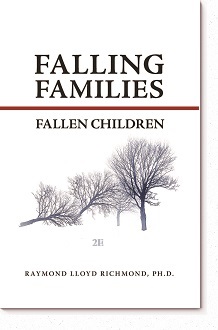
Falling Families, Fallen Children by Raymond Lloyd Richmond, Ph.D. Do
our children see a mother and a father both living in contemplative love for
God with a constant awareness of His presence and engaged in an all-out battle
with the evil of the world? More often than not our children don’t see living
faith. They don’t see protection from evil. They don’t see genuine, fruitful
devotion. They don’t see genuine love for God. Instead, they see our external
acts of devotion as meaningless because they see all the other things we do that
contradict the true faith. Thus we lose credibility—and when parents lose credibility,
children become cynical and angry and turn to the social world around them for
identity and acceptance. They are children who have more concern for social approval
than for loving God. They are fallen children. Let’s bring them back.
Ordering
Information |
|
|





















 Reprints of this article
are available
Reprints of this article
are available