|
|
|

What’s
wrong with sports? Don’t they teach us fair play?
 n today’s world, competitive
sports have become a ubiquitous cultural institution, and so, on the surface,
it may seem that they are all for “fun” and that they teach
“fair play.” n today’s world, competitive
sports have become a ubiquitous cultural institution, and so, on the surface,
it may seem that they are all for “fun” and that they teach
“fair play.”
Love—or
Pride?
Nevertheless, the underlying
values of competitive sports derive from the ancient pagan Greek adoration
of athletic strength, prowess, and glory. But look closely: these are all
ideals based in the sin of pride. Then look again:
pride stands completely opposed to the virtue of
love.
|
If morality requires
respect for the life of the body, it does not make it an absolute value.
It rejects a neo-pagan notion that tends to promote a cult of the body,
to sacrifice everything for its sake, to idolize physical perfection and
success at sports. By its selective preference of the strong over the weak,
such a conception can lead to the perversion of human
relationships. |
|
| |
—Catechism of the Catholic
Church (2289) |
|
God is love. Moreover, because God
is love, a genuine Christian life does nothing but represent God’s love
to the world. I mean that literally: as God presents his love to us, we in
turn must re-present it to the world.
|
Finally, all
of you, be of one mind, sympathetic, loving toward one another, compassionate,
humble. Do not return evil for evil, or insult for insult; but, on the contrary,
a blessing. . . . |
|
|
— 1 Peter 3:8-9a |
|
The Scandal of
Pride
When the Greeks built a gymnasium
in Jerusalem during the Maccabean Dynasty, the Jews were scandalized (see
2 Maccabees 4:7 ff.), and it holds even more true today that competitive
sports are a scandal to Christianity because you simply cannot present
love to the world through the evil-for-evil and
insult-for-insult nature of strife and
competition.
|
Love is patient,
love is kind. It is not jealous; [love] is not pompous, it is not inflated,
it is not rude, it does not seek its own interests, it is not quick-tempered,
it does not brood over injury. . . . |
|
|
— 1 Corinthians 13:4-5 |
|
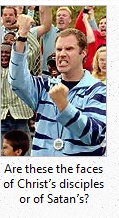 Now, when parents kill each other over
arguments about children’s sports, you know something is seriously wrong
under the surface and that love has been gravely defiled; so just imagine the
corruption—not to mention the organized crime—underlying professional and
amateur sports. Now, when parents kill each other over
arguments about children’s sports, you know something is seriously wrong
under the surface and that love has been gravely defiled; so just imagine the
corruption—not to mention the organized crime—underlying professional and
amateur sports.
Do you think you will find in
competitive sports any hint of holiness? Where is
humility,
patience, or
kindness? Instead the playing fields are
strewn with boasting, pomposity, inflation, jealousy, rudeness, self-interest,
anger, and brooding over injury.
Our cultural adoration of competitive
sports teaches us to put our trust in power, mastery, and competitive
strategy—and to kill, whip, trounce, or trample anyone who gets in our
way. All of this “sportsman” frenzy stands completely opposed
to true Christian conduct, as lovingly described by Saint Paul:
|
Let us never
be boastful, or challenging, or jealous toward one another. Help carry one
another’s burdens; in that way you will fulfill the law of
Christ. |
|
|
—Galatians 5:26; 6:2 |
|
Imagine, for example, playing
ping-pong without hitting the ball back, so that the other person can accumulate
all the points he wants. Imagine playing bridge without doing anything to
obstruct the other players in claiming all the points they want. Imagine
two teams of men joyfully walking from one end of a field to the other, helping
each other to accumulate all the touchdowns they want. In the eyes of the
world, it would be boring, wouldn’t it? Well, in the eyes of the world,
Christianity is boring. That’s why the Roman Empire made a sport
out of killing Christians: it made Christianity into something
exciting.
Boasting
Saint Paul, moreover, who not
only clearly understood the truth about Christian life but also lived it
right into martyrdom, had no use for puffing
up his ego by boasting about a favorite sports team:
|
I will rather
boast more gladly of my weaknesses, in order that the power of Christ may
dwell with me. Therefore, I am content with weaknesses, insults, hardships,
persecutions, and constraints, for the sake of Christ; for when I am weak,
then I am strong. |
|
|
— 2 Corinthians 12:9b-10 |
|
In fact, Saint Paul, summed
up the Christian mission in a few words that show how the frenzy of competitive
sports has no place in a Christian lifestyle:
|
But may I never
boast except in the cross of our Lord Jesus Christ! |
|
|
— Galatians 6:14 |
|
St. Thomas Aquinas’
Opinion
Saint Thomas Aquinas did not speak
directly about sports, but he did say in his Summa Theologica that the
following vices (which certainly characterize sports) are mortal sins.
II-II:37 discord
II-II:38 contention
II-II:41 strife
II-II:43 scandal
II-II:65 bodily injury
II-II:108 vengeance
II-II:112 boasting
II-II:116 quarreling
II-II:132 vainglory
II-II:162 pride
“But wait a minute,” you say. “We’re
just doing these things for fun. We’re not really committing any sins.”
Really? Can a man have sex with a
prostitute and say it’s just for fun and not really a sin? Can a married woman
“have a fling” with someone she meets on a cuise and say it’s just for fun and that
she’s not really committing adultery? Can a street gang kill someone on the street
and say it’s just for fun and not really murder?
The Real
Crown
 Saint Paul, in his merciful
attempt to become “all things to all” (1 Corinthians 9:22) for
the sake of preaching the gospel, often used the metaphor of “running
the race” (1 Corinthians 9:24–27; Hebrews 12:1) to illustrate
the virtues of discipline and perseverance in grace. Saint Paul, in his merciful
attempt to become “all things to all” (1 Corinthians 9:22) for
the sake of preaching the gospel, often used the metaphor of “running
the race” (1 Corinthians 9:24–27; Hebrews 12:1) to illustrate
the virtues of discipline and perseverance in grace.
If you read his words carefully,
however, you will realize that, in contrast to the vain, perishable prize
of human glory sought by athletes, Saint Paul sought the eternal, unperishable
crown of God’s glory. It is a crown given only to the
humble, as Saint Paul knew and as the Blessed
Virgin before him attested: “For He has regarded the humility of His
servant; behold, therefore, from this day all generations will call me
blessed.”
|
If you were to
pray the Litany of Humility as it should be
prayed—that is, not just saying the words but yearning
for their fulfillment in your very being—you would find it impossible
to play competitive sports. |
|
Now, it often happens that high
school and university students will pray before a game. Ironically, this
only reveals the fundamental fraud of their
faith: if they really trusted in God to protect them in all things, they
would not be using competition with others to make themselves feel strong
and powerful.
Going for the
Gold?
The truth is, if you learn to
love others as God loves us, it will simply break your heart to compete with
anyone for any reason. Until you do learn this
love, and as long as you cling to the
illusions of your own athletic prowess, you
will be like the rich man who walked away from Christ. Whereas Christ demanded
humble self-sacrifice, the rich man wanted to
go for the gold.
 Jesus
in most appropriate language . . . censured severely the various fashions
and frivolities lately introduced from Athens. He condemned likewise the
games and juggling now in use among them, and which were also spreading
throughout Nazareth and other places. These games were likewise a product
of their intercourse with Athens. Jesus stigmatized them as unpardonable
since they that indulge in them look upon them as no sin; consequently, they
do no penance for them, and therefore they cannot be pardoned. Jesus
in most appropriate language . . . censured severely the various fashions
and frivolities lately introduced from Athens. He condemned likewise the
games and juggling now in use among them, and which were also spreading
throughout Nazareth and other places. These games were likewise a product
of their intercourse with Athens. Jesus stigmatized them as unpardonable
since they that indulge in them look upon them as no sin; consequently, they
do no penance for them, and therefore they cannot be pardoned. |
—The Life of Jesus
Christ
as told by the Venerable Anne Catherine Emmerich |
The Wisdom of
Non-competition
Christianity is fundamentally
a religion that values non-competition because Christ taught us to place
all our trust in God while seeking our spiritual hope in His Kingdom. Therefore,
all the Catholic mystics have realized that the ways of the social world
are useless distractions to the spirit.
Moreover, this wisdom of
non-competition and detachment from worldly success is so profound that even
non-Christian philosophers have sought it.
|
THEREFORE,
the sage holds in
his embrace the one thing (of humility) and manifests it to all the world.
He is free from self-display, and therefore he shines; from self-assertion,
and therefore he is distinguished; from self-boasting, and therefore his
merit is acknowledged; from self-complacency, and therefore he acquires
superiority. It is because he is thus free from striving that therefore no
one in the world is able to strive with him. |
|
| |
—Lao Tzu
The Tao Te Ching, 22.2. |
|
Think about that. If you are free from striving,
no one in the world is able to strive with you. That’s the first step to the real
peace that everyone asks for yet rarely finds. Yes, you ask for peace.
You ask for many things. But you “do not receive, because you ask wrongly, to spend it on your
passions” (James 4:3).
The text of
this webpage, integrated with other material from my websites,
has been conveniently organized into a paperback book of 350 pages, including
a comprehensive index.
 |
|
Though Demons Gloat: They Shall Not Prevail
by Raymond Lloyd Richmond, Ph.D.
Though we are attacked by liberal activists from without and by apostasy
from within, the true Church—that is, the body of those who remain
faithful to Church tradition—weeps, and she prays, because she knows
the fate of those who oppose God.
Our enemies might fear love, and they can push love
away, but they can’t kill it. And so the battle against them cannot be
fought with politics; it requires a profound personal struggle against
the immorality of popular culture. The battle must be fought in the
service of God with pure and chaste lifestyles lived from the depths of
our hearts in every moment.
Ordering Information |
|
|






















 Read an opinion of dissent
. . .
Read an opinion of dissent
. . .