|
|
|
The word
of reproach is a key that unlocks a door,
because reproach reveals a fault
of which the evil doer is often unaware. |
— Saint
Gregory the Great |
Witnessing the Faith |
Spiritual Counsels |
Books |
About CSF
“Don’t be judgmental!” |
Silenced by “Diversity” |
Necessary Judgment |
Forbidden Judgment |
Judgment can be Negative or Positive |
Lying to Evade Judgment |
God’s Inspiration or Demonic Influence |
Psychological Counsels |
Summary
 ON’T be judgmental! ON’T be judgmental!
How often have you heard that
exclamation as a snappy rebuttal to an attempt to warn someone of an
error?
“No
one should come to Church wearing shorts.”
“Don’t be judgmental!”
“Anyone
who makes a public denial of the faith should be
denied Communion.”
“Don’t be judgmental!”
“Women
who do not dress modestly are prostitutes of the
devil.”
“Don’t be judgmental!”
“It’s
a mortal sin to follow a lifestyle defiant of chastity.”
“Don’t be judgmental!”
“It’s wrong if a priest doesn’t follow the
rubrics.”
“Don’t be judgmental!”
“That
priest isn’t defending the faith, he’s pouring it down the
drain.”
“Don’t be judgmental!”
“Those
who love the world and seek approval and acceptance
through social media are flirting with doom.”
“Don’t be judgmental!”
|
The truth is, none of these things
is judgmental, but the agents of Satan in the Church
would have you believe that these and similar statements are judgmental in
order that they might silence any opposition to their nefarious
goals.
In fact, they even tried this
same tactic with Jesus Himself. When He criticized the Pharisees for their
hypocrisy (Luke 11: 42-46), a scholar of the law complained, “Teacher,
by saying this you are insulting us too.” And what did Jesus do? Did
He slink away like a dog with his tail between his legs? No. He rebuked the
scholars, too: “Woe also to you scholars of the law! You impose on people
burdens hard to carry, but you yourselves do not lift one finger to touch
them.”
Silenced by
“Diversity”
Now, several verses in the New
Testament do warn us against being judgmental; see, for example, Matthew
7:1 (“Stop judging, that you may not be judged”), Luke 6:37
(“Stop judging and you will not be judged”), Romans 14:13 (“Then
let us no longer judge one another”), and James 4:12 (“Who then
are you to judge your neighbor?”).
Because of these verses, many
persons today, especially in our contemporary social climate of political
correctness and diversity, claim that it’s
“judgmental” to speak about moral values in society or to say anything
to defend the faith because someone might feel hurt and offended.
“Don’t be
judgmental!” they say. “Who are you to talk? You’re not perfect
either!”
Well, to speak about and defend
the true faith is an act of love, and we don’t have to be perfect in
order to love. So, rather than be silenced on the spot, let’s ask a couple
of questions here. “What sort of judging is forbidden to us?” But
first, let’s ask, “What sort of judgment is necessary for
us?”
Necessary
Judgment
Consider that we have all kinds
of judges in our society whose purpose is to judge. These men and women must
determine whether someone accused of a crime is guilty or not, and then they
must determine a legally fitting punishment. If these judges stopped judging,
free civil society would collapse. The Bible does warn us that these judges
must act with impartiality and justice, but this sort of judging is not what
is meant when we are told not to judge our neighbor.
We also have a personal level
of judgment. For example, in psychology, one aspect of a clinical interview
is the determination of a patient’s capacity for good judgment.
This refers to a person’s ability to ascertain the prudence of his or her
actions and to determine the trustworthiness of others. Persons who cannot make
these sorts of judgments are considered to be psychologically disordered. In
non-psychological language, this capacity for good judgment is called
wisdom. Wisdom has been extolled though the ages, and, so, neither
is this sort of judging meant when we are told not to judge our
neighbor.
Forbidden
Judgment
Then what kind of judging is
forbidden to us?
Well, it’s a special kind
of judgment, something given to Christ alone.
|
Nor does the
Father judge anyone, but He has given all judgment to His Son. |
|
|
—John 5:22 |
|
And what does this judgment entail?
Saint John explains:
|
Whoever rejects
Me and does not accept My words has something to judge him: the word that
I spoke, it will condemn him on the last day. |
|
|
—John
12:48 |
|
In other words, the judgment
forbidden to us and given to Christ alone is the determination of whether
any individual soul will enter the Kingdom of Heaven or whether that soul
has, by its own actions, condemned itself to
Hell.
Entering into the Kingdom of
Heaven is not a simple matter of saying the words, “I accept Jesus as
my savior.” After all, many persons who claim to love God and who appear
to be holy and pious have secret sins hidden within their hearts. Conversely,
many persons who appear to be wretched sinners
have sorrowful contrition hidden within their hearts. Because God’s
patience allows us until the very last
moment of life to repent our
sins, our judgment occurs after death. No human,
then—only Christ—can probe the depths of the human heart in its
ultimate destiny, “for He will bring to light what is hidden in darkness
and will manifest the motives of our hearts” (1 Corinthians
4:5).
|
At the moment
of judgment after death, every soul will have to face Christ Himself. It
will see itself in the light of divine truth, and—assuming that
it recognized and repented its sins before
death—it will sink down into purgation so that it can stand before
God’s love in heaven without being burned by it. The unrepentant soul,
however, upon perceiving the truth of its sins, will find the glory of
God’s love—the love its sins have defiled—to be unendurable,
and will want to flee from heaven. Just imagine how horrible it would be if
you had to surrender yourself to a band of demons to be carried off to your
everlasting doom, all the while knowing that it was all your own
fault.
God’s
justice is perfect, but God is also merciful,
and any soul can experience His mercy if it calls
out for mercy with a penitent heart before death. |
|
Therefore, no
one should attempt to say whether or not anyone will be saved because that
judgment is reserved for Christ only.
Judgment can
be Negative or Positive
Notice that judgment can be negative
or positive, and that we are forbidden to make either
judgment.
Negative
Judgment
You can commonly hear people
making negative judgments when they say things like, “He was
such an evil man that I just know he’s burning in hell right now!”
Well, no one but God knows whether that man repented his sins at the last
moment of his life and found reconciliation with
God.
Positive
Judgment
Moreover, we persist in preempting
Christ by making positive judgments in subtle ways. For example,
it’s not uncommon to hear at a funeral, “Aunt Alice was such a
kind and generous woman that she is with the angels in heaven right now!”
Well, even one unrepentant mortal sin on Aunt Alice’s soul could have
invalidated all the good she ever did, and so, like it or not, saying that
she is in heaven is a judgmental act.
Also, when well-meaning but
self-deceived persons make the claim that “everyone
will go to Heaven,” they are presuming to make a judgment. It’s
a positive judgment, yes, and they may be scandalized to think that in their
attempts to avoid being judgmental they are actually being
judgmental, but so it is.
Lying to Evade
Judgment
In a court of law, someone accused
of a crime will often say things like, “I was ignorant of that law,”
“I didn’t mean to do it,” or “It was an accident; I was
only trying to help someone.” Now, the person could be telling the truth,
but the person could just as well be lying. How is the judge to know the
truth? Well, he can’t know for certain, so he has to make an intuitive
guess. Sometimes he will be right, and sometimes he will be wrong—and quite
often guilty persons walk away laughing.
In regard to theological and
spiritual matters, people will also lie. To hide their
sins, they will lie to others deliberately. To hide
their sins, they will seek out liberal confessors
who will tell them they have done nothing wrong. And, to hide their sins,
they will lie to themselves, unconsciously. They might say, for example,
“I’m only seeking the good of the Church,” or “I’m
only doing what I believe is right.” Maybe so. But they could just as
well be seeking the sweet taste of
disobedience.
So what can anyone do about such
persons?
Well, we have to leave the judgment
to Christ, because only Christ can discern the true motive for anyone’s
behavior. Only Christ can discern genuine ignorance from unconsciously veiled
culpability.
And where does this leave all
of us?
Well, we should all be
examining our unconscious
motives with fear and trembling, because the
lies we tell ourselves can fool us and they can fool others but they can’t
fool Christ.
God’s
Inspiration or Demonic Influence?
In regard to the concept of judgment,
it is true that we cannot tell solely from observable behavior what might be going
on in a person’s heart. But then a grave mistake can be made. Some persons
might then say that, because God calls us to Himself in various ways, we should
not rebuke someone who does something that is spiritually wrong. “We all have
our own paths to God,” they say with a dismissive self-assurance.
“Don’t be legalistic.”
Well, not every human
motivation comes from the Holy Spirit. Not every
behavior can be accepted equally, because some behaviors are sin, and sin
is motivated by demonic influence.
Keep in mind here that no matter what we
do, our virtue is not in the details of the action itself but in our willingness to
be good servants who do only what they are supposed to do (see Luke 17:7–10). What
really matters to God is that we surrender ourselves to revering Him with loving
attention to even small details. Carelessness walks the same path as disobedience,
a path that takes you right into the service of the devil and his motto: “Do what
thou wilt.”
When it is Appropriate
to Give a Warning
In general, if the inappropriate behavior
affects only the offender, and if you do not have a personal relationship with the
offender, it is best to remain silent and put your suffering into prayer. If the
behavior clearly affects others, however, such as when someone may be talking loudly
in Church, then it would be good to correct the offender.
When you have to speak up, keep in mind
that the way you say something can determine if you are being judgmental or not.
Moreover, even if you say something that is not judgmental, be careful not to be
hurtful. Furthermore, unless someone asks you for advice or guidance, be careful not
to fall into the spiritually fatal error of telling others that they should do what
you think they should do.
• |
“You filthy woman! You should be
ashamed of yourself for dressing like that! If you don’t stop wearing clothes
like that you will go to hell!” Saying this is
judgmental, and it is hurtful. In saying that the woman is filthy,
you are judging the woman’s being. Plus, you are trying to shame her—and
scare her—into doing what you want her to do. None of this has anything to
do with real love. |
• |
“It’s wrong to dress like
that.” Saying this is not judgmental; it’s
a statement of fact. You are saying that the behavior, not the person, is
wrong. Moreover, you are not telling anyone what to
do,[1]
you are stating a fact that someone can use or not, to determine his or her own
course of action—a course of action that Christ Himself will eventually
judge. |
Summary
No matter how much anyone hurts
you, train yourself not to desire that anyone be condemned, because, even
though many will be lost, Christ still does not desire the condemnation of
anyone. When James and John wanted to call down fire from heaven to punish
a town that had refused to welcome Jesus, He rebuked them (Luke 9:54-55).
Why? Well, God is “patient . . . not wishing that any should perish
but that all should come to repentance” (2 Peter 3:9).
Nevertheless, we can—and
must—warn others, without
hatred or anger,
when they commit sin. We have an obligation (see
the Catechism of the Catholic Church, 2088 and 1868) to call attention
to error and to defend the faith.
All of this is an act of
love, not judgment—and we don’t have to
be perfect in order to love.
So, if you witness the faith and
someone retorts, “Don’t be judgmental. Who are you to talk? You’re not perfect.
How do you justify yourself?” just say, “I don’t justify myself. Holy orthodox
and catholic and apostolic love justifies me. I don’t have to be perfect to
love. For the sake of love, I’m just giving you a warning that you are making
a big mistake—and Christ, not I, will be your judge on your last day.”

What the
Catechism of the Catholic Church says:
2088 The
first commandment requires us to nourish and protect our faith with prudence
and vigilance, and to reject everything that is opposed to it.
1868 Sin
is a personal act. Moreover, we have a responsibility for the sins committed
by others when we cooperate in them:
—by participating directly and voluntarily in them;
—by ordering, advising, praising, or approving them;
—by not disclosing or not hindering them when we have an obligation
to do so;
—by protecting evil-doers.

Notes.
1. Demanding that others change their behavior
will only drive them deeper into their behavior and may provoke hostility.
Moreover, it will cause you stress, along with physiological complications
such as high blood pressure, when others refuse to do what you want them
to do. Also, the obstinacy of others will be a wound to your pride, and that
can drive you right into the snares of
hatred and
spiritual murder.
The text of
this webpage, integrated with other material from my websites,
has been conveniently organized into a paperback book of 350 pages, including
a comprehensive index.
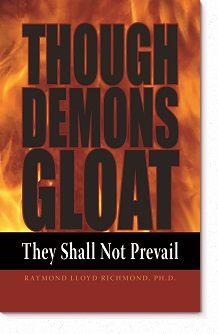 |
 |
Though Demons Gloat: They Shall Not Prevail
by Raymond Lloyd Richmond, Ph.D.
Though we are attacked by liberal activists from without and by apostasy
from within, the true Church—that is, the body of those who remain
faithful to Church tradition—weeps, and she prays, because she knows
the fate of those who oppose God.
Our enemies might fear love, and they can push love
away, but they can’t kill it. And so the battle against them cannot be
fought with politics; it requires a profound personal struggle against
the immorality of popular culture. The battle must be fought in the
service of God with pure and chaste lifestyles lived from the depths of
our hearts in every moment.
Ordering Information |
|
|