|
|
|

I have
to say that for me and, I believe, for many other [religious of my
order], there exists an even greater benchmark than the Magisterium of
the Roman Catholic Church. We used to speak of a well-formed conscience and
a pure heart shaped by prayer and the love of God. Unfortunately, that has
fallen out of favor in recent years. We [specific religious order]
have stood at the “edge” since our beginnings while nurturing a
great love for the Church.
 hen you speak about standing
at the “edge,” it clearly doesn’t mean standing at the edge of the world,
detached from its allures, looking toward heaven in good Christian faith
and with pure love for the Church. Instead, you’re speaking about a desire
to dilute theology to accommodate popular
political sentiment, and in that sense,
“standing on the edge” means only that you already have one foot
in hell. hen you speak about standing
at the “edge,” it clearly doesn’t mean standing at the edge of the world,
detached from its allures, looking toward heaven in good Christian faith
and with pure love for the Church. Instead, you’re speaking about a desire
to dilute theology to accommodate popular
political sentiment, and in that sense,
“standing on the edge” means only that you already have one foot
in hell.
That’s a sad thing, and
yet that’s the consequence of original sin.
Conscience really has no meaning except in the context of our
baptism into freedom from the slavery to sin.
When we are ever mindful of our promises to reject all the works of the
devil and to live a holy,
chaste lifestyle, then conscience can warn us when
we are in danger of betraying those baptismal promises.
If we try to follow any
“conscience” not illuminated by those baptismal promises, we will
be walking in spiritual darkness, following a
guide undisciplined by self-denial and
obedience to the Magisterium of the Church. Without
faithfulness to the tradition of the Church, there
simply cannot be a “well-formed conscience” because conscience is formed by the
faith that has been handed down to us. If we renounce
the tradition of the Church, we will be led so far into a distortion
of the Gospel message of love and
mercy that we will end up falling right over
its edge into self-gratification and sin.
God placed us in this world with
free will so that we would be capable of
true love. And yet, given all my clinical experience
and knowledge of the psychology of the
unconscious, it’s no surprise to me—a great
sadness, yes, but no surprise—that most persons use their free will
to send themselves straight to their doom.
|
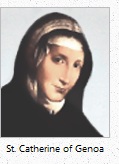 And
when I hear it said that God is good and He will pardon us, and then see
that men cease not from evil-doing, oh, how it grieves me! The infinite goodness
with which God communicates with us, sinners as we are, should constantly
make us love and serve Him better; but we, on the contrary, instead of seeing
in His goodness an obligation to please Him, convert it into an excuse for
sin which will of a certainty lead in the end to our deeper
condemnation. And
when I hear it said that God is good and He will pardon us, and then see
that men cease not from evil-doing, oh, how it grieves me! The infinite goodness
with which God communicates with us, sinners as we are, should constantly
make us love and serve Him better; but we, on the contrary, instead of seeing
in His goodness an obligation to please Him, convert it into an excuse for
sin which will of a certainty lead in the end to our deeper
condemnation. |
|
|
—Saint Catherine of Genoa
The Life and Doctrine of Saint Catherine of Genoa,
Chapter XV |
|
|