|
|
|

I’m
not certain I could live up to the standards of living you have mentioned.
I’m wondering if you have to be born inherently good in order to live
that righteously. (That seems like too strong a word, but the only one that
comes to mind.)
 e are all born inherently good.
That’s a truth fundamental to Catholic theology. In order to live righteously,
all we have to do is keep before ourselves at all times the
desire to learn to live righteously. God does
not ask us to be perfect; He just wants us to dedicate ourselves to learning
how to live a holy life. e are all born inherently good.
That’s a truth fundamental to Catholic theology. In order to live righteously,
all we have to do is keep before ourselves at all times the
desire to learn to live righteously. God does
not ask us to be perfect; He just wants us to dedicate ourselves to learning
how to live a holy life.
If you make this simple decision
to learn from everything, even your mistakes, you will not be
be afraid of making mistakes,
and you will find that in due time you will want to do anything it takes to
live in holiness. Make your best effort, then God will guide you.
Do your best
and let God do the rest.
The process is like tending a
garden—in this case, the garden of baptismal grace—lest it go to weeds. The
process begins with a humble willingness to learn from your mistakes without
blaming others or hating yourself. Then it continues by your resolving to cherish
the sacraments, to detach yourself from the impiety of the social world around
you, to care for your body and clothe it with chaste modesty,
to pray constantly for your good and the good of others,
to maintain a moment-by-moment awareness of the presence of God, and to be
grateful for all that God gives you. With
these resolutions in place, you will receive the grace to be aware of
temptations to commit sin and the courage to resist them.
Saints are Made,
not Born
Keep in mind that Christ chose
tax collectors, zealots, and unsophisticated fishermen for his Apostles to
prove to us that even the most wretched of sinners
can become saints.
Saint Paul, before he became a
Christian, was a murderer. He murdered Christians, and still he became a saint,
one of the greatest of all saints.
This points to the great mystery
of God’s love for us: in spite of what we deserve, God does not condemn
us to what we really deserve. A murderer like Saul, a tax collector like
Matthew, and a proud, sluttish celebrity like Mary
Magdalene all became saints to prove that no one has to be perfect to
open the heart to God’s love and step onto the path to sainthood. Such is
the awesome depth of God’s mercy.
Saints, therefore, are not born
holy. Moreover, sinners are not born evil. Our social experiences in the womb,
in infancy, in childhood, and throughout life shape our
personalities.
Wounded by Family
Dysfunction
Sadly, many persons have been
so wounded as children by family dysfunction
that they have come to believe they are
garbage and deserve nothing but condemnation;
however much they might intellectually want growth and
healing, deep in their hearts they
fear any change and resist it. Moreover, behind this
resistance to change is an unconscious resentment at
their parents for having failed in real love, and this resentment works
unconsciously to obstruct any spiritual
growth.
|
Remember, anyone
can do anything for the love of God; the question, therefore, is not whether
you can do it, but whether you want to do it. When you’re
angry at God, you won’t want to do anything. And why would you
be angry at God? Well, you’re angry at your
parents for being hypocrites, and you’re
angry at God because, in your opinion, He didn’t stop your parents from being
hypocrites.[1]
So, when your
parents fail in their faith, you will hold secret grudges against both them
and God. Any disobedience you show your parents
will be your revenge on them for their parental failures.
Similarly, a lack of spiritual growth is a form of revenge on God. Essentially,
your continued psychological dysfunction and your lack of spiritual progress is
your secret revenge at everyone.
Many persons claim
that they don’t have any anger at their parents, but their lack of spiritual
growth proves otherwise; they are saturated with
unconscious anger. A common
reason for this dilemma is a child’s hiding the anger by not wanting to see it
or talk about it so as to protect the parents; that is, the child sees that the
parents do some good, so anger at the parents’ failures seems unjustified,
causing the child to feel guilty and bad for even daring to say that the
parents have failed in love. The sad irony is that hiding the anger doesn’t
heal it; it only keeps the anger alive in the shadows where it feeds resentment
and self-punishment. |
|
The Spark of
Hope and Love
Still, in spite of this unconscious
fear and resentment, a small spark of hope and love can always be found in
every soul. Do whatever you can now, according to your present capacity for
love. Any attempts you make will allow some
healing water to nourish your soul. Be
patient, and don’t try to do everything
at once.
|
The ancient Greek
philosopher Aristotle taught that if you want to acquire a certain
quality, then begin by acting like others who have that quality, and
eventually you will develop that
quality.[2]
In the same way,
if you want to climb out of your mental and spiritual stagnation and live
a holy life, then start by doing the things that constitute a holy life.
All that holds you back is your unconscious pride
and spiritual blindness: your continued satisfaction
of defending your own self-interests at the
expense of others. In this wretched state, you won’t
even know what faith is.
But you don’t
have to wait until you
feel faith before you can follow the spiritual counsels.
Just do them anyway; sow their seeds
within your soul and soon you will be surprised to see some awesome new growth
filling in the bare spots left by your pride. As the growth continues and
strengthens, pride itself will wither and be overgrown by
holiness. |
|
Now, the
spiritual counsels on this website aren’t
really things you have to do, they are things that any soul in love
with God would desperately want to do. Why? Because
self-restraint helps to lift the psychological
defenses that prevent God’s graces from
sinking into us; with those defenses stripped away, the living waters of
salvation can finally reach our thirsty souls. So it’s simple: the more
you restrain your desire for self-satisfaction
and complacency, the more your soul grows in holiness.
For example, if you can’t
keep all of the Liturgy of the Hours, then say just
the Evening Prayer when you get home from work—and do it with the understanding that
prayer is protection from evil. If you can’t throw away
your TV completely, then cut away one hour of viewing each day—and do it with the
understanding that entertainment is an opening to evil
influence. If you can’t eat simple vegetarian foods for every meal, then at least
avoid meat on Wednesdays and Fridays, the traditional fasting days—and do it with the
understanding that gluttony is an opening to evil influence. If you can’t
do without make-up every day, then do without it at least on Sundays—and do it with the
understanding that vanity and pride are openings to evil influence. And so on.
Just do what you can; as your ability to love begins to grow, your ability to do
things for the sake of love will also grow.
With Trials as
a Teacher
You might wonder why some persons
grow to such great spiritual heights and why others make so little progress.
Well, Saint John of the Cross explains it.
|
 And here it ought to be pointed
out why so few reach this high state of perfect union with God. It should
be known that the reason is not that God wishes only a few of these spirits
to be so elevated; He would rather want all to be perfect, but He finds few
vessels that will endure so lofty and sublime a work. . . .
There are many who desire to advance and persistently beseech God to bring
them to this state of perfection. Yet when God wills to conduct them through
the initial trials and mortifications, as is necessary, they are unwilling
to suffer them and they shun them, flee from the narrow road of life [Mt.
7:14] and seek the broad road of their own consolation, which is that of
their own perdition [Mt. 7:13]; thus they do not allow God to begin to grant
their petition. They are like useless containers, for although they desire
to reach the state of the perfect they do not want to be guided by the path
of trials that leads to it.” And here it ought to be pointed
out why so few reach this high state of perfect union with God. It should
be known that the reason is not that God wishes only a few of these spirits
to be so elevated; He would rather want all to be perfect, but He finds few
vessels that will endure so lofty and sublime a work. . . .
There are many who desire to advance and persistently beseech God to bring
them to this state of perfection. Yet when God wills to conduct them through
the initial trials and mortifications, as is necessary, they are unwilling
to suffer them and they shun them, flee from the narrow road of life [Mt.
7:14] and seek the broad road of their own consolation, which is that of
their own perdition [Mt. 7:13]; thus they do not allow God to begin to grant
their petition. They are like useless containers, for although they desire
to reach the state of the perfect they do not want to be guided by the path
of trials that leads to it.” |
|
|
—Saint John
of the Cross
The Living
Flame of Love, Stanza 2.27 |
|

Notes
1. Hearing it said that God will give us what
we ask for, children tend to believe that, if they pray for it, God will
control the behavior of other persons. Because they do not understand that
a literal answer to their prayers would be a violation of the
free will of others, the children get angry
at God when He doesn’t make others change their behavior.
2. Nicomachean Ethics, II:1.
The text of
this webpage, integrated with other material from my websites,
has been conveniently organized into a paperback book of 350 pages, including
a comprehensive index.

Though Demons Gloat: They Shall Not Prevail
by Raymond Lloyd Richmond, Ph.D.
Though we are attacked by liberal activists from without and by apostasy
from within, the true Church—that is, the body of those who remain
faithful to Church tradition—weeps, and she prays, because she knows
the fate of those who oppose God.
Our enemies might fear love, and they can push love
away, but they can’t kill it. And so the battle against them cannot be
fought with politics; it requires a profound personal struggle against
the immorality of popular culture.
This battle must be fought in the service of God with pure and
chaste lifestyles lived from the depths of our hearts in every moment.
More Information |
Additional Reading
Healing
Psychological Healing in the Catholic Mystic Tradition
by Raymond Lloyd Richmond, Ph.D.
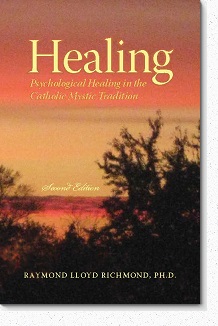 A treasure of a resource for psychological
and spiritual healing. Information gathered from my websites is now available at your fingertips
in book form with a comprehensive index. A treasure of a resource for psychological
and spiritual healing. Information gathered from my websites is now available at your fingertips
in book form with a comprehensive index.
Psychological defenses help to protect us from
emotional injury, but if you cling to the defense mechanisms that were created in your
childhood and carry them on into adulthood—as most everyone does unconsciously—your quest
for spiritual healing will be thwarted by overwhelming resentments and conflicts.
Still, God has been trying to show you that there is more to life than resentment and
conflict, something so beautiful and desirable that only one thing can resist its pull:
hate.
So now, and in every moment until you die, you will have a profound choice between your
enslavement to old defenses and the beauty of God. That decision has to come from you.
You will go where you desire.
More information
|