|
|
|
Love |
Healing |
Spiritual Counsels |
Books |
About CSF
The Writing
of the Gospels | The Gospels of Mark
and Matthew: The Anointing | The Gospel
of John: “Mary” | The Gospel
of Luke: A “Sinful” Woman | Mary
Magdalene | Mary Magdalene as
Witness |
A Homily by Pope Gregory the Great
 EFORE
looking into what the Gospels say about
Mary Magdalene, let me first introduce you to some history of the New Testament
Gospels, because each Gospel, for different theological reasons, says something
different about Mary. EFORE
looking into what the Gospels say about
Mary Magdalene, let me first introduce you to some history of the New Testament
Gospels, because each Gospel, for different theological reasons, says something
different about Mary.
The Writing of
the Gospels
Tradition says that the Gospel
of Matthew was the first Gospel written. But, as Biblical scholarship started
looking at everything through modern principles of literary criticism, it
was noticed that the Gospel of Matthew (as well as the Gospel of Luke) actually
borrowed information, sometimes word-for-word, from the Gospel of Mark. Some
scholars therefore claim that the Gospel of Mark had to have been written
first. But actually, no one knows what really happened. Obviously, Matthew
borrowed from the information in the Gospel of Mark, but that information
could have been oral, not written; so maybe Matthew wrote it first, and then,
after the Gospel of Matthew began circulating, maybe someone decided to publish
the Markan information as the Gospel of Mark. In any event, it really
doesn’t matter that much in terms of Christianity itself. But it does touch
on what we know about Mary Magdalene.
The Gospels of
Mark and Matthew: The Anointing
You can find in Mark 14:3-9 the
story of the Anointing at Bethany, when a woman (not named) poured
costly, fragrant oil on the head of Jesus. Matthew 26:6-13 repeats this story
just about word-for-word from the Gospel of Mark.
|
Something everyone
seems to overlook in Mark’s story is Judas’ snide remark about
the cost of the oil. Take the time to figure it out. What does 300 days wages
really amount to? Just to get a rough modern estimate, let’s use $7/hour
as a minimum wage and multiply by 8 hours for a day for 300 days; we get
about $17,000. That’s a lot of money for one tiny jar of oil! And this
woman poured it all on Christ. $17,000 worth.
So what in the world was this woman doing with a $17,000 flask of rare aromatic
oil in the first place? Well, maybe she was a very wealthy woman, given over
to a life of worldly decadence—perhaps like an actress or other celebrity
of today.
And therein you have the depth of her sin and the depth of her repentance
and love for Christ. And Christ understands all this. He forgives her sins.
So let’s just say that this woman was asking for
forgiveness and put her money where her mouth
was. |
|
The Gospel of
John: “Mary”
The Gospel of John, the last
Gospel written, tells the same story as the Gospel of Mark and the Gospel
of Matthew, but John 12:1-8 adds some details. John identifies the woman
by name as Mary, the sister of Martha and Lazarus (the man Jesus had raised
from the dead; see John 11:1-44). But the theological intent of the story
remains the same as it is in the Gospel of Mark and the Gospel of
Matthew.
The Gospel of
Luke: A “Sinful” Woman
In the Gospel of Luke, however,
the third Gospel written, things get changed a bit. Luke 7:36-50 tells the
story with a different theological intent. Here the woman is nameless, but
she is described as a “sinful” woman, and the point of the story
is about how a person with much to be forgiven has much reason to
love.
Mary
Magdalene
Now you’re probably wondering
by now what this all has to do with the woman we call Mary Magdalene. And
so far, it doesn’t have anything to do with her—at least,
by name. Magdalene is first introduced by name in Luke 8:2, and all we know
of her history is what Luke says there: Jesus had cured several women of
“evil spirits and infirmities” and seven demons had gone out of
“Mary, called Magdalene.” That’s it.
|
Now, we might wonder
what it means that, through Jesus’ command, seven demons had gone out of Mary
Magdalene. Does it mean that she was possessed, as
with head spinning and green vomit? Does it mean that she had
multiple
personalities?
Well, no, to
both questions.
Demonic possession
does not necessarily have any great drama attached to it. It can be something
that seems very ordinary, something that has no obvious outward
appearances—other than a disrespect for authority and a decadent
lifestyle. |
|
However, because of the account
of the Anointing given in the Gospel of John, in which the woman is called
Mary, tradition has tended to merge John’s story with the story in the
Gospel of Luke (7:36-50), so that the “sinful” woman in Luke’s
account is thought to have been the Mary of John’s account.
“Sinful” has also been expanded in popular sentiment to mean a
prostitute, and, because the account of “Mary, called Magdalene”
by name in the Gospel of Luke follows right after Luke’s “sinful
woman” story, popular sentiment has made Mary Magdalene a
“prostitute” who anointed Jesus.
|
But was Mary
Magdalene really a prostitute? Well, just consider any of the celebrities of
today’s world who fill social media with perversity, scandal, and gossip.
Are they prostitutes? Or are they just broken, lost souls possessed by decadence and
sin, hiding their emotional pain
behind empty illusions of
vanity and glamor?
No, Mary Magdalene
was no different from any of them—except for the fact that she repented her
sins. |
|
Mary Magdalene
as Witness
As for what we are actually told
about Mary Magdalene by name, besides the short introduction in the Gospel
of Luke, all we have is the accounts of the Crucifixion and Resurrection.
Matthew 27:56 and Mark 15:40 and John 19:25 all tell us that Mary Magdalene
was present at the cross; Luke mentions that “the women” who had
followed Christ from Galilee witnessed the Crucifixion, but Mary Magdalene
isn’t named.
All of the Gospels mention Mary
Magdalene by name as a witness to the Resurrection, but only the Gospel of
John tells the full story. And on this story, the following homily by Pope
Gregory the Great has its basis.
She longed for
Christ, though she thought He had been taken away
 HEN
Mary Magdalene came to the tomb and did not find the Lord’s body, she
thought It had been taken away and so informed the disciples. After they
came and saw the tomb, they too believed what Mary had told them.
The text then says: The disciples went back home, and it
adds: but Mary wept and remained standing outside the tomb. HEN
Mary Magdalene came to the tomb and did not find the Lord’s body, she
thought It had been taken away and so informed the disciples. After they
came and saw the tomb, they too believed what Mary had told them.
The text then says: The disciples went back home, and it
adds: but Mary wept and remained standing outside the tomb.
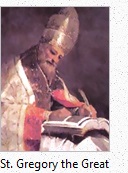 We should reflect on Mary’s attitude and the great love she felt for
Christ; for though the disciples had left the tomb, she remained. She was
still seeking the One she had not found, and while she sought she wept; burning
with the fire of love, she longed for Him who she thought had been taken
away. And so it happened that the woman who stayed behind to seek Christ
was the only one to see Him. For perseverance is essential to any good deed,
as the voice of truth tells us: Whoever perseveres to the end will be
saved. We should reflect on Mary’s attitude and the great love she felt for
Christ; for though the disciples had left the tomb, she remained. She was
still seeking the One she had not found, and while she sought she wept; burning
with the fire of love, she longed for Him who she thought had been taken
away. And so it happened that the woman who stayed behind to seek Christ
was the only one to see Him. For perseverance is essential to any good deed,
as the voice of truth tells us: Whoever perseveres to the end will be
saved.
At first she sought but did not find, but when she persevered it happened
that she found what she was looking for. When our desires are not satisfied,
they grow stronger, and becoming stronger they take hold of their object.
Holy desires likewise grow with anticipation, and if they do not grow they
are not really desires. Anyone who succeeds in attaining the truth has burned
with such a great love. As David says: My soul has thirsted for the living
God; when shall I come and appear before the face of God? And so also
in the Song of Songs the Church says: I was wounded by love; and again:
My soul is melted with love.
Woman, why are you weeping? Whom do you seek? She is asked why she
is sorrowing so that her desire might be strengthened; for when she mentions
Whom she is seeking, her love is kindled all the more ardently.
Jesus says to her: Mary. Jesus is not recognized when He calls her
“woman”; so He calls her by name, as though he were saying: Recognize
Me as I recognize you; for I do not know you as I know others; I know you
as yourself. And so Mary, once addressed by name, recognizes who is speaking.
She immediately calls Him rabboni, that is to say, teacher,
because the One whom she sought outwardly was the One who inwardly taught
her to keep on searching.
—From a homily on the Gospels
by Gregory the Great, pope
Office of Readings, July 22:
Mary Magdalene
|