|
|
|

I am preparing
to enter an RCIA program, and every day is a new test, and I feel like
I am failing every one of them. I feel like the tests are here to show me
that I can’t do this. Even at Church today I felt helpless. The reading
[Luke 9:51-62] was talking about the disciples of Jesus and I didn’t
understand what was going on. What is He trying to tell me? The reading said
that people were trying to follow Him. One man asked to go bury his father
before joining Jesus. Jesus told him not to. Another wanted to say good-bye
to family and he also was told not to. I thought Jesus wanted us to take
care of each other. I just don’t understand. If we are asked to do
God’s work, that means to take care of each other, right? Obviously
NOT right. Why would Jesus not want us to bury our dead? Why would Jesus
want us to leave without saying good-bye?
|
 find it very sad that many, if
not most, RCIA programs in this country are run by
dissenters from the true
Faith whose sole purpose is to mislead innocent souls
with lies and distortions of genuine Christianity. These RCIA teachers don’t
have a clue about the demonic oppression and apostasy
attacking the Church today, nor do they understand the great
spiritual battle against evil that defines the
Church; instead, in their ignorance they present the Church as
a human fellowship organization dedicated to social justice. find it very sad that many, if
not most, RCIA programs in this country are run by
dissenters from the true
Faith whose sole purpose is to mislead innocent souls
with lies and distortions of genuine Christianity. These RCIA teachers don’t
have a clue about the demonic oppression and apostasy
attacking the Church today, nor do they understand the great
spiritual battle against evil that defines the
Church; instead, in their ignorance they present the Church as
a human fellowship organization dedicated to social justice.
Furthermore, even if the priests
in such parishes understood how powerless they often are to purge their parishes
of apostate teachers, the priests still fail to take a stand in their homilies by
explaining and defending Catholic dogma directly to the people.
Consequently, those poor souls in the
RCIA classes have to sit through homilies that give clever intellectual explanations
of Biblical texts but fail to teach the people how to live holy lives by detaching
themselves from the moral corruption of the world. Sadly,
many priests themselves fail to live in spiritual detachment from the world, and so
they fail to achieve the intuitive, mystical understanding of the Church that persons
such as Saint John of the Cross and Saint Teresa of Avila attained. So we have
multitudes of souls hungry for the truth who are fed people-pleasing homilies that
do little more than whet the appetite for coffee and donuts after Mass.
Now it’s significant that this
passage from Luke so troubled you, because it points directly to what the purpose
of RCIA should be. So, to understand the full meaning of this passage, let’s
begin by first putting the text in its historical context.
The Historical
Context:
Leaving the Spiritually Dead World Behind
Jesus was leading His disciples
to Jerusalem—to His Passion and death on a cross, and, ultimately, to
His Resurrection and the establishment of the Church. Thus the journey to Jerusalem
represents the way to Heaven and the Way of the Cross
represents the most difficult passage along the way. Jesus needed to make it clear,
then, that His journey to Jerusalem was not just some vacation pilgrimage. To follow
Him—then or now—means to give up everything: to “die”
to the world and its concerns for wealth and social prestige, and, with resolute
determination, to turn full attention to the journey ahead.
In this passage from Luke, Christ was
speaking to a man who intellectually wanted to become a disciple, but who in his
heart was more concerned with securing for himself his family inheritance and
therefore his social prestige. To go back and bury his father meant to arrange
things so that when his father died, he would be secure. Christ knew all of this,
so He said what He said, speaking directly to the lack of true faith in this man’s
heart, so as to put to the test his desire to follow Christ.
Letting the “dead bury the
dead” means, therefore, to make a clear and total break with the spiritually
dead—that is, with the spiritually
“dead” world you’re leaving behind.
When you resolve to travel to “Jerusalem,” you can’t look
back. In that moment of conversion, the past means nothing, and the future
becomes everything.
Our Real Social
Obligations
Now, to us, in the world today,
this passage has an additional—a psychological—meaning. Christians
today must follow Jesus in spirit, not along a real dusty road to
a real city plodding along behind the actual historical Jesus. So, yes, to
follow Him in spirit we do have to “die” to the world, but
nevertheless we still have our real lives in this world with real social
obligations. When we part from our friends, we really do say goodbye to them.
When our parents die we really do have to bury them.
But there is more to life than
its literal social obligations.
The Desire for
Love and Acceptance
“Letting the dead bury the
dead” means that to live a genuine Christian life we have to give up
our psychological desire to make the
world—the spiritually “dead”—give
us the love and acceptance we believe we deserve.
Let me explain.
Let’s assume, for example, that
your parents are still living and that your father is an
alcoholic, or that your mother is a sort of
professional “victim,” always complaining of being
mistreated and criticizing everyone with an acid tongue. Or maybe your parents
aren’t quite this bad, but maybe they have misunderstood you in other, more
subtle, ways. In any event, you would be wounded deeply, and you would have
suffered greatly because of the inconsiderate behavior of others. You would
feel unnoticed, unheard, and unloved. You would feel abandoned. You would feel
rejected. You would feel the anguish of not knowing what is going on, and you
would feel the frustration of not having anyone explain things to you. So what
can you do?
Well, in the past, as a result
of all the hurt that was ever inflicted on you, you felt
victimized. You complained about how poorly you were
treated. Moreover, in those complaints, you wanted
unconsciously to show your parents—and the rest of the
world around you—how much you have been hurt. Furthermore, in wanting to show
them how much you have been hurt, you have wanted
compensation—and, in some ways, you have wanted
something that is more than a just compensation for what you have lost; you
have wanted revenge.
OK. So that’s what you have
done according to the ways of the world. You have
done what many persons do in law, and what almost everyone does in politics and
sports: feel victimized and demand satisfaction for your hurt. And if you can’t
get that satisfaction, you will find ways to act out your pain. Smoke cigarettes.
Drink alcohol. Use marijuana. Become overweight. Dress immodestly. Defile your
body with tattoos and piercings. Defile your soul with sexual perversions. Allow
your physical and mental health to deteriorate. Reject the Church. Scoff at
authority. Lost in pain, lost in confusion, and lost in an empty desperation for
love, you will do anything it takes to make someone notice you.
An End to
Victimization
Yes, everyone craves revenge. But
what did Jesus do when his disciples wanted to call down fire from heaven to
avenge the insult they have received? Jesus rebuked them. (See Luke 9:54-55.)
Consequently, as a Christian, it’s
important to respond to your hurt by “letting the
dead bury the dead.” In other words, stop trying to make the spiritually
dead—your mother, your father, and anyone else who has ever hurt
you—“love” you or give you the
recognition you so desperately crave. Whenever you are injured, realize that
you cannot call down fire from heaven to avenge yourself. You cannot
make the world treat you fairly. You cannot make the world
love you. You cannot make the world notice you. Instead, turn all
your attention, with resolution and determination, to the real destination
of your life: Jerusalem, where all victimization must end, and where
suffering and death on a cross for the sake of
others is the only path to true love—and the
Kingdom of Heaven.
So there you have it. In the
end, as you say, “I can’t do this”—but the full truth
is that you can’t do it alone, without the grace of following
Jesus to Jerusalem.
If you follow Jesus, you will
have life.
But if you stay angry and reject Him,
you are dead. The spiritually dead are concerned about their affairs in this world,
so if you turn from Christ to go back and arrange things as you want them so that
you can draw benefit from the world, you are dead. If you claim that you want to
follow Christ but haven’t detached yourself from the world, you are the dead
wanting to bury the dead.
Therefore, if you stay in the place
of psychological victimization, like disobedient RCIA teachers, you are dead.
You’re simply defending your pride, feeling sorry
for yourself and demanding that the world notice your pain. But
healing from victimization involves recognizing your
feelings of hurt and then resolving to speak about them
charitably and calmly without demanding anything. If
others listen to you, fine. Work with them to find a solution to the problem, as
you have done by writing to me. And if they fail to hear you, well,
pray for their repentance. Then tell yourself, “I
don’t need them” and let the dead bury the dead.

Though Demons Gloat
They Shall Not Prevail
by Raymond Lloyd Richmond, Ph.D.
 |
|
The text of
this webpage, integrated with other material from my websites,
has been conveniently organized into a paperback book of 350 pages, including
a comprehensive index.
Though we are attacked by liberal activists from without and by apostasy
from within, the true Church—that is, the body of those who remain
faithful to Church tradition—weeps, and she prays, because she knows
the fate of those who oppose God.
Our enemies might fear love, and they can push love
away, but they can’t kill it. And so the battle against them cannot be
fought with politics; it requires a profound personal struggle against
the immorality of popular culture. The battle must be fought in the
service of God with pure and chaste lifestyles lived from the depths of
our hearts in every moment.
Ordering Information |
|
Healing
Psychological Healing in the Catholic Mystic Tradition
by Raymond Lloyd Richmond, Ph.D.
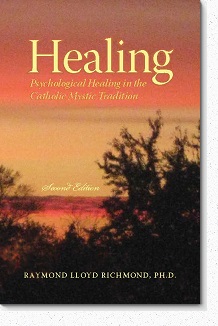 A treasure of a resource for psychological
and spiritual healing. Information gathered from my websites is now available at your fingertips
in book form with a comprehensive index. A treasure of a resource for psychological
and spiritual healing. Information gathered from my websites is now available at your fingertips
in book form with a comprehensive index.
Psychological defenses help to protect us from
emotional injury, but if you cling to the defense mechanisms that were created in your
childhood and carry them on into adulthood—as most everyone does unconsciously—your quest
for spiritual healing will be thwarted by overwhelming resentments and conflicts.
Still, God has been trying to show you that there is more to life than resentment and
conflict, something so beautiful and desirable that only one thing can resist its pull:
hate.
So now, and in every moment until you die, you will have a profound choice between your
enslavement to old defenses and the beauty of God. That decision has to come from you.
You will go where you desire.
More information
|