|
|
|

I am
25 years old. . . . I am hardworking; I hold education as
one of the highest values. I work full time, but have done a master’s
degree at night and am planning to do another. I am generally considered
easy going and likable by people who know me. I believe in treating everyone
with respect regardless of their situation, and that isn’t to tout myself
as an angel but that kind of thinking unfortunately is not always prevalent
in society.
In August, something not so great happened. . . . I was helping
my mother with some shopping, and while I was waiting in front of a store
by myself, some guy started yelling at me to move out of the way. He was
pulling back in a large black SUV, had a very loud voice, and was very rude
and insulting and just not the type of person I am used to dealing
with. . . . I begrudgingly moved rather than step out, but
also gave him the middle finger, which I admit was stupid but it drove me
crazy that he called me an idiot with such malice in his voice (and driving
a big SUV too, which fit the personality). . . . That incident
threw me into anxiety and grief worse than I ever thought
possible. . . . I was humiliated in public not for some other
person’s temper, and the transgressor drove off and got the last word
in as well. . . . in the back of my mind this lingers as an
open transaction, something that could happen again, and that somebody out
there actually thinks of me this way. . . . a part of me
can’t let go of the scorn that was showered on me and also that my relative
peace of mind was broken. . . .
I grew up Catholic. . . . I was quite active until about the
age of 18, when doubts overwhelmed my beliefs about going to Church and that
religion was best lived personally. I definitely do believe in God, I believe
that He acts in ways that we cannot always comprehend and that there is a
reason for everything. . . . I have been drawn to your site
for more learning; and though still somewhat agitated and carrying a dark
cloud over the event, this has certainly forced some
introspection.
|
 ou offer a perfect testimony to
the fact that no matter how well-educated we may be, and no matter how much
we might think of ourselves as kind and considerate, we can suddenly
encounter the shocking reality that our peaceful exteriors
hide a seething mass of unconscious
anger. ou offer a perfect testimony to
the fact that no matter how well-educated we may be, and no matter how much
we might think of ourselves as kind and considerate, we can suddenly
encounter the shocking reality that our peaceful exteriors
hide a seething mass of unconscious
anger.
In fact, many persons—not
just the laity but also the religious, sad to say—use an exterior of
spiritual “niceness” to hide some very
ugly emotions.
Therefore, I certainly sympathize
with your anxiety and grief, because when I was
your age I was in the same place. Yes, just like you, I thought of myself
as peaceful and easy-going. And, yes, I, too, “believed in God”
in a vague, personal, generically Protestant
way. Only when I entered into psychoanalysis as part of my training in clinical
psychology did I begin to recognize how much my deepest emotional life was
completely out of my conscious awareness. And only when I converted to
Catholicism and submitted to all the spiritual
counsels that I describe on this website (and that I never learned in
my Protestant seminary education) did I really understand how much we all,
secretly in our hearts, dread human scorn—and
how much hard and constant work it takes to live a genuinely
peaceful life through
self-sacrifice as Christ demands of us
all.
So you have two
options for healing.
You can enter into intensive
Catholic psychotherapy and discover
for yourself, over the course of treatment, the dark and
frightening reality of your own
unconscious. Then, if you have the courage to
persevere, you will discover the divine grace that flows through the unconscious
as your purification progresses.
Or you can submit to the
spiritual purgation I describe on this website,
and through self-restraint and
prayer you can discover and heal the
pride and vanity that
dwells so deeply in all of us, laity and religious alike. Because our wounds
lie so deep, God’s love must cut even deeper.
 Whether
a soul is wounded by other wounds of miseries and sins or whether it is healthy,
this cautery of love immediately effects a wound of love in the one it touches,
and those wounds deriving from other causes become wounds of love. Whether
a soul is wounded by other wounds of miseries and sins or whether it is healthy,
this cautery of love immediately effects a wound of love in the one it touches,
and those wounds deriving from other causes become wounds of love. |
—Saint John of the Cross
The Living Flame of Love, 2.7 |
For most of us, sadly,
love is only a surface scratch, so either option
will take hard, disciplined work. With the first option you will at least
understand why you act so irrationally, and that will bring you some peace
in this life. The second option—on its own, or combined with the first
option—can bring you everlasting peace because it demands more than
just a personal belief that God exists; it demands a
belief in God—and a consequent obedience
to God’s will—that must govern your entire moment-by-moment existence.
“You shall love the Lord, your God, with all your heart, with all your
soul, and with all your mind” (Matthew 22:37).
Just
remember one thing. Saint Catherine of Genoa, the great lay mystic who literally
wrote the  book on Purgatory,
showed us that the price
a person pays for spiritual purification in this life is hardly anything
compared to the price he would have to pay in Purgatory.
book on Purgatory,
showed us that the price
a person pays for spiritual purification in this life is hardly anything
compared to the price he would have to pay in Purgatory.
Mind you, this assumes that
unrepentant sins resulting from indifference
to, or disavowal of, Catholic teaching are repented at
least at the moment of death so that they don’t send
that person straight to hell. Think about that. It
gives practical spiritual meaning to the statement that “you can pay now
or you can pay later.”

Healing
Psychological Healing in the Catholic Mystic Tradition
by Raymond Lloyd Richmond, Ph.D.
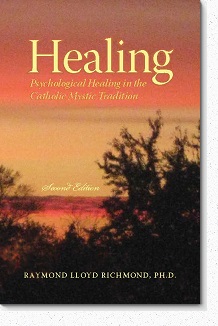 A treasure of a resource for psychological
and spiritual healing. Information gathered from my websites is now available at your fingertips
in book form with a comprehensive index. A treasure of a resource for psychological
and spiritual healing. Information gathered from my websites is now available at your fingertips
in book form with a comprehensive index.
Psychological defenses help to protect us from
emotional injury, but if you cling to the defense mechanisms that were created in your
childhood and carry them on into adulthood—as most everyone does unconsciously—your quest
for spiritual healing will be thwarted by overwhelming resentments and conflicts.
Still, God has been trying to show you that there is more to life than resentment and
conflict, something so beautiful and desirable that only one thing can resist its pull:
hate.
So now, and in every moment until you die, you will have a profound choice between your
enslavement to old defenses and the beauty of God. That decision has to come from you.
You will go where you desire.
More information
|