|
|
|

This
question isn’t meant to threaten, judge, or attack you or your website
in any way. I understand and agree with your explanations in using alcohol,
drugs, mobile devices, even religion itself as psychological defenses. But my
question is, aren’t psychologists merely using psychology as their own
psychological defense? Psychologists seem so quick to call the inferior behavior
of others out, but in reality they are running from their own emotional confusion
by an incessant drive to be in control of the minds and emotions of themselves
and others. And while Catholic psychotherapists such as yourself preach the
virtue of humility and letting go, in reality they are a bit hypocritical
because they themselves never really “let go and let God.” Instead
they use psychology as a mechanism to hide from the wounds of their unconscious.
Maybe psychology is just the “highest” form of such a defense.
Have you considered that maybe since humans are of the flesh, it is impossible
to escape such psychological defenses? Thanks for all you do.
|
 iven that most
psychotherapists [1]
are not Catholic, I would say that most psychotherapists are, to use
your words, “merely using psychology as their own psychological
defense.” I can even state what they are defending themselves against:
the need to surrender to the truth of the Christian faith. And given that
many psychotherapists who call themselves Catholic either do not really live
in complete obedience to the true Faith or do not
understand the psychology of the Catholic mystics, I also agree with you
that these persons use psychology to avoid having to “let go and let
God.” iven that most
psychotherapists [1]
are not Catholic, I would say that most psychotherapists are, to use
your words, “merely using psychology as their own psychological
defense.” I can even state what they are defending themselves against:
the need to surrender to the truth of the Christian faith. And given that
many psychotherapists who call themselves Catholic either do not really live
in complete obedience to the true Faith or do not
understand the psychology of the Catholic mystics, I also agree with you
that these persons use psychology to avoid having to “let go and let
God.”
Catholic
psychotherapy, as I describe it on this website, has one purpose: to
help individuals fully confront and heal the wounds
of their unconscious by overcoming the fear of living
in complete obedience to the true
Faith.
Not all
psychological defenses are unhealthy, however; many
defenses, such as humor, serve a highly functional purpose. Thus we really
cannot “escape” our defenses because, as you say, we are humans
of the flesh. With genuine trust in Christ, however,
we can be set free from our defensive—and often
unconscious—tendency to
hide our pain from ourselves. And once we
stop hiding our pain from ourselves we can stop hiding our pain from God,
and then we can live honest religious
lifestyles.

Notes.
1. Just to clarify the technical
terms, a psychotherapist is someone who practices
psychotherapy, and such a person
can legally practice under any of several professional licenses: Psychologist,
Marriage and Family Therapist (MFT), and Licensed Clinical Social Worker
(LCSW). For more information about these various licenses, and about the
difference between psychotherapy and counseling, see my web page (on A
Guide to Psychology and its Practice) called
Psychology: Clinical and Counseling—and
Licensure

Healing
Psychological Healing in the Catholic Mystic Tradition
by Raymond Lloyd Richmond, Ph.D.
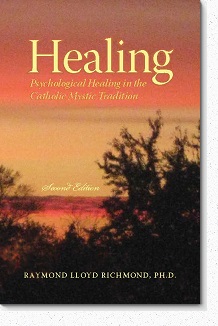 A treasure of a resource for psychological
and spiritual healing. Information gathered from my websites is now available at your fingertips
in book form with a comprehensive index. A treasure of a resource for psychological
and spiritual healing. Information gathered from my websites is now available at your fingertips
in book form with a comprehensive index.
Psychological defenses help to protect us from
emotional injury, but if you cling to the defense mechanisms that were created in your
childhood and carry them on into adulthood—as most everyone does unconsciously—your quest
for spiritual healing will be thwarted by overwhelming resentments and conflicts.
Still, God has been trying to show you that there is more to life than resentment and
conflict, something so beautiful and desirable that only one thing can resist its pull:
hate.
So now, and in every moment until you die, you will have a profound choice between your
enslavement to old defenses and the beauty of God. That decision has to come from you.
You will go where you desire.
More information
|