|
|
|

[Through
much of my life] I was convinced (and I still struggle with this issue)
that I could not turn to God. After all, isn’t it a teaching of the
Church that if one isn’t in the state of grace, then one’s prayers
are worthless (except the prayers asking for the grace of repentance)? I
could not pray for my family when they were in terrible pain, and that was
and is a helpless and horribly guilty feeling. I believed I could not go
to confession, I was not God’s friend, so basically I couldn’t
ask for anything from Him until I was first able to go to confession. That
is a vicious trap: BECAUSE I could not ask God to help me and my family in
their sufferings, I felt even more trapped in sin/guilt/regret/self-hatred.
I still struggle with this.
 irst of all, please understand
that God does not demand that we be perfect before He will love us. He simply
asks us to accept His guidance so that we can learn from our mistakes and
grow in perfection. irst of all, please understand
that God does not demand that we be perfect before He will love us. He simply
asks us to accept His guidance so that we can learn from our mistakes and
grow in perfection.
Now, some traditions have said that
when we are in a state of sin our prayers are worthless. But this doesn’t
mean that our prayers are worthless simply because we are in a state of
sin; if ever our prayers are worthless it is because
the state of mind that underlies our sin is the state of mind of
not desiring God more than anything else in the world. In this case sin
is the effect of a disordered desire, because so
long as you desire the satisfactions of the world you
put yourself in a state of mind that is not penitent and does not want to turn
to God to seek His mercy. Thus, in this disordered
state of mind, you are saying that you do not really want any help. That’s
the psychological dynamic that makes your prayers ineffective.
So let’s look at what it
will take for you to turn away from sin in order to make it possible
for you to turn to God. For truly it is always possible to turn to
God no matter how worthless you feel. Never doubt that God’s mercy is
always available to the penitent.
The State of
Grace
When you are in a state of grace,
you are in a state of mind and heart to receive the graces God continuously
pours out upon all of his creation. If you are not in a state of
grace—that is, when you are living in
sin—you cut yourself off from accepting God’s
graces. God doesn’t stop his graces because of your
disobedience; you reject those graces
through your own disobedience. In her Spiritual Dialogue, Saint Catherine
of Genoa expressed this very elegantly:
|
 This Soul also beheld a
certain ray of love issuing from that divine fountain, and darting towards
man with a force as if to annihilate him; and she saw that when it found
impediments, then, if it were possible for God to feel pain, he would suffer
the greatest of all grief. This ray aimed only to penetrate the soul, and
it was her own fault if she were not penetrated by it, for the ray surrounded
her on all sides, seeking entrance; but the soul, blinded by
self-love, did not perceive it. This Soul also beheld a
certain ray of love issuing from that divine fountain, and darting towards
man with a force as if to annihilate him; and she saw that when it found
impediments, then, if it were possible for God to feel pain, he would suffer
the greatest of all grief. This ray aimed only to penetrate the soul, and
it was her own fault if she were not penetrated by it, for the ray surrounded
her on all sides, seeking entrance; but the soul, blinded by
self-love, did not perceive it. |
|
|
—Saint Catherine of Genoa
Spiritual Dialogue, First Part, Chapter VIII |
|
The
Sacraments
Now, the Sacraments—the
visible manifestations of God’s grace—are administered through
the Church, and, being tangible things, they are protected with tangible
methods. Thus the Church denies them to persons not in a state of
grace.
But aside from the Sacraments,
your ability to overcome disobedience and to receive and benefit from God’s
grace is purely between you and God. All you have to do is learn to pray
properly.
Praying
Properly
To pray properly, it is important
to pray for the right thing, and it is important to pray
enough.
Praying for
the Right Thing
When many persons pray to God,
they try to tell God what to do. They ask God to do what they want,
or to prevent something they don’t want, or to give them material
things that they think they need. For them, prayer is all about
them.
Real prayer, however, is about
praying that God’s Will be done. In real prayer we seek first the Kingdom
of Heaven and God’s righteousness, and then all the other things we
need will follow from there (see Matthew 6: 31–33).
So, no matter what
difficulties and obstacles afflict you, learn
to pray for the strength and the courage to endure all trials and
difficulties gracefully, to trust in God’s
justice and providence, and to grow in
love and chaste purity as
a consequence of your struggles.
Praying
Enough
Most persons don’t pray
enough for one simple reason: they are too preoccupied with seeking the
satisfactions of the world. Rather than praying, they
spend their time watching TV and movies, playing sports and video games,
listening to music, chatting on their phones, texting their friends, surfing
the Internet, and entangling themselves more and more in their social networks.
They waste hours of life daily, and years of life over a lifetime, on things that
have nothing to do with the Kingdom of Heaven. It’s no wonder that they do
not find the answers to their prayers that they seek: they turn to the world
before they will turn to God.
So, to pray enough,
detach yourself from the unholy ways of the
world and devote all of your mind, all of your heart, all of your soul, and
all of your strength to keeping your attention focused on the Kingdom of
Heaven.
Assistance from
the Communion of the Saints
Still, as you are learning how
to pray properly, directly to God, you also have access to the Communion of
the Saints. If we ourselves are lacking,
 we
can call upon the Saints for their intercession to pray on our behalf. we
can call upon the Saints for their intercession to pray on our behalf.
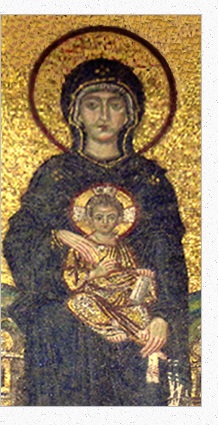
The greatest saint of all—especially
in regard to assisting sinners—is the Blessed Virgin, the Refuge of
Sinners. In the Hail Mary we
ask her every day—well, actually, for those who pray the
Angelus and the Rosary,
it’s literally dozens of times a day—“pray for us
sinners.”
Not only can we implore the Blessed
Virgin to carry our prayers for others to her Son—even if we ourselves
are not completely pure—but also our prayers might somehow crack open
our own hardened hearts to let in a tiny ray of divine grace that can then
take root and start to grow within us.
Keep in mind here that God will
not violate our free will, and so no divine action
can make us holy or stop us from sinning. But in our love for
the Blessed Virgin, and in our awe for her profound humility and obedience,
our free will can be softened by her motherly softness, and so we can be
slowly weaned from a state of sin to a state of grace,
from self-hatred to proper self-love.
Both Saint Dominic and Saint Louis
Marie de Montfort, for example, rescued large parts of
Europe from heresy by fostering devotion to praying
the Rosary. Their efforts prove that anyone  who prays devoutly and faithfully for the intercession of the
Blessed Virgin must of necessity be led to greater and greater purity of heart.
who prays devoutly and faithfully for the intercession of the
Blessed Virgin must of necessity be led to greater and greater purity of heart.
 How can anyone who venerates the purity, humility, and
obedience of the Blessed Virgin not grow in purity, humility, and obedience under
her guidance? How can anyone who venerates the purity, humility, and
obedience of the Blessed Virgin not grow in purity, humility, and obedience under
her guidance?
All it takes, then, is that you
consecrate yourself to the Blessed
Virgin.[1]
As long as you know that you are now committing some sins, even if you cannot
now see the full depth of them, no matter how disgusted you feel with yourself,
no matter how much you doubt your ability to change, just throw yourself
at her feet. See her as the Mother of
Mercy who seeks always The Divine Mercy of
her Son, and then follow her instructions. Slowly you will reject your own
desire for sin, and your eyes will be opened to
more and more of your sins—things that even now you think are not
sins—and you will grow, day by day, in your ability to receive God’s
grace.
|
 Let the weak sinful soul
have no fear to approach Me, for even if it had more sins than there are
grains in the world, all would be drowned in the unmeasurable depths of My
mercy. . . . My mercy is greater
than your sins and those of the entire world. Who can measure the extent
of my goodness? Let the weak sinful soul
have no fear to approach Me, for even if it had more sins than there are
grains in the world, all would be drowned in the unmeasurable depths of My
mercy. . . . My mercy is greater
than your sins and those of the entire world. Who can measure the extent
of my goodness?
For you I descended
from heaven to earth; for you I allowed myself to be nailed to the cross;
for you I let my Sacred Heart be pierced with
a lance, thus opening wide the source of mercy for you. Come, then, with
trust, to draw graces from this fountain. I never reject a contrite heart.
Your misery has disappeared in the depths of My mercy. Do not argue with
Me about your wretchedness. You will give me pleasure
if you hand over to me all your troubles and griefs.
I shall heap upon you the treasures of My grace. |
|
|
—as told to St.
Faustina
(Diary, 1059; 1485) |
|

Notes.
1. Complete instructions for the Consecration
to Jesus through Mary can be found in Saint Louis Marie de Montfort’s
book, True Devotion to the Blessed
Virgin.

Healing
Psychological Healing in the Catholic Mystic Tradition
by Raymond Lloyd Richmond, Ph.D.
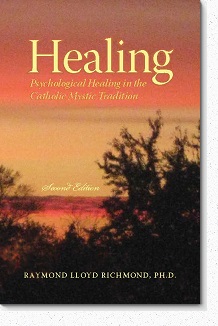 A treasure of a resource for psychological and spiritual healing. Information
gathered from my websites is now available at your fingertips in book form with a
comprehensive index.
A treasure of a resource for psychological and spiritual healing. Information
gathered from my websites is now available at your fingertips in book form with a
comprehensive index.
Psychological defenses help to protect us from
emotional injury, but if you cling to the defense mechanisms that were created in your
childhood and carry them on into adulthood—as most everyone does unconsciously—your quest
for spiritual healing will be thwarted by overwhelming resentments and conflicts.
Still, God has been trying to show you that there is more to life than resentment and
conflict, something so beautiful and desirable that only one thing can resist its pull:
hate.
So now, and in every moment until you die, you will have a profound choice between your
enslavement to old defenses and the beauty of God. That decision has to come from you.
You will go where you desire.
More information
|