|
|
|

I am
confused about Saint Faustina. I am reading her book . . . and
I am confused about the Sacred Heart of Jesus. I really thought it was Saint
Margaret Mary that Jesus asked to bring the image of His heart to us. But
Saint Faustina’s book makes me think He gave it to her. Were they both
given the image? Did they live at the same time? I don’t
understand.
 od’s infinite love is impossible
for anyone to understand. Even angels cannot understand it fully. So when
we humans try to speak about God’s love, we
have to use approximations, speaking in metaphors and symbols. od’s infinite love is impossible
for anyone to understand. Even angels cannot understand it fully. So when
we humans try to speak about God’s love, we
have to use approximations, speaking in metaphors and symbols.
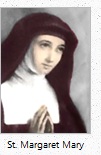 Saint Margaret Mary,
who lived from 1647 to 1690, received the revelations about the
Sacred Heart of Jesus. Saint Faustina, who
lived from 1905 to 1938, received the revelations about
The Divine Mercy. Saint Margaret Mary,
who lived from 1647 to 1690, received the revelations about the
Sacred Heart of Jesus. Saint Faustina, who
lived from 1905 to 1938, received the revelations about
The Divine Mercy.
 The images associated with
these revelations—the Sacred Heart of Jesus and The Divine Mercy—
point to the ultimate mystery of Christianity: that to save us from death
to sin, God emptied Himself in love for us through
the Incarnation, Passion, and Death of His only Son and continues to empty
Himself into our lives in the Church through the Holy Spirit. The images associated with
these revelations—the Sacred Heart of Jesus and The Divine Mercy—
point to the ultimate mystery of Christianity: that to save us from death
to sin, God emptied Himself in love for us through
the Incarnation, Passion, and Death of His only Son and continues to empty
Himself into our lives in the Church through the Holy Spirit.
The Refusal to Hate
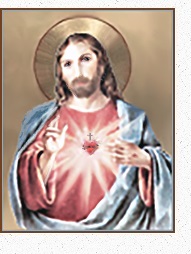 In the image of the
Sacred Heart of Jesus we see most clearly one
aspect of love: the refusal to hate. In spite of all the wounds we
have inflicted on Him, Christ continues to love us anyway. No matter how
much we treat Him with indifference, ingratitude, and contempt, He does not
retaliate with anger. No matter how much we abuse
His love for us, He continues to seek our ultimate good, our freedom from
slavery to sin. In the image of the
Sacred Heart of Jesus we see most clearly one
aspect of love: the refusal to hate. In spite of all the wounds we
have inflicted on Him, Christ continues to love us anyway. No matter how
much we treat Him with indifference, ingratitude, and contempt, He does not
retaliate with anger. No matter how much we abuse
His love for us, He continues to seek our ultimate good, our freedom from
slavery to sin.
The Desire for Mercy
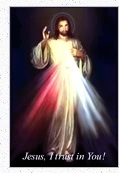 In the image of
The Divine Mercy we see most clearly a second
aspect of love: the desire for mercy rather than punishment. Just
before the outbreak of WWII, Christ gave this image to the modern world,
a world growing increasingly cold in faith and a world increasingly lost
to cruelty and perversion. And yet, in spite of all the sins we commit, Christ
reminds us that even the most wretched of sinners
deserves His mercy. No matter how brutally we treat
others, He wants us to repent and to throw
ourselves into His mercy, rather than suffer the inevitable
judgment that awaits those who refuse to
repent. In the image of
The Divine Mercy we see most clearly a second
aspect of love: the desire for mercy rather than punishment. Just
before the outbreak of WWII, Christ gave this image to the modern world,
a world growing increasingly cold in faith and a world increasingly lost
to cruelty and perversion. And yet, in spite of all the sins we commit, Christ
reminds us that even the most wretched of sinners
deserves His mercy. No matter how brutally we treat
others, He wants us to repent and to throw
ourselves into His mercy, rather than suffer the inevitable
judgment that awaits those who refuse to
repent.
|
I do not want
to punish aching mankind, but I desire to heal it, pressing it to My Merciful
Heart. I use punishment when they themselves force me to do so; my hand is
reluctant to take hold of the sword of Justice. Before the Day of Justice
I am sending the Day of Mercy. . . .
I cannot punish
even the greatest sinner if he makes an appeal to My compassion, but on the
contrary, I justify him in My unfathomable and inscrutable
mercy. . . .
Tell sinners
that no one shall escape My hand; if they run away from My Merciful Heart,
they will fall into My Just Hands. |
|
|
—told to Saint
Faustina by Jesus,
Diary (1588, 1146, 1728) |
|
Therefore, both images—the
Sacred Heart of Jesus and The Divine Mercy—are equally true for us today.
Neither image overshadows the other. In a world decaying more and more into
corruption, both images speak to us of our only hope: repentance and
transformation of our hearts through an acceptance of divine
love.
|