|
|
|
Catholic Psychotherapy |
Spiritual Counsels |
Books |
About CSF
The Mistake of Invalidation |
The Proper Way
 ONSIDER, for a moment, the way a
dysfunctional father treats his family. Instead
of being a good father—sympathetic, loving
toward others, compassionate, humble, and always
returning a blessing for insult (see 1 Peter 3:8)—he will, overtly or
subtly, wear down his wife and children with criticism and faultfinding.
He will play “mind games” with them, denying their feelings even
as he smiles at them. ONSIDER, for a moment, the way a
dysfunctional father treats his family. Instead
of being a good father—sympathetic, loving
toward others, compassionate, humble, and always
returning a blessing for insult (see 1 Peter 3:8)—he will, overtly or
subtly, wear down his wife and children with criticism and faultfinding.
He will play “mind games” with them, denying their feelings even
as he smiles at them.
In his selfishness, he denies
his children’s reality. That denial will wound the children deeply.
But, because the children can’t just go find another father, and because
they lack the psychological capacity to understand the games that are being
played with their minds, the pain will be driven down into their unconscious,
forcing them to defend themselves internally and intellectually. They will
teach themselves to suppress their true feelings. They will view the world
with cynicism. And the residue of that defensiveness will continue even into
adulthood to affect all of their interpersonal relationships.
This continuing dynamic will
be seen especially in the way these adults now treat their own
children.
Maybe you are one of these
adults.
Instead of validating the reality
of your children’s pain, you will tend to deny it. When a child is hurting,
you will tend to say, “Oh, it’s not that bad. Stop
whining.”
What does this do to the children?
Well, they know very well the reality of their pain. And they know very well
that you’re denying it. So they lose trust in you. And then they
will unconsciously develop ways to keep testing you with their behavior,
trying to “get you” to finally acknowledge their reality. And the
more you see them as a nuisance, the more they see you as a
failure.
So what’s the proper way
to help children heal from pain?
The Proper Way
FIRST, validate the child’s reality.
•
|
For physical
wounds, say something like this: “Yes, it hurts, doesn’t it?
And, oh, look at that blood! What nice, strong red blood! You’re doing
a very good job of bleeding!” |
|
• |
For emotional
wounds, be upfront and never try to protect children by hiding the
truth—be assured, they already have a good idea of what’s going
on anyway. All they need from you is the truth so that they don’t have
to concoct their own imaginary explanations to fit the situation. You might
say, for example, “Yes, it’s scary, isn’t it? Grandma is in
hospital because the doctors think she has cancer. Right now, we don’t
know any more than that. There will be medical tests in the next couple of
days.” |
|
SECOND, teach them to trust in God and teach
them that all things—even pain—will pass.
•
|
For physical
wounds, say something like this: “Now, it won’t hurt forever.
The bleeding will stop when it’s ready to stop. So let’s say a
prayer to God for your healing, and then we will go and do what needs to
be done to clean up the wound.” |
|
• |
For emotional
wounds, don’t lie and say that everything will be OK. Instead, admit
that you really don’t know what might happen next and teach the children
to pray and trust in God. “Yes, Grandma could die. So let’s pray
that she will be OK. But whatever happens, we must trust in God that He will
protect us and help us.” |
|
What a gift to a child! Reality
and faith!
How many of us never received
these gifts? And what a wounded mess our world is because of it.
When seeking
out my help in the face of some sort of family crisis, parents often admit
to me that they have hidden the truth from their children. Then they quickly
add, “I was trying to protect them.”
Well, you cannot
protect children by hiding anything from them. You can protect them only
by teaching them to trust in God’s protection. |
Recommended
Reading
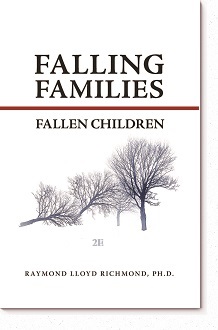
A treasure of a resource for psychological and spiritual healing. Information
gathered from my websites (including this webpage) is now available at your fingertips
in book form.
 |
 |
Falling Families, Fallen Children by Raymond Lloyd Richmond, Ph.D. Do
our children see a mother and a father both living in contemplative love for
God with a constant awareness of His presence and engaged in an all-out battle
with the evil of the world? More often than not our children don’t see living
faith. They don’t see protection from evil. They don’t see genuine, fruitful
devotion. They don’t see genuine love for God. Instead, they see our external
acts of devotion as meaningless because they see all the other things we do that
contradict the true faith. Thus we lose credibility—and when parents lose credibility,
children become cynical and angry and turn to the social world around them for
identity and acceptance. They are children who have more concern for social approval
than for loving God. They are fallen children. Let’s bring them back.
Ordering
Information |
|
|